


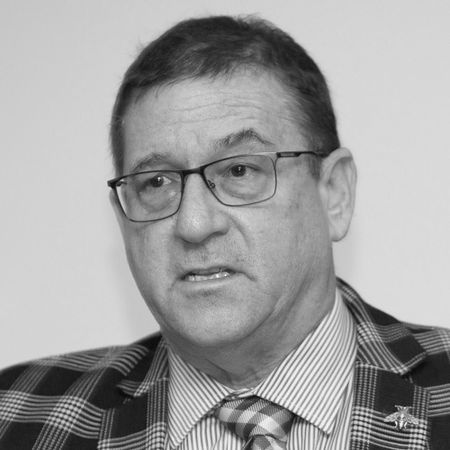
The fact that the Freedom Front plus is fielding William Basil Harrington as its mayoral candidate for the Nelson Mandela Bay Metro is concerning (Ed Note: Harrington goes by the name of Bill). His initial election as a councillor for that municipality in 2021 seems to have slipped under the radar. Harrington was convicted of the murder of Mbongeni Jama in 1991 when he was a constable in the police riot unit in Pietermaritzburg.
/file/attachments/orphans/Opinion-Jeffrey-apartheidkillers-elect5_948262.jpg "Freedom Front Plus Bill Harington councillor lamented the municipality's ongoing infrastructure decay. (Photo: Deon Ferreira)")
I remember Jama’s abduction and murder by the riot unit well.
I was a leader of the ANC in the then Natal Midlands region and the ANC’s liaison person with the South African Police. Jama’s detention on that warm Sunday afternoon was reported to me by an ANC member from the area who was concerned because there appeared to be no reason for his arrest. He was also concerned about Jama’s safety since the riot police were known to assault ANC supporters without cause. I immediately took it up with the Pietermaritzburg police leadership.
The police were initially unable to trace Jama. Eventually they found out which police vehicle was in the area and the identities of the three policemen who were in the vehicle: Constable William Harrington, who was in command, Constable Frans Stefanus Erasmus and a kitskonstabel, Nhlanhla Madlala. The term “kitskonstabel” was used because they had only had very rudimentary training and were thus “instant policemen”. The police informed me that the men confirmed they had detained Jama but initially they claimed to have released him. Eventually they admitted to murdering him and took the police to where they had dumped his body.
Harrington, Erasmus and Madlala were convicted of Jama’s murder, with Harrington receiving the longest sentence of the three. The three men applied for amnesty for the crime at the Truth and Reconciliation Commission, but the applications were all rejected by the Amnesty Committee which failed to find a qualifying political objective.
Jama was a teenager and still at school. He was part of a large group of youngsters from Richmond who had fled from their homes, parents, schools and lives to Pietermaritzburg because the community they were living in was being targeted by Inkatha. He was living in a refugee centre that the ANC led by Harry Gwala had established in Dambuza, Edendale, close to which he was arrested.
/file/attachments/orphans/Opinion-Jeffrey-apartheidkillers-elect2_538129.jpg "A portrait of Harry Gwala on March 28, 1993 in South Africa. (Photo: Gallo Images / Rapport archives)")
I never knew Jama, but the likelihood is that he was just an ordinary youngster caught up in the political violence that had engulfed the area in which he lived. The appeal court judgment described Jama as an “innocent pedestrian who was found next to the road and who was taken away, assaulted and ultimately murdered in cold blood”. It is possible that he was picked up by the riot police merely for being an ANC supporter. There were numerous instances of riot unit members arbitrarily detaining young males in ANC-aligned areas and severely assaulting them before releasing them.
They murdered Jama because they had assaulted him and feared he would report them should they let him go.
Harrington tried to excuse his actions by concocting an implausible story about Jama having a notebook on his person which detailed planned attacks on Inkatha leaders as the reason for detaining and assaulting Jama. Had this notebook been real, they could have used this to charge Jama. Instead, Harrington said he threw the notebook out of the police vehicle during Jama’s assault and interrogation. Allegations of involvement in criminal conduct were often created to justify the arrest and assault of UDF and ANC members and exposed as lies if the case was ever brought to court.
Harrington and the two men under his command detained and murdered an innocent teenager and dumped his body. They tried to conceal the murder. They tried to shift the blame onto Jama by claiming he was involved in crimes. Harrington tried to avoid responsibility by claiming that he had been indoctrinated by the police to see the ANC as the enemy. He gave as a reason for the murder: “My honour, as interrogator, and my authority was in doubt, and I could not handle it that an ANC supporter could just stare me in the face without any sound or answer.”
Apart from Jama’s assault and murder, Harrington also admitted at his amnesty hearing to selling guns confiscated from ANC supporters to Inkatha supporters to supplement his police salary. He also admitted to assaulting other ANC supporters and throwing them over a bridge into a river and not knowing whether they lived or died.
Denial of history
Harrington is not legally prevented from being elected to public office. Indeed, other former convicts have been elected. So, why single out Harrington?
Our history as South Africa is drenched in the blood of subjugation and oppression culminating in the struggle for democracy from the 1960s until the first democratic elections. What the regime was defending was a system of racial exclusion from both political and economic participation as well as a lack of access for Black people to education, health and other social services. This history formed the country we are today and the position each of us occupy in society today. It is the reason white people continue having the most wealth, occupying the most senior positions in the private sector and having the lowest unemployment of all races. Acts that attempted to defend apartheid need to be condemned by South Africans today and those who perpetrated these acts should be frowned upon. Germany, for example, imposed restrictions on former Nazis who had committed serious crimes from holding public office or working in the public sector.
Unfortunately, more than 30 years after the end of apartheid some white South Africans are denying that history and their involvement in it. Instead, they try to project themselves as victims in democratic South Africa, the creation of which they vigorously opposed. This is particularly so with the Freedom Front Plus, AfriForum and Solidarity.
The FF+, in its response to the current queries about Harrington, refers to his crimes as a “mistake” and fails to acknowledge its apartheid context. It then attempts to deflect the matter by claiming that Harrington’s bloody history is only being raised as an election issue by FF+ opponents.
Harrington is reported to have claimed during an election debate in Nelson Mandela Bay that neither he nor the FF+ ever supported apartheid. This is a lie since he admitted to being an AWB supporter in his amnesty application and although the Freedom Front was formed to contest the democratic elections, a significant component (including current leader Corné Mulder) were members of the Conservative Party who strongly supported white supremacy and left the National Party because they opposed PW Botha’s very limited reforms. They were even prepared to go to war to oppose the first democratic elections.
Harrington assaulted and strangled a young man who was still a scholar and only just out of childhood. He instructed Madlala to “shoot the ANC dog”. Jama was murdered to prevent him from reporting his assault. They attempted to conceal the crime by hiding the body and initially denying responsibility. In trying to justify their actions they tried to shift the blame onto the person they had murdered by concocting implausible allegations against him.
Harrington claims he asked for forgiveness from Jama’s mother. However, her lawyer informed the amnesty hearing that Mrs Jama was unable to do so “because she doesn’t believe a word of what they have said in their application. She doesn’t believe that they have been frank with this Committee, and effectively the question of their political motives is basically an excuse to get out of gaol”.
The FF+ has made a choice, and it must answer for it. Putting Harrington forward for mayor tells the public what the party is prepared to accept in those who seek power. Jama’s murder and the efforts to conceal it deserve an honest reckoning from both the candidate and his party. Withdrawing his candidature would show that the FF+ understands why this history still matters in a democratic South Africa. DM
Comments
Scroll down to load comments...