



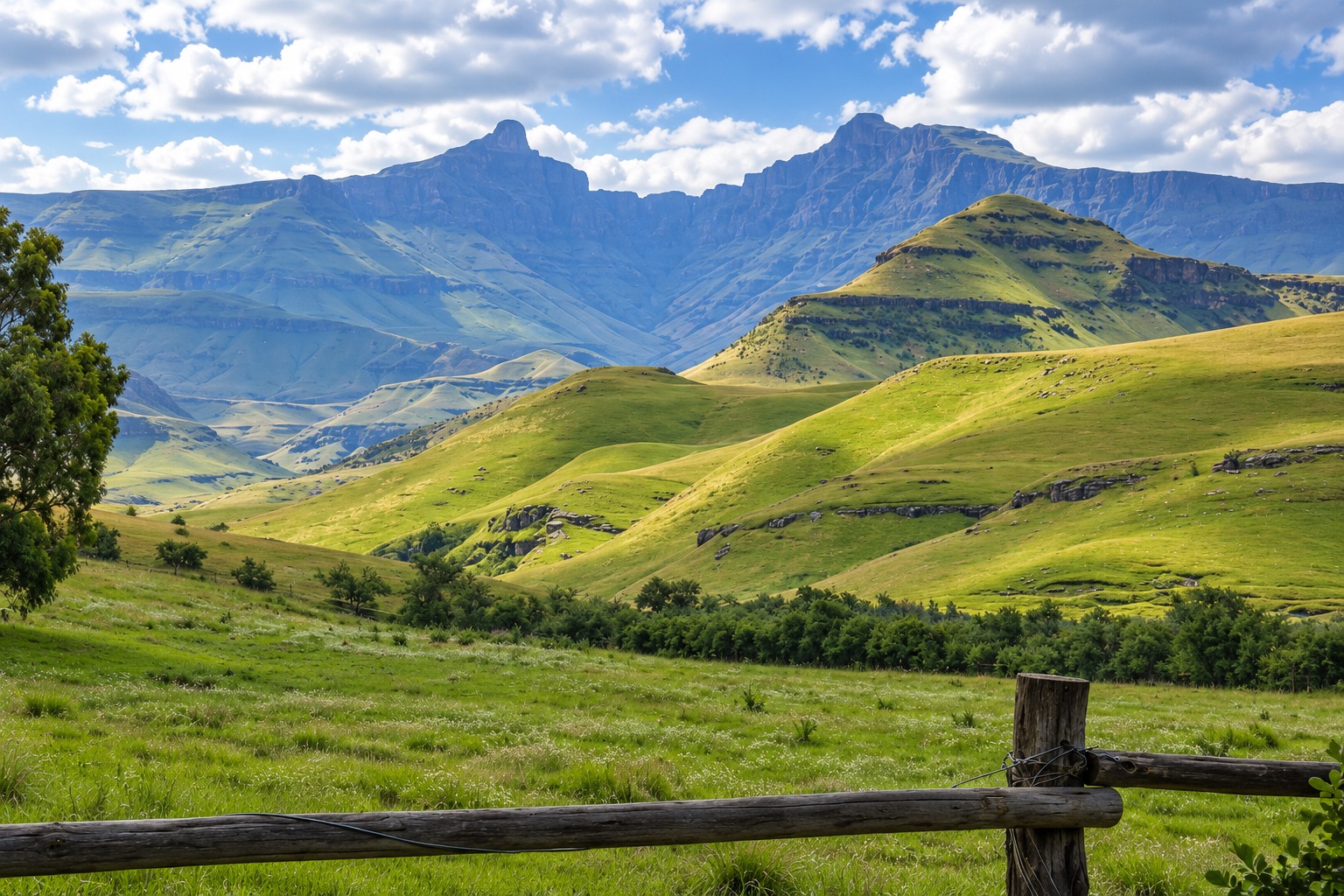
 The Drakensberg grasslands that first inspired Craig Morris to study ecology. (Photo: Craig Morris)

Watching grass grow is supposed to be what you do when every other possibility for entertainment has been exhausted. Craig Morris made a career of it. The surprising thing, once you listen to him, is that the rest of us have managed to find grass boring.
We walk over it, mow it, feed it to livestock and occasionally set it alight. We admire it when it resembles a billiard table and complain when it gets ideas above its station. A flower-filled patch becomes neglected. A chemically assisted green rectangle becomes a garden achievement.
Morris, a grassland ecologist, would like us to get down on our knees and reconsider.
His fascination began as a schoolboy in the Cathedral Peak area of the Drakensberg, surrounded by a sea of grass beneath the mountains. Learning to identify a few species led to discovering that grassland science was something one could actually study.
Research in high mountain grasslands deepened the attachment. He remembers a landscape so unfamiliar it brought to mind the worlds at the top of Enid Blyton’s The Magic Faraway Tree.
“It was a magical place to spend a couple of years collecting data, so that really entrenched my love of grasslands and open ecosystems, as they call them now.”
An early scientific lesson was more unsettling. When grazing animals were removed from a long-running experiment, he found “there was rapid and irreversible change”. Taking away disturbance was itself a disturbance. Leaving a grassland alone, he discovered, does not necessarily preserve it.
To understand why, first meet the grass.
What looks like a flimsy tuft is, in Morris’ account, a well-equipped survivor. Its growing points sit “right down near the soil surface”, protected from grazing mouths and flames. Buds supply replacement shoots, called tillers, which carry the potential for further shoots.
“So you’ve got a whole set of modular units that can regrow and create more,” he explains.

Bite it, burn it or mow it and the plant can rebuild from below the damage. That, Morris explains, is central to its persistence. Anyone pulling grass from between paving stones may already suspect they are up against a formidable opponent.
Its success extends to our dinner plates. Wheat, rice, maize, sugar cane and bamboo are all grasses, as Morris confirms.
“Most people eat grass every day.” We are “grass eaters and then eaters of eaters of grass”.
Your cereal is grass. So is the source of the sugar you perhaps should not have added. Eat beef and you have simply lengthened the supply chain.
Morris mentions writer Michael Pollan’s suggestion that plants have recruited us to further their interests. “We even grow these fantastic lawns, we spend millions on it, we create stadiums around it,” he says.
For an organism without a brain, grass has acquired an impressive maintenance department.
But now Morris wants us to look between the tufts.
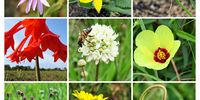
“What you’ll really notice is in between the grasses are all the wild flowers.”
These and other herbaceous plants, known as forbs, account for much of a grassland’s plant diversity, he explains. They feed pollinators, provide food for grazing animals and include medicinal plants. They’re not decorative extras scattered through the real business of producing cattle feed.
And the view changes as you move.
“When you look at the next-door square metre, you get different sets,” he says. Understanding that patchiness is important to how a grassland is managed.
Then there is the part we cannot see.
Morris describes an underground world of roots, bulbs, tubers and rhizomes, where plants maintain reserves against difficult times.
“Grassland soils are a really good store of carbon,” he says. Some organic matter becomes strongly attached to minerals. “That’s not easy for the microbes to get at. So, that’s a more permanent store.”
Fungi’s mycorrhizal filaments add another layer of activity.
“They connect to grasses and extend their root system far and so wide.” In exchange for carbon from plants, Morris explains, the fungi supply nutrients. The apparently simple surface conceals an underground economy.
It also conceals age. Morris describes ancient communities whose plants keep renewing themselves, sometimes through clonal growth or persistent underground organs.
“How old is a grass plant? That’s a question that needs to be answered.” For some underground structures, dating is difficult: “We don’t know, because they don’t have tree rings.” New leaves don’t mean a new plant. They clone, so they could be eternal.
That’s why he objects to treating grasslands as unfinished forests, awaiting an enthusiastic person with a spade and some saplings.
“It’s worth being grassland. Should be grassland,” he says.
Fire helps explain why. Morris describes how burning removes accumulated old growth and lets light reach new shoots. “They’re almost like farmers of fire,” he says of grasses. “They use disturbance, also like grazing, to entrench their position and gain advantage.
“I’m not going to call it a disturbance any more because it’s part of the grassland rhythm.”
That doesn’t mean burning everywhere. Morris distinguishes fire-dependent grasslands from drier systems requiring different management. But suppressing fire can have dramatic consequences, as long-running experiments show.
In unburnt plots, “the grass is almost gone, you’ve just got trees”. His conclusion is blunt: “The removal of fire, removal of disturbance is effectively destroying the grassland.”
Grazing demands care too. His research points to damage when repeated trampling destroys wildflower leaves before plants replenish their underground reserves.
“You don’t need to trample a good intact grassland. You shouldn’t do that relentlessly year after year.”
Which brings us to the suburban lawn, that small kingdom in which almost everything must be the same height.
Morris has little affection for the manicured ideal. Asked whether it’s the opposite of the variety he values, his reply is emphatic: “Exactly the opposite.”
“We should manage grassland to create patchiness,” he explains. Birds, for example, have different requirements: “Some need long grass to nest in, some like the short grass to feed.
“You need that patchiness to cater for a whole variety of biodiversity.”
His own garden reinforced the lesson. As he watched, a bare patch beneath a tree, seemingly a failure to grow grass, proved valuable to wildlife. The gardener’s disappointment was another creature’s opportunity.
“You need those bare parts of your lawn,” he says. “You need a habitat if you want wildlife in the gardens.”
For Morris, the guiding principle is simple: “You don’t want uniformity. You want variation.”
The public’s great misunderstanding is contained in two words: just grass. After talking to Morris, they seem a remarkably small description for an ancient, busy, partly buried world on which we all depend. DM


Comments
Scroll down to load comments...