




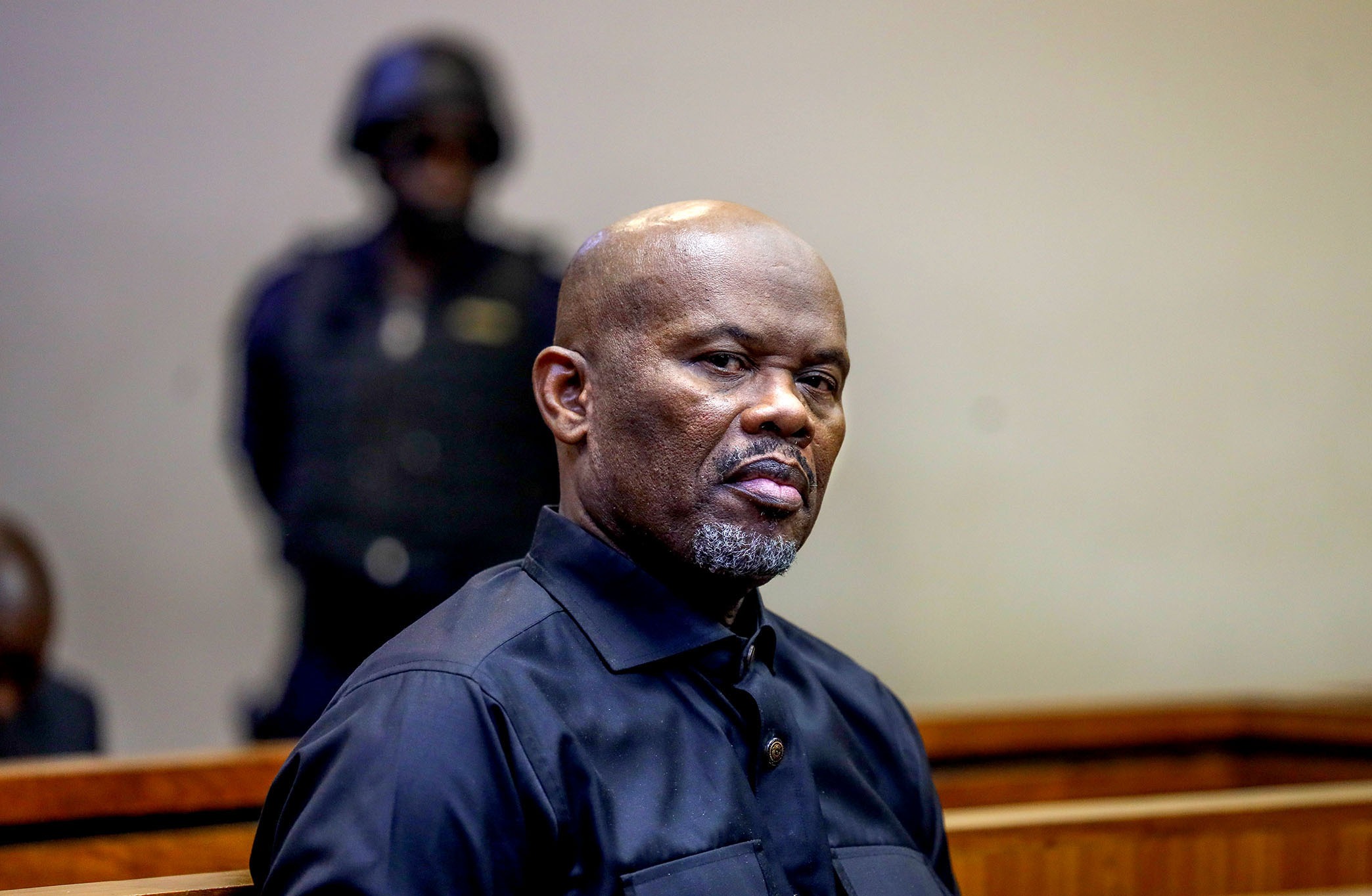
 Former deputy national commissioner for crime detection, Shadrack Sibiya, appears at the Randburg Magistrate’s Court for his bail hearing on 20 October 2026 in Randburg. (Photo: Gallo Images / Sharon Seretlo)
Former deputy police commissioner Shadrack Sibiya would “go to any length” to tamper with evidence implicating him and posed a risk to witnesses, including one he had threatened, the Randburg Magistrate’s Court heard on Tuesday, 20 October, as it refused his release on bail.
Magistrate Hleziphi Mkhasibe took note of two threats Sibiya made, the first being “I will wipe out you and your entire family” directed to Mr M, his former associate and a father of the 16-year-old teenager he is accused of sexually grooming.
The other threat was: “I will deal with you easily.” This, according to Mkhasibe, “establishes a dangerous pattern of behaviour” and shows intent on his part in that he genuinely meant to cause harm.
She said it showed that the alleged threats were not simply a momentary lapse in judgement but pointed to an intention to cause harm, because Sibiya knew at the time that Mr M was a State witness and that his arrest was imminent.
“He could have opted not to call Mr M, but he allowed his anger and ego to cloud his judgement,” Mkhasibe said.
After weighing Sibiya’s constitutional rights and personal circumstances against the interests of justice, Mkhasibe found: “The applicant failed to show exceptional circumstances to be released on bail.”

Sibiya has been in custody since his arrest on 20 September and is being held at Kgosi Mampuru II Correctional Centre. He faces six charges, including the rape of an 18-year-old, sexual grooming of a 16-year-old, human trafficking and negligent handling of a firearm.
He has pleaded not guilty and, through his legal team, argued that intercourse with the 18-year-old was consensual.

‘I am afraid of the accused’s release’
In deciding to deny Sibiya bail, Mkhabise said she also considered statements from the two young complainants, who detailed their fears about his being released.
The 16-year-old complainant, “ZM”, who is in witness protection, said she suffered daily anxiety because Sibiya was a senior police officer and had allegedly threatened her father.
“I feel my entire family would be exposed to more danger, and I will blame myself as I am the one who reported the matter,” she said. “I am very scared that if he is released on bail, he will do harm to my father or myself.”
The second complainant, 18-year-old “MC”, told the court that the case had taken a severe emotional toll on her and that she had experienced suicidal thoughts because of her fear of what could happen if Sibiya was released.
“He will therefore find me dead already, as I’ve already suffered enough,” she said.

The court has heard that one of MC’s friends had allegedly been approached by someone who wanted her to provide a contrary statement to that of MC’s affidavit.
The court also heard that one of the witnesses in the case had been called and offered money in exchange for dropping the charges.
Mkhabise was careful not to link Sibiya directly to these incidents because he remained in custody, and ordered that they should be investigated.
‘No end to what he will do’
Beyond the alleged threats, the court was concerned that Sibiya could tamper with evidence and interfere with witnesses if released.
In arguing against granting Sibiya bail, the State said he had wiped his phone clean before his arrest, getting rid of potential evidence.
During the bail hearings, Sergeant Nokukhanya Ndlovu read into the record message exchanges between Sibiya and the 16-year-old complainant. In those messages, Sibiya requested explicit videos and photographs of the teenager and later instructed her to delete them.

Mkhasibe said Sibiya’s actions were particularly concerning because, as a high-ranking police officer, he would have understood the importance of evidence and the consequences of destroying it.
“As a high-ranking police officer at the time, he was aware that he was committing a crime. He was also aware that he’s tampering with evidence that has the potential of implicating him,” she said.
“To my mind, the accused will go to any length, and/or there’s no end to what he will do, to tamper with evidence that implicates him.”
The magistrate noted that some of the alleged crimes were conducted from the comfort of his home, using a cellphone, and it would be impossible to attach a condition that he must not use a cellphone if released.
“There is a likelihood that if the accused is released on bail, he will contact the 16-year-old, who is vulnerable and may be influenced by the applicant, considering she is a child, compounded by her feeling that she exposed her family to harm.”
‘Strong case’
Last week, Sibiya’s lawyers spent almost a full day arguing for his release, submitting that he was not a flight risk, suffered from diabetes, hypertension and high cholesterol, and was his family’s breadwinner.
At the heart of the defence’s closing arguments was that the State’s case against Sibiya is “very weak”. Sibiya’s advocate, Estelle Killian, said that evidence linking her client to the alleged trafficking of teenage girls was “insufficient and flimsy”.
The court, however, was of a different view, finding that: “There is a strong case against the accused. To say the State’s case is weak is misdirection on behalf of the defence…”
Mkhasibe said prosecutors had “presented evidence that the State’s case is strong against the applicant”.
She stressed, however, that the court was not making a finding on Sibiya’s guilt, saying that, like any other person, he remained innocent until proven guilty.
With the bail application now concluded, the case will head to trial, which is expected to start on 24 November 2026, if Sibiya does not appeal against the decision. DM
Comments
Scroll down to load comments...