



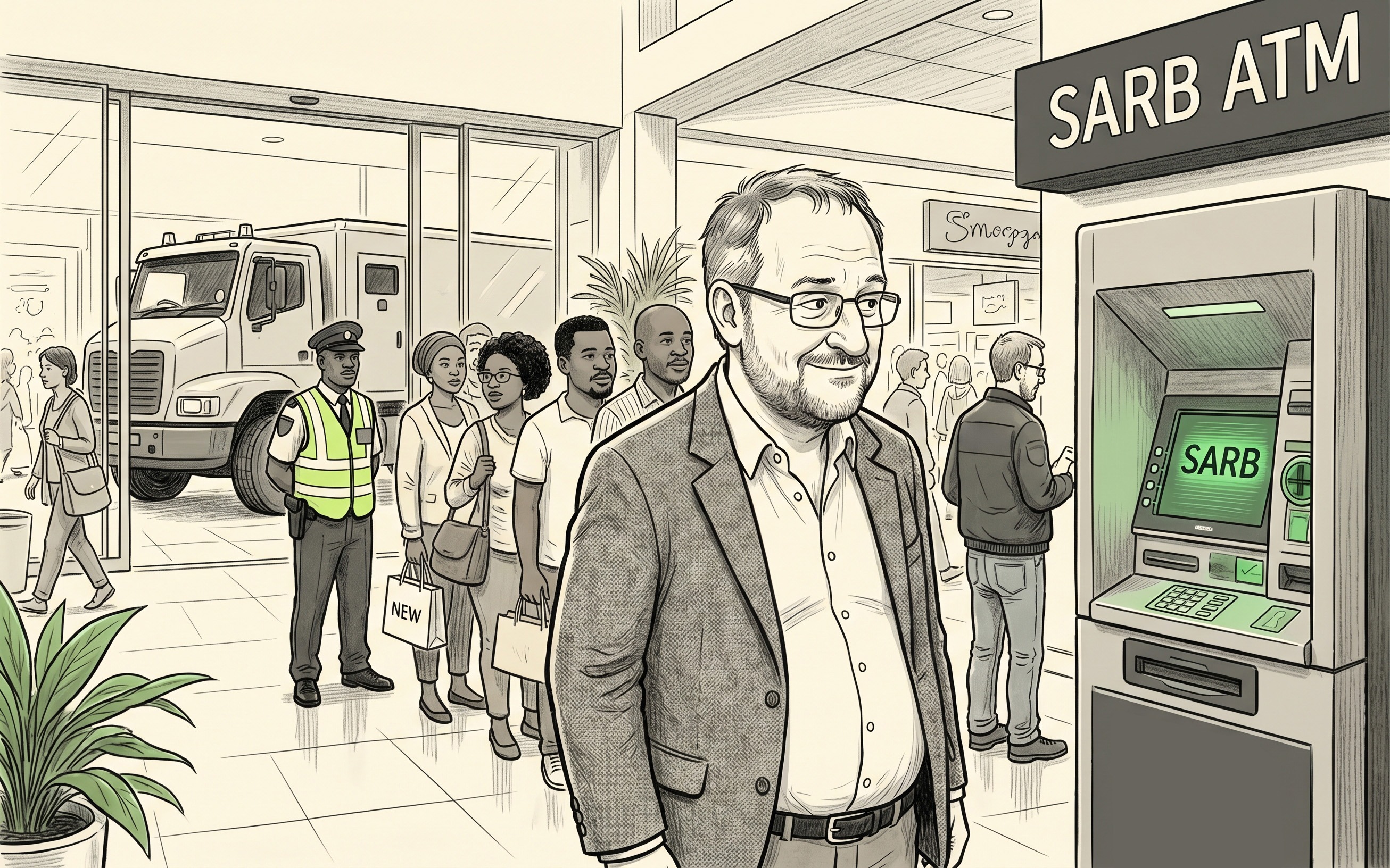
 South Africa’s ATM network could soon be managed by a Reserve Bank-backed cash management company. | Illustrative image: (Generated with Google Gemini Flash Image 2.5)
There is something fascinating about looking at where banks put their ATMs.
There are certain criteria they need to assess, there needs to be a lot of foot traffic, it must be convenient and, more and more, it must be safe to use.
I remember years ago when it seemed every November shopping period was marked by a huge increase in cash-in-transit heists in Gauteng.
A few years later the banks got together and got someone to design a massive new cash van.
Instead of the vans being based really on a mini-bus, the van was based on a truck chassis, which made it much harder to stop or tip over.
A few Christmases later early morning radio bulletins would start with something else. Somewhere an ATM would have been blown up by people trying to steal the cash inside.
It’s a good reminder of how tough it must be to manage ATMs if you’re running a bank.
Almost no matter what you do, someone is going to try to get to the cash inside.
Now it looks like the entire ATM is going to go through its biggest change, probably since we first saw such a thing as a cash machine back in 1977.
As old as the hills
The current financial model of ATMs has lasted a little longer than the first institution to use them here did.
United Building Society eventually became part of Volkskas and then merged into what is now Absa.
The current driver of where an ATM is situated is where the bank that owns it believes it will get a lot of traffic.
This is why there are so many of them in some places, like any big shopping centre near you, while there are so few in much poorer places.
The problem with this, of course, is that the richer you are, strangely, the less cash you use.
Instead you tap your phone or watch or, no doubt coming soon, your left eye, and off you go.
If you use a minibus taxi you are probably going to need cash.
As a result the SA Reserve Bank is going to take over ATMs.
It’s a lot more complicated than that. But the major thrust is that the SA Reserve Bank will create a cash management company that will manage the ATMs.
Commercial banks, which currently own those machines, will be able to receive some kind of compensation or shares in that company.
The obvious aim is firstly to try to make sure cash is accessible where people really need it, and to make your withdrawals cheaper.
Obviously, you might use an ATM for a lot more than withdrawals, but if you consider what you can do on your phone nowadays, I suspect the future of that functionality might be limited.
I’m sure that the only way this model can work is if you still pay to withdraw cash.
Moving cash around is expensive and someone will have to pay for it. And the cheapest way to do it will surely be to spread the cost among everyone who uses ATMs across the entire country.
All of this makes complete sense for a country like ours. It’s exactly the right kind of intervention the Sarb should make in a country like ours.
But I have a couple of slight niggles.
At the moment you can probably withdraw a large amount of cash from a branch of your bank for relatively little money.
If you use another bank’s ATM with a smaller amount of cash, you might find it’s a little more expensive over the longer term.
Average cost
For all of this to work, you need to make sure the average cost of withdrawing cash comes down.
Already the banks work together to move cash around, so it’s unlikely there will be much of a saving there.
And they must already use what they earn from ATMs in richer areas to subsidise machines in poorer areas that are less used.
What’s really driven our current model is the incentive for a bank to run an ATM. Generally speaking, the more you have the more people will use them and the more money you will make from fees.
And obviously, the more you have the more likely someone is to join your bank.
That incentive will now be removed.
And instead, something that will be run by the government will be in charge.
Now if there is one institution that has shown itself to be absolutely top-notch in our society, an example to others, it’s the Sarb.
But I can well imagine the arguments that might come from some people who worry that even fantastic institutions in the government can start to fail.
And I’m sure there is some kind of legal argument that would say a bank should have the right to run its own network of ATMs if it wants to.
The other real change is going to be to the branding.
We won’t see so much colour in our shopping centres any more; they will all have the same branding.
The Reserve Bank might have many attributes. But I’m not sure the use of bright colours is one of them.
So, I hope they outsource the design to someone bright and funky.
And that I will still be able to find them, no matter where in the mall they might be hiding. DM
Comments
Scroll down to load comments...