


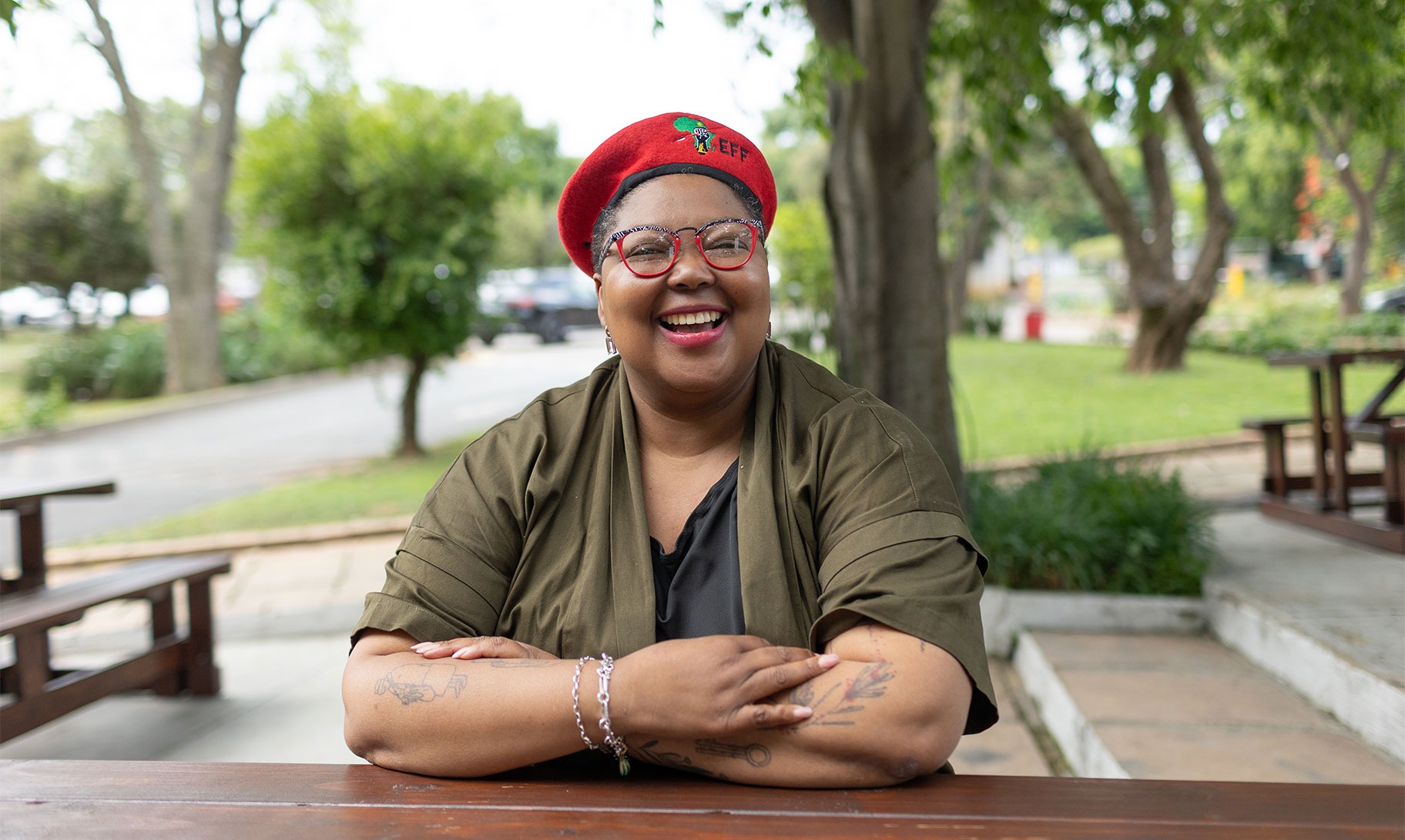
 EFF mayoral candidate for Johannesburg Dr Tlaleng Mofokeng poses for a portrait at Milk Bar in Parkmore, Johannesburg on 6 October, 2026. (Photo: OUR CITY NEWS / Alaister Russell)
When Dr Tlaleng Mofokeng was approached about becoming the Economic Freedom Fighters’ mayoral candidate for Johannesburg, her husband was the first person she told. He encouraged her to make herself available, telling her that after years of fighting for other people’s rights around the world, she should bring that fight to the city they called home.
That was one of their last conversations before her husband died on 10 July, leaving the 44-year-old medical doctor and human rights activist to navigate the demands of an election campaign while grieving his death and adjusting to life as a single parent.
For a brief period, Mofokeng questioned whether she could or should continue, but ultimately decided the reasons she agreed to stand had not changed. “I would feel like I’m letting myself down if I didn’t do this because the reasons why I said ‘yes’ are still the same and still existed even after he had passed away,” she said.
Mofokeng enters Johannesburg’s mayoral contest with an extensive career in medicine, international health policy and human rights advocacy, including serving as the United Nations Special Rapporteur on the right to health. Although this is her first attempt at elected office, she has helped develop the EFF’s election manifestos since the party’s early years.
She hopes to bring a different approach to the Johannesburg Metro, a municipality beset by political instability, failing infrastructure and deteriorating services, and argues that the City’s leadership has lost sight of the people it is supposed to serve.
/file/attachments/orphans/OCN-Tlaleng-Mofokeng-EFF-3_339813.jpg "EFF mayoral candidate for Johannesburg Dr Tlaleng Mofokeng poses for a portrait at Milk Bar in Parkmore, Johannesburg. October 6, 2026. (Photo: OUR CITY NEWS / Alaister Russell)")
At the centre of her candidacy is the belief that dignity, care and empathy should shape how Johannesburg is governed, especially when decisions affect residents who already struggle to access essential services or have little influence over the institutions that deliver them.
“Why I always talk about dignity in my candidacy is precisely because dignity has been eroded from all of us, for so long,” Mofokeng said.
Mofokeng says her activism began during her childhood in QwaQwa and has remained central to her work as a doctor and international human rights advocate, describing herself as an activist first and a doctor second.
It’s personal
Her commitment to Johannesburg is also personal. Sitting at Milk Bar at George Lea Park in Sandton, while rushing between meetings recently, she described having moved to Johannesburg as a young doctor and remembers travelling through popular and familiar taxi routes and public space, feeling safer in the city that many residents now fear entering.
She recalls a city where people worked hard, embraced its cultural life and found opportunities despite their circumstances, and she believes much of that determination remains even as the infrastructure supporting it has deteriorated.
“I think that’s where our disappointment comes from... Our passion and our drive is not matched by processes and resources and infrastructure that works to meet us somewhere,” she said.
Mofokeng’s proposals combine the EFF’s commitments to insourcing municipal services and expanding access to basic infrastructure with a greater emphasis on how residents participate in decisions affecting their communities.
She wants ward-based people’s assemblies, technical oversight teams to scrutinise infrastructure spending and a one-stop municipal service centre where entrepreneurs and informal traders can get help with permits, registration and compliance.
Rather than relying primarily on punitive enforcement, she argues that municipal officials should help residents understand and comply with regulations, while giving communities greater insight into how budgets are allocated.
Migration
Mofokeng is also critical of politicians who exploit frustration over migration, arguing that failures in government planning, immigration administration and service delivery have contributed to tensions between communities. The exploitation of these tensions for political gain was on display again recently in Soweto and in Durban, which led to public violence following misinformation about a Constitutional Court ruling on asylum laws.
/file/attachments/orphans/OCN-Tlaleng-Mofokeng-EFF-2_628825.jpg "EFF mayoral candidate for Johannesburg Dr Tlaleng Mofokeng speaks to OUR CITY NEWS during an interview at Milk Bar in Parkmore, Johannesburg. October 6, 2026. (Photo: OUR CITY NEWS / Alaister Russell)")
“It can’t be that 5% of the population is the one that’s causing all of the queues in the clinics or causing all of the queues in the schools,” she said, rejecting the suggestion that migrants are responsible for Johannesburg’s wider problems.
Her approach raises questions about financing and implementation, as the City continues to battle collapsing infrastructure and reduced revenue collection, while the EFF proposes employing more municipal workers, reducing outsourcing and expanding services – all of which would require significant administrative changes and investment.
Mofokeng believes the municipality can recover resources through better management, reduced waste and stronger negotiations with the national government. But coalition politics could further complicate those ambitions, particularly where the EFF’s opposition to privatisation conflicts with the priorities of potential governing partners. Mofokeng, however, refuses to exclude parties from pre-election negotiations, arguing that a mayor must represent residents regardless of how they voted.
Wider concerns
Her concerns extend beyond municipal finances and infrastructure to the conditions in which people live, including the fear of violence that restricts women’s freedom and the disappearance of public spaces where children can play. She also advocates for renewed investment in Johannesburg’s theatres, cultural institutions and recreational facilities.
“We work hard in Johannesburg, but we also come here to play and to dream, and to be creative. And I think it’s very important to not neglect that,” she said.
For Mofokeng, the mayoralty is a chance to change how the municipality functions rather than build another political career. “I don’t want to be a mayor for too long. I want to be a mayor, achieve things, change systems. But this is not a new career move for me,” she said.
/file/attachments/orphans/OCN-Tlaleng-Mofokeng-EFF-1_443280.jpg "EFF mayoral candidate for Johannesburg Dr Tlaleng Mofokeng poses for a portrait at Milk Bar in Parkmore, Johannesburg. October 6, 2026. (Photo: OUR CITY NEWS / Alaister Russell)")
Her decision to continue campaigning despite her husband’s death has also brought the importance of community support into sharper focus. She spoke about the friends and family who have helped her manage the responsibilities of parenthood while allowing her the space to grieve.
“Grief is also its own thing. It comes in its own time and it comes in waves,” she said.
Despite the financial and political challenges ahead, Mofokeng remains committed to her vision for Johannesburg, drawing encouragement from her final conversation with her husband and the words that helped convince her to stand. DM
This interview is part of an ongoing series by Our City News featuring key mayoral candidates contesting the City of Johannesburg in the local government elections.
Daily Maverick’s Joburg Bureau is for people who love this city. Get the latest Joburg news, events and conversations sent straight to your phone every Friday. Join the WhatsApp Community.
/file/attachments/2985/WhatsAppImage2025-11-21at1946001_346702_1cea9e715c05dc0a538fc79753ac3401.jpeg "Our City News logo")
Comments
Scroll down to load comments...