



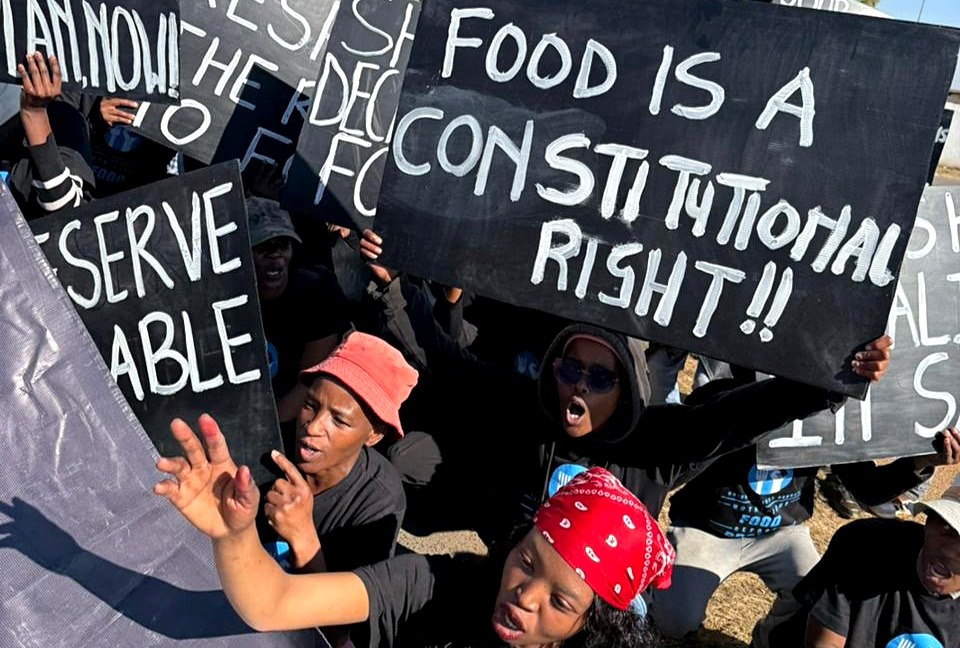
 Members and supporters of the Union Against Hunger picket outside a Shoprite store on 27 May 2026, as part of the union’s Food Justice Week, centred around World Hunger Day on 28 May. (Photo: Supplied / Union Against Hunger)
Who would have thought that a key local government election campaign linchpin would be a clear and coherent strategy for how political parties plan to tackle hunger. Although I suppose not so surprising because South Africa’s runaway hunger problem is a powder keg primed and ready to go off at the slightest provocation.
It is simply unacceptable that at last check Stats SA’s general household survey recorded that in 2025, 9.4 million of our people went hungry in a country that most certainly does not have a food production issue. What we have instead, is food going to waste and a malnutrition issue as a result of the inaccessibility of healthy foods and oversaturation of unhealthy ultra-processed foods and drinks.
This manifests in 22% of households not having access to adequate food, with the Northern Cape being the highest at 43%, followed by 32.3% in North West and 30.8% in the Eastern Cape.
Earlier this year my colleagues Lillian Roberts and Daniélle Schaafsma meticulously mapped just how deep the crisis extends across the country, highlighting that 74.8% of black South Africans are living below the upper-bound poverty line, and as such experience hunger the most acutely, a reflection of the country’s continued inequality across racial lines.
/file/dailymaverick/wp-content/uploads/2023/04/MC-Tuesday-4April_5.jpg "Section 28 provides “every child” with an unqualified right to “basic nutrition”. (Photo: Flickr / Julien Harneis / Wikipedia)")
But perhaps the most grotesque finding in our landscape is how we are allowing hunger to cannibalise our children, with chronic malnutrition resulting in stunting that is 5% higher than the global average, at 27%. Answering questions in Parliament, Health Minister Dr Aaron Motsoaledi said that more than 450 children under five died in public hospitals with malnutrition as an underlying condition within nine months of 2025.
But what our food justice coverage has been mapping and unravelling is that our hunger is not some uncontrollable phenomenon over which we have no power. It is orchestrated by our food systems being concentrated in the hands of a few large players, where the Competition Commission has uncovered price-fixing cartels in staples from bread to maize meal. But beyond food just being unaffordable, what is critical is that people are being starved of healthy and nutritious food.
On one end, we have people being squeezed by ever-increasing food prices, forcing them to buy cheap and unhealthy food, and on the other hand, the practical inability of people to grow their own food as an alternative. Because while food gardens are great, not everyone has access to enough space to plant and grow the diverse fruit and vegetables required for a healthy diet.
/file/dailymaverick/wp-content/uploads/2025/10/GettyImages-2226367581.jpg "World-Food Day")
And yet the National Food and Nutrition Security Plan sits collecting dust, having expired in 2023 after being largely unfunded, it’s coordinating council having never met. A replacement remains in draft, uncosted and without a budget. Civil society has called on the government to finally revive it and adopt a new plan by today, World Food Day – an urgent call that does not seem to have been heeded.
So what should we be doing this World Food Day to put practical solutions into place rather than drowning in the despair of a world that is hungry by design?
An article published by the University of the Western Cape’s Centre of Excellence in Food Security, by Professor Jaap de Visser in 2019, lays responsibility at the doorstep of municipalities, bluntly stating that they “are not off the hook for food security”.
He posits that: “Municipalities can use their power to regulate fresh produce markets to connect small-scale farmers and informal traders to consumers. They can likewise use their power to regulate refuse removal to reduce food wastage. And they can use their power to regulate billboards in a way that discourages the promotion of unhealthy foods.
“Clearly, then, municipalities are awarded powers that relate directly and indirectly to the realisation of the right of access to food, even when they overlap with the powers of national and provincial government.”
/file/attachments/orphans/MC-Hunger-Elections11_349755.jpeg "Build One SA co-founder and deputy leader Nobuntu Hlazo-Webster (left), also mayoral candidate for Johannesburg. Lubabalo Cecil Magwentshu (middle) is a senior member of the African Transformation Movement (ATM) and former member of the Mayoral Committee for Community Development in Johannesburg. One thing Johannesburg should do, he said, was to audit unused land and allow people to farm, along with establishing a nutritious food basket identified through wholesalers for the lowest price. Mantombi Nkosi, Regional Spokesperson for the greater Gauteng region for the ANC, highlighted that hunger is not an abstract policy decision. She was about to list the programs the ANC had implemented in Johannesburg but was drowned out with boos and shouting. (Photo: Lillian Roberts)")
Civil society has also long argued for a maternal grant that would address hunger and adequate nutrition for the expectant mother and the foetus, addressing issues of stunting proactively.
The case has been made by the civil society coalition made up of the Children’s Institute, the DG Murray Trust, Grow Great, Ilifa Labantwana, PRICELESS SA, the Institute for Economic Justice (IEJ) and the Union Against Hunger, that it would cost R2-billion a year, versus an estimated R13.8-billion in the public health costs of hunger- and malnutrition-related issues.
But perhaps on the eve of our Constitution’s 30th anniversary and our seventh local government elections since our democratic dispensation, it’s worth asking ourselves:
When did we get comfortable with living side by side with the majority of our people going hungry? When did we start accepting that some children’s fate is to have their futures starved away in a country that produces not only enough to sustain ourselves, but other countries too?
So as we all deliberate on our 4 November votes, we should be asking our candidates questions like: “What will your council do about water for food gardens, market access for informal traders or ensuring that more healthy and affordable food is accessible for everyone?”
Because while it makes us feel better to know that we give the occasional tub of leftovers every week to the people on the side of the road or to a feeding scheme, we should be getting behind the proposed solutions of working together with civil society and municipal councillors to ensure that the unwelcome visitor that is hunger within our communities is expelled.
And, that we restore those who are going hungry’s dignity by allowing them the means to feed themselves. DM
Comments
Scroll down to load comments...