



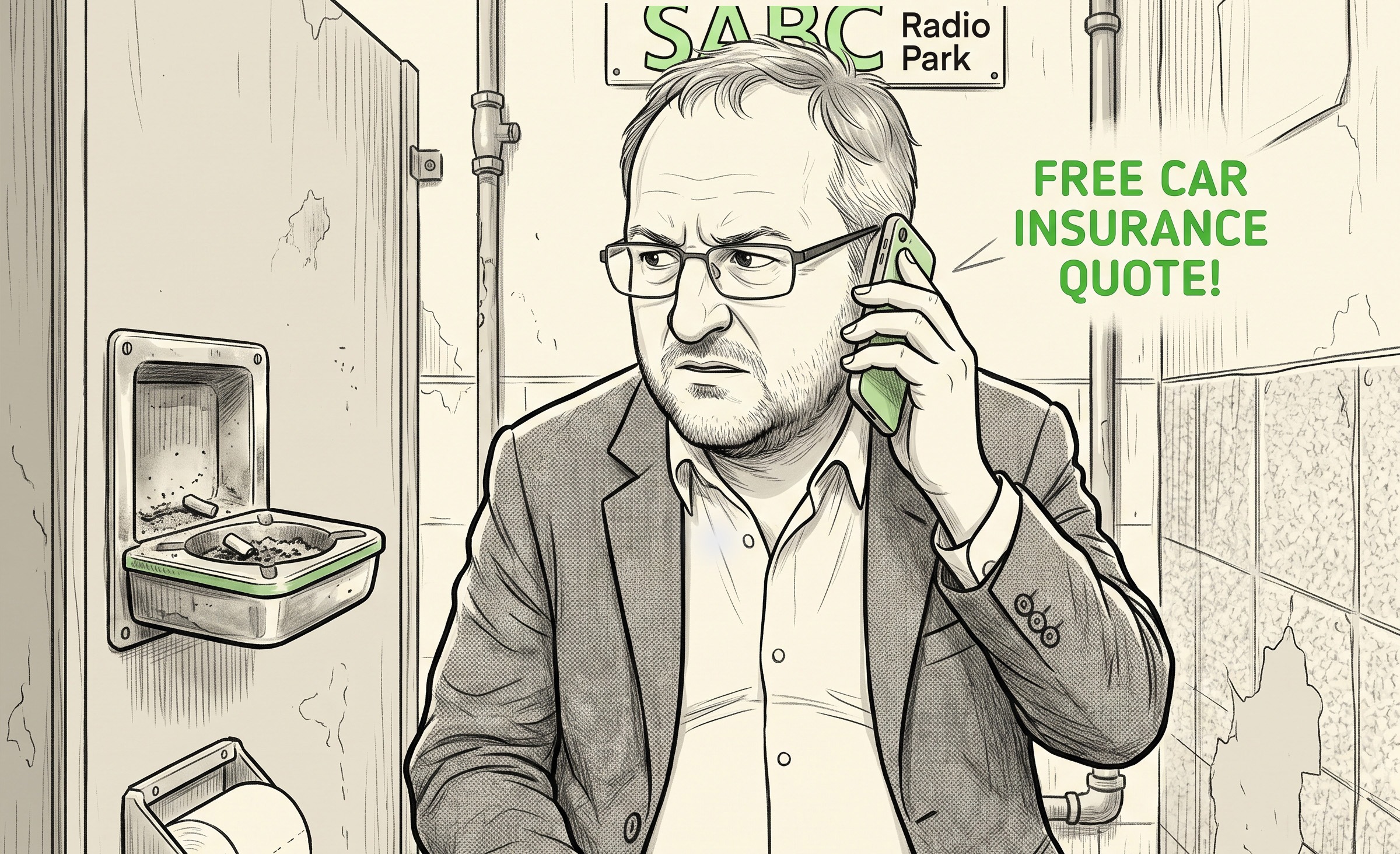
 A new plan to curb South Africa’s spam calls faces doubts over enforcement. Illustrative image: (Generated with Google Gemini Flash Image 2.5)
There are some questions that I think I will never really understand the answers to.
I’m not talking about quantum physics or international trade. I’m talking about some aspects of life that are more banal.
Like why does my supper plate look exactly the same as the collection of stuff meant for the compost heap? Or how is it that the toilet cubicles in the SABC Radio Park building still have an ashtray?
And why does AfriForum take up so much space in our national discussion?
For a long time one of those questions has been how on Earth does the economic model that leads to so many people calling my phone actually work?
I think most of us assume that we have a wide circle of family, friends, associates, rivals and enemies. And none of them, and I really do mean none of them, have ever bought something as the result of a cold call.
It was the thread running through my mind last night when I was talking to the acting head of the National Consumer Commission Hardin Ratshisusu. He was on The Money Show explaining how their new plan to stop spam calls will work.
It’s a little more complicated than it should be, but essentially you will go to their website, click a series of categories that you do not want to get calls about (think car insurance…) and then all of the direct marketers that are registered by the National Consumer Commission will be told and they will not call you.
Ratshisusu says that while you do have to click each category, it won’t take long – it should just be 10 clicks (or, I presume… taps). And that should dramatically reduce the number of spam calls you get.
Do you think it will work?
Ja. Me neither.
It’s the Wild West out there
It just feels to me like it’s the Wild West out there; probably 99% of the people who have called you have got your information through breaking the Protection of Personal Information Act in the first place. They’re not going to stop now because of something called the Consumer Commission.
What can the commission really do? Is it going to saddle up and go after these people? How will it know who they really are?
When you get these calls do you ask the pre-recorded voice on the other end who is really paying them? And if it’s a real live human being, are you going to ask them?
I often wonder what it must be like to be that person.
As a bright and shiny 22-year-old I tried my hand at the cold-calling thing [Editor’s note: we call it the BPO profession now, Stephen]. It was landline to landline in those days, selling some kind of cleaning detergent.
In about three and a half days of work I came to realise two important things.
I was going to work incredibly hard at something else to make sure I would never ever have to do this again. And yes, cleaning detergent really is as boring as you think it is.
I was lucky, I had a qualification and was able to go and do something else. So many of the people who phone you and I don’t, and they’re absolutely desperate for the job.
I know people who’ve told me how when they started to put the phone down the other person either swore at them out of sheer repeated frustration, or was actually quite emotional.
And there must be an economic case for this business.
After having to listen to how the National Consumer Commission was going to regulate his members, Direct Marketing Association CEO David Dickens told The Money Show that actually it does work.
He says that while many people have access to cars and money and can go and get what they want or order it online, many others, often in rural areas, have none of those things.
He suggests that in fact for them to get a phone or funeral insurance or something like that is to wait for someone to phone them and then start the transaction like that. There must be something in this. And perhaps it is this aspect of our economy that is holding up this model.
Car insurance
That still doesn’t explain why I get so many calls about car insurance though. By definition any potential customer for that has means.
And I also worry, as I think we all do so often, about how easy it must be to take advantage of someone who does answer a phone and is happy to enter into a financial transaction with a person they’ve never spoken to before.
Dickens also reckons that the roughly 200 companies that belong to his association are pretty pleased with this new plan. They’re obviously the established industry, they benefit from playing by the rules.
I’m sure they will be hoping that somehow the commission will finally be able to deal with those who don’t.
Like you, I won’t be holding my breath. There is so much illegality in this industry it might prove impossible to weed it all out.
But it’s going to be fun to watch them try. DM
Comments
Scroll down to load comments...