




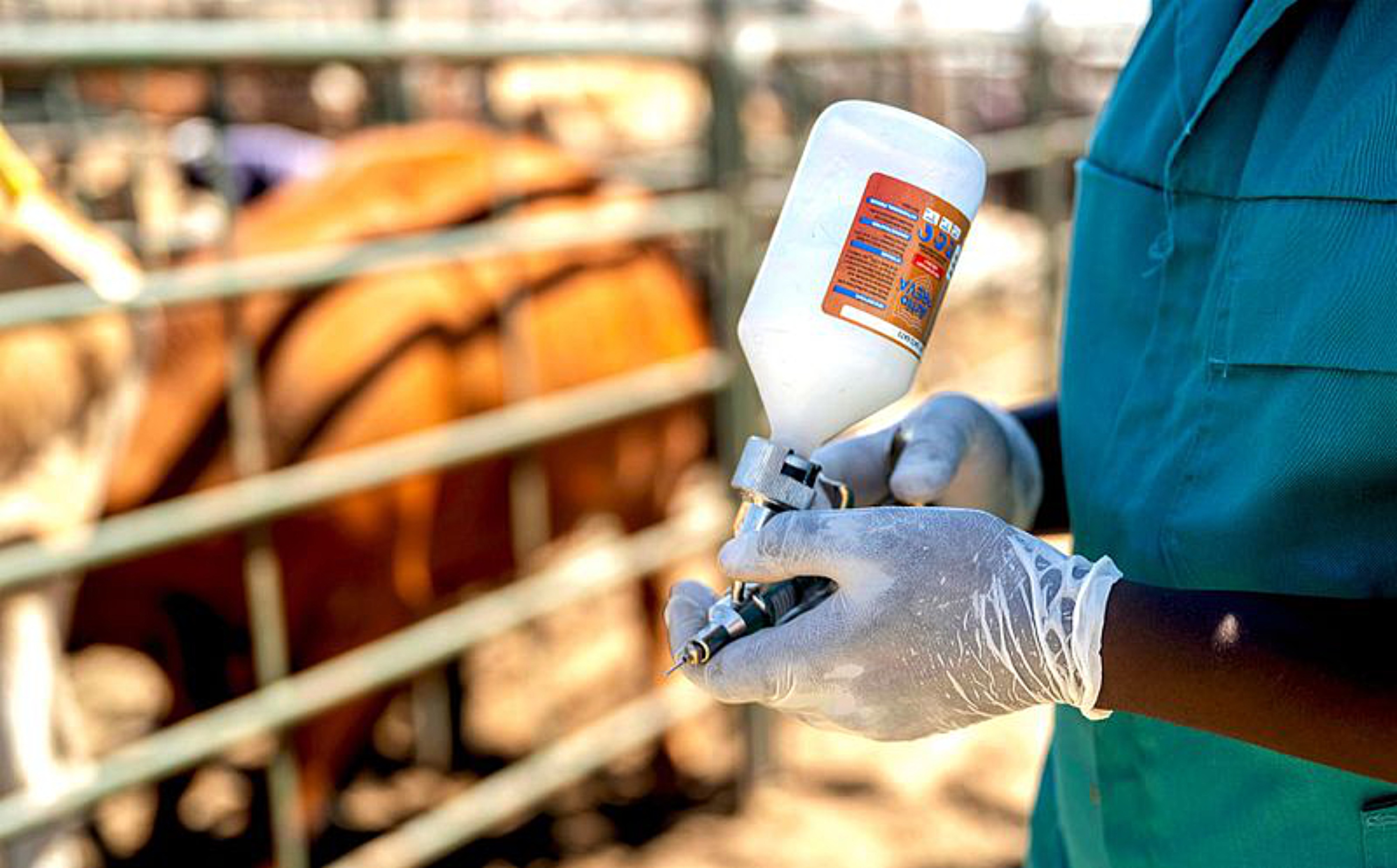
 A worker prepares to vaccinate cattle against against foot-and-mouth disease in Fisantekraal, Cape Town, on 15 February 2026. (Photo: Gallo Images / Die Burger / Jaco Marais)
Farmers and experts have welcomed the Agricultural Research Council’s (ARC) decision to allow qualifying private companies to manufacture the ARC’s intellectual property right foot-and-mouth disease (FMD) vaccine at a large scale for the first time.
This was proposed by Agriculture Minister Willie Aucamp and approved by the council’s board on 21 September.
According to ARC marketing coordinator Malebo Maleka, the council has successfully restored local FMD vaccine production, but its current manufacturing infrastructure limits the volume that can be produced in the short term. Allowing suitably qualified private companies to manufacture the ARC vaccine under controlled and conditional licensing arrangements provided an opportunity to increase production capacity while the ARC continued to rebuild and expand its own manufacturing capability.
Maleka said private sector participation can complement the ARC’s production capacity while the council continues its planned infrastructure and production scale-up. It also created the potential to strengthen domestic manufacturing capability and reduce dependence on imported vaccines over time. Any private sector manufacture of the ARC’s vaccine would remain subject to the applicable regulatory, quality, biosafety and licensing requirements.
Daily Maverick sent questions to the Department of Agriculture, but had not received a response by the time of publication.
Overdue decision
The director of the Bureau for Economic Research and a professor in agricultural economics at Stellenbosch University, Johann Kirsten, said the ARC’s decision to allow the private sector to manufacture its vaccine should have been made years ago.
“Why did it take us so long to get private capacity or give the right to private manufacturers to manufacture? Then we would not have worried about state procurement, importation from abroad, which is not necessarily efficient,” he said.
Daily Maverick sent further questions about the ARC board’s decision, but had not received a response by the time of publication.
South Africa entered the current outbreak with a registered vaccine but nobody licensed to manufacture it at scale, said Andrew Morphew, the spokesperson for FMD Response SA, a farmer-led and funded initiative that tracks South Africa’s operational and regulatory response to FMD outbreaks in the country. It is administered by a steering committee of industry representatives.
The ARC’s vaccine was registered in 2022, but the first batch of about 12,900 doses appeared only in February 2026, he said. “By our count, there was a period of 127 days in this outbreak in which not a single dose of FMD vaccine entered the country.”
He explained that this has been a crisis defined by no vaccine, and that allowed rampant spread. Had manufacture been contracted out when the vaccine was registered, South Africa would have had registered it at scale and might have been able to prevent the outbreak from reaching this “catastrophic point”.
While he welcomed the decision, Morphew added that “a licence is not a dose” and the effectiveness of private production can only be measured once vaccinations begin.
Small-scale livestock farmer and livestock commodity head in KwaZulu-Natal for the African Farmers’ Association of South Africa, Philani Ndlovu, agreed that allowing the private sector to manufacture the ARC vaccines could have controlled the outbreak sooner.
He believes this latest decision could speed up the vaccination of livestock in areas that the state-subsidised mass vaccination campaign hasn’t reached yet. Ndlovu noted that the campaign only reached him after he experienced an outbreak resulting in deaths among his livestock.
/file/attachments/orphans/Iman-FMDvaccines1_213929.jpg "Cattle being prepared for vaccination. (Photo: Supplied / Philani Ndlovu)")
Smallholder beef cattle farmer Linda Mthalane Nkosi, who had her cattle vaccinated through the state vaccination campaign three weeks ago, believes that if the ARC’s vaccine had been manufactured privately sooner, she would have set aside money to buy doses as soon as possible despite her current debts.
“As smallholder farmers we stand the chance to lose everything with no livestock insurance to protect ourselves. So, having a vaccine that we can control when we receive it, is a step in the right direction,” Nkosi told Daily Maverick.
While the licensing arrangements are being developed, pricing considerations will form part of the relevant contractual, regulatory and procurement processes. Nkosi said she is very concerned about whether private companies will inflate the price and if she will be able to afford it.
/file/attachments/orphans/Iman-FMDvaccines3_449061.jpg "Small-scale farmer Linda Mthalane Nkosi and her Brahman Bull (Photo: Supplied / Linda Mthalane Nkosi)")
Pirbright Institute test verification achieved
The ARC board has also decided to submit representative FMD field-circulating virus isolates from South Africa to the Pirbright Institute in the UK in October for a second round of vaccine-matching assessments or to test the efficacy of vaccines in South Africa against various strains.
The goal is to provide an additional scientific assessment of the suitability of available local and imported vaccines against FMD viruses currently circulating in South Africa.
FMD Response SA, which has previously called for this action, claims Aucamp has done the right thing in directing that South Africa’s field isolates go to the Pirbright Institute for independent vaccine matching.
According to Morphew, South Africa sent field samples to the institute in January, and October must be the second round of many, on a regular schedule that builds a verified history.
The World Organisation for Animal Health allocates each reference laboratory (such as the ARC) a quota of 50 samples a year, and South Africa should use that allocation in full, Morphew said. The results of the testing should be published, so that farmers and trading partners can see them first-hand, he added. DM
Comments
Scroll down to load comments...