



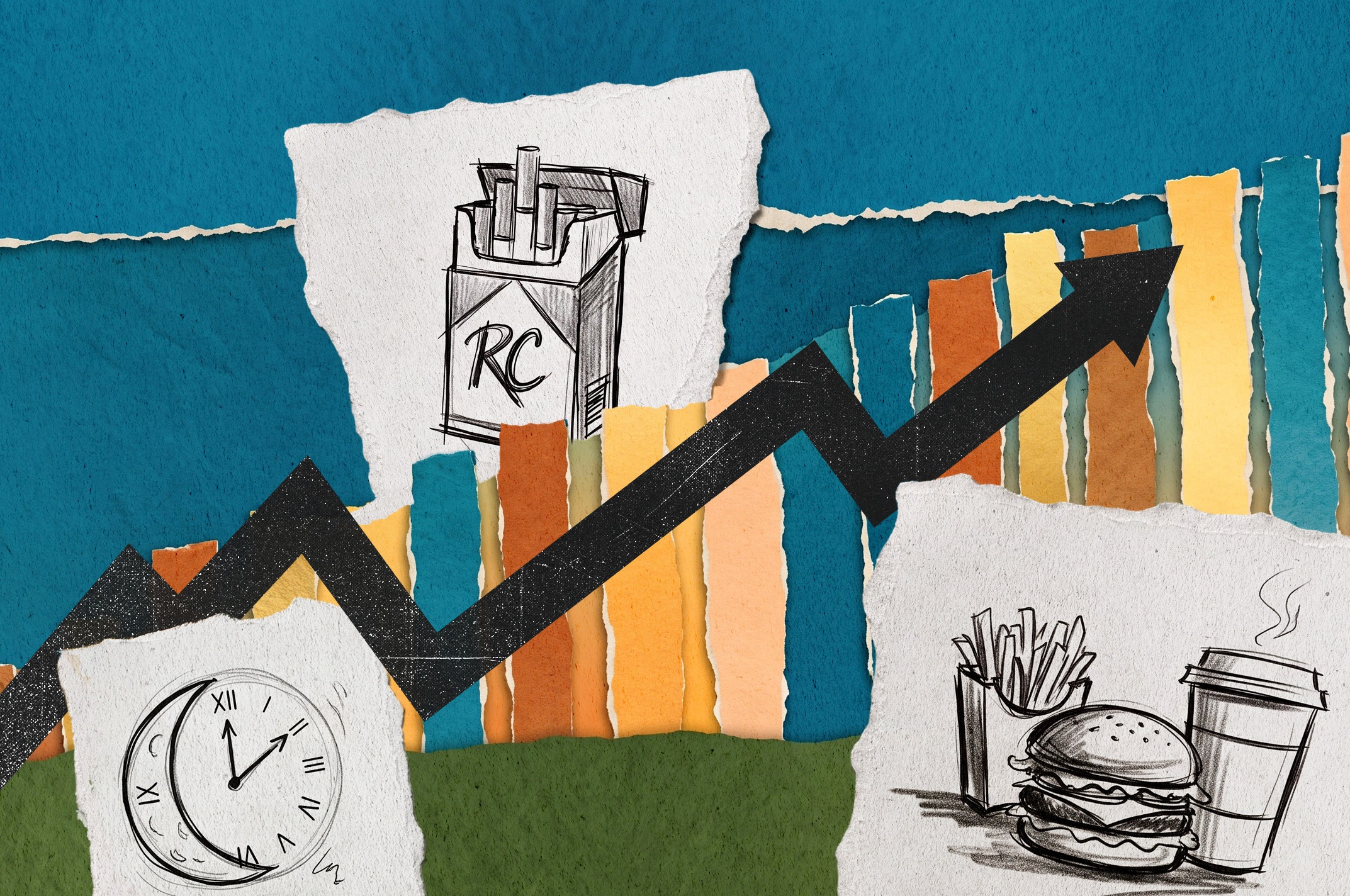
 Illustrative image: Righard Kapp | Torn paper edges (Source: texturefabrik.com) | Sketch elements generated with Google Gemini Flash Image 2.5
One doesn’t have to look far on social media for scare stories about increasing cancer rates. While there are some wildly inaccurate claims, there are also several reliable sources sounding the alarm. Apart from some worrying data, there is also just the visceral reality that many of us know friends or family who died far too soon. Just in 2026, we have lost Ufrieda Ho and Estelle Ellis, two of our leading journalists, to cancer.
The picture is a complicated one. To start with, different cancers are on different epidemiological trajectories. On the one hand, rates of cervical cancer are expected to decline due to HPV vaccination (most cases of cervical cancer are caused by HPV infection), while rates of colorectal cancer in younger people appear to be on the increase. Throwing all cancers together obscures such nuances.
Demographic changes are playing a big role. South Africa has an ageing population, and since the risk of several cancers increases with age, more older people will, on the whole, mean more cases of cancer. One of the largest global cancer studies found that more than half of cancer deaths are in people aged 65 or older. Even though the study found that total cancer deaths more than doubled from 1990 to 2023, this was driven by there being more older people – globally, the age-standardised cancer mortality rate actually went down by 24% over this 33-year period. It should be noted, though, that most of this improvement was seen in wealthy countries.
/file/attachments/2998/Cancer7_270772.png)
Poorer countries
The picture looks less rosy in poorer countries. Urbanisation and globalisation are factors in South Africa, with increasingly Westernised lifestyles exposing more people to smoking, alcohol use, processed food and obesity – all factors linked to increased risk of some cancers.
/file/attachments/orphans/Cancer_series_211_298300.jpg "Cancer is on the increase in South Africa as its population undergoes an epidemiological transition
<br>in the wake of urbanisation and globalisation: increasing Westernised lifestyles are exposing more people to smoking, alcohol use, processed food and obesity.
<br>(Photo: Gallo Images / Alet Pretorius)")
The available numbers are not straightforward to parse. The main source of data in South Africa is the National Cancer Registry (NCR), which keeps track of mainly lab-confirmed cancer diagnoses in the country – although there are initiatives to add diagnoses that are not lab-confirmed. The NCR counted a total of around 91,600 diagnosed cases in 2024. Invaluable as it is, the NCR provides only part of the picture since they report only diagnosed cases, and not all cases of cancer are diagnosed.
To get a sense of total cases – both diagnosed and undiagnosed – one has to look at estimates produced using mathematical modelling that builds on sources like the NCR’s data. Here, there are two commonly cited sources.
/file/attachments/orphans/Cancer_series_24_510741.jpg "The consumption of ultra-processed foods is on the rise in South Africa, with poverty being one of the key driving factors. (Photo: iStock)")
The International Agency for Research on Cancer (IARC) estimates that there were around 102,000 new cases of cancer in South Africa in 2024, in the region of 241,000 people living with cancer, and around 55,000 deaths due to cancer.
The Global Burden of Disease collaboration has higher estimates. It put new cases in 2023 at 127,000, people living with cancer at 335,000, and cancer deaths at 70,000. Incidentally, these numbers are quite similar to those for tuberculosis, where there are in the region of 300,000 new cases a year in South Africa and around 50,000 annual deaths.
The Global Burden of Disease collaboration also publishes projections up to 2050. While such projections are inherently uncertain, they do underscore what the scientific literature seems to be anticipating – a substantial increase in global cancer deaths to around 18 million by 2050 – it was around 10 million in 2023. As shown in the graph below, in South Africa, cancer deaths (neoplasms on their online data tool) are forecast to almost double from around 64,000 in 2024 to 127,000 in 2050. As noted above, much of this increase will be driven by changing demographics and lifestyles.
/file/attachments/orphans/Cancer_series_223_624473.jpg)
/file/attachments/orphans/Cancer_series_222_763058.jpg)
The IARC’s Global Cancer Observatory lists the most prevalent cancer types diagnosed among South African men in 2024 as prostate cancer (31%), lung cancer (10.4%) and colorectal cancer (7.2%). For women, it was breast cancer (25.1%), cervical cancer (18.4%) and colorectal cancer (6.3%).
Urbanisation and globalisation
At Stellenbosch University’s medical campus in Cape Town’s northern suburbs, cancer epidemiologist Professor Yoshan Moodley, convener of the university’s MPhil in Cancer Science, explains that South Africa sits between the infectious-disease profile of a lower-income country and the non-communicable disease profile of a high-income country.
Using a koki to draw a graph on a whiteboard, he says: “South Africa is in a transition. We still have a high burden of infectious disease, like HIV, TB and diarrhoeal [infections], but we also have increasing burden of non-communicable disease like cancer, heart disease and diabetes; which cannot spread from one person to another.”
Typically, low-income countries have a high number of deaths from infection. As a country develops, he says it becomes more industrialised, there’s more globalisation, and eating fast food becomes more common. “We see that the diets and the lifestyle of these populations change. So the diet becomes more westernised, the habits may change, there may be more alcohol use, tobacco use,” says Moodley.
/file/attachments/orphans/Cancer_series_26_572039.jpg "Middle-income countries have an increasing number of children who are unvaccinated against preventable diseases. (Photo: Jeff J Mitchell / Getty Images)")
At the same time, industrialisation generally improves the living conditions of a country. “So you would have things like clean water being provided, sanitation, vaccination programmes for the young children and things like that,” he says. “So that decreases the infectious diseases,” but Moodley adds that what’s increasing are cancers, heart disease and non-communicable diseases.
Moodley says this has been found to particularly affect people who until recently lived in rural parts. “People had healthy lifestyles when they lived rurally,” he says. “It’s predominantly black African people where it’s increasing the most. Generally, white, coloured and Indian people had more urban lifestyles before, but it’s black African people who are developing cancers as they start to be exposed to urbanised lifestyles.”
Lung cancer and smoking
The World Health Organisation’s Global Status Report on Cancer 2026, developed jointly with the IARC, names lung cancer as the leading cause of cancer deaths globally. The IARC points to lung cancer as South Africa’s most deadly cancer too, with 6,732 lung cancer deaths in 2024, and 7,693 new cases of lung cancer that year.
For the latest nationwide smoking data in South Africa, lung specialist at the University of Cape Town, Professor Richard van Zyl-Smit, refers to the 2021 Global Adult Tobacco Survey, implemented by the South African Medical Research Council, which showed that 29.4% of people in South Africa (12.7 million adults) were using tobacco – in men the number stood at around 42% and in women just under 18%.
Van Zyl-Smit tells Spotlight and Daily Maverick that despite South Africa’s stringent anti-tobacco legislation – a ban on product advertising, increasing tobacco prices, health warnings and public smoking bans – he reckons smoking in South Africa is on the rise.
“Factors include the increase of the so-called illicit market,” he says. “Cigarettes can now be bought for R10 or R20, reducing the financial burden and making it easier to keep smoking.”
/file/attachments/orphans/Cancer_series_21_472284.jpg "As Parliament continues to discuss the merits of electronic cigarettes as ‘safer’ alternatives to tobacco and the need for a multitude of vape flavours, immeasurable harm is befalling our children. (EPA-EFE / Tolga Akmen)")
On vaping or electronic cigarettes, he says: “If you are a non-smoker, you have a higher risk of lung cancer if you vape, given that cancer-causing chemicals are present in e-cigarettes; how much higher is unclear.” Referring to research in Australia, he says: “The reduction in cancer, switching from tobacco to vaping, may not be as dramatic as the marketing of vaping devices would suggest”.
Breast cancer
The IARC lists breast cancer as South Africa’s second most deadly cancer in 2024, with 5,377 deaths and 13,338 new cases that year.
Asked about increasing incidents of breast cancer in South Africa – the most common cancer among South African women – Cape Town specialist breast and endocrine surgeon, Dr Liana Roodt, explains: “The picture is nuanced. South Africa is seeing a growing number of women diagnosed with breast cancer.
“Part of this reflects genuine increases associated with an ageing population, urbanisation, obesity, reduced physical activity, delayed childbearing and other lifestyle-related risk factors.
“At the same time, our diagnostic capabilities have improved considerably. Better imaging, greater awareness and improved access to biopsy mean we are detecting cancers that previously would have presented much later.” Indeed, in the past, many incidents of cancer in South Africa were simply not reported and not recorded.
Roodt refers to a 2025 study about breast cancer determinants in low-to upper-middle-income countries, which paints a sobering picture of modern lifestyle factors shaping breast cancer risk.
/file/attachments/orphans/Cancer_series_22_298534.jpg "Cape Town specialist breast and endocrine surgeon, Dr Liana Roodt.
<br> (Photo: lady_rosella / Instagram)")
The researchers estimate that tobacco use – including passive smoking – results in a 22% higher risk of breast cancer, oral contraceptives 19%, and night work 14%, possibly due to disrupted circadian rhythms. In these instances, exposure time is significant, the study states.
Other risk factors for breast cancer include age, family history and air pollution. In addition, the findings suggest that adequate fruit and vegetable consumption could reduce breast cancer risk by 18%
/file/attachments/2998/Cancer1_442520.png)
Endocrine-disrupting chemicals
Asked about endocrine-disrupting chemicals – substances found in some plastics, pesticides, industrial pollutants, cosmetics and everyday consumer products that can interfere with the body’s normal hormonal signalling – Roodt says: “The evidence is still evolving. Rather, concern centres on cumulative lifetime exposure, particularly during vulnerable periods such as foetal development, puberty and pregnancy.
“Communities living near industrial pollution, using certain pesticides or with limited access to safer environmental conditions may experience greater exposure, making this both an environmental and a public health equity issue.”
She says environmental risk is also deeply intertwined with inequality.
“When a family is struggling to feed itself, concerns about endocrine-disrupting chemicals, pesticides or industrial pollutants in their food, water, food packaging and general environment become a luxury they simply cannot prioritise or are not even aware of. Many exposures are invisible, unavoidable and poorly understood, meaning that our most vulnerable communities may carry a disproportionate burden of environmental risk through no choice of their own.”
Cancer: What it is and how it happens
But what is cancer and how does it come about in the first place?
To understand how cancer can occur, one first needs to understand some basics about the immune system. An important player, points out Moodley, is lymphocytes – a type of specialised white blood cell. Normally, if there is an abnormal cell somewhere in the body, the immune system, with the help of these white blood cells, should be able to “tackle that cell and destroy it so it doesn’t multiply”.
If there is “dysfunction” in the immune system, says Moodley, then these white blood cells don’t function as they should and thus won’t be able to destroy that abnormal cell. Cancer is essentially an abnormal cell that is multiplying rapidly and growing uncontrollably, which then causes a tumour to form.
“Under normal circumstances, if all the genetic material is okay or properly functioning within the cell, if there’s a problem with the cell, the cell destroys itself,” Moodley says. “It’s called programmed cell death.”
But this does not happen when the immune system is not functioning properly. “Like, if there’s a genetic mutation that you’ve inherited from your parents. Or, smoking causes a change in the DNA of your lung cells, for instance. The DNA tells the cell what to do, but when there’s a problem in the instruction, then the cell doesn’t behave as it normally would,” he says.
Damage to cell DNA can also be caused by chronic inflammation. “[F]or instance, obesity is a risk factor for cancer because there’s continuous inflammation in the body,” says Moodley. “So your immune system is always working, and when your immune system is always working, it starts to produce all of these different substances. And when that happens, it can cause damage to the DNA.”
He also points out how a viral infection can be a catalyst for cancer: “Let’s assume somebody has a viral infection: the hepatitis virus which infects the liver and causes liver cancer. Because the body detects that there’s something foreign in the liver – the virus – it keeps attacking the virus. So it starts to destroy the tissue. The new tissue that grows doesn’t behave normally. But the virus keeps surviving within the liver. So that’s why a lot of people who have liver cancer with hepatitis virus, they have scarring in the liver as well.”
These many complexities and differing mechanisms mean that finding cures for different cancers is among the greatest scientific challenges of our time. This is one reason why, despite some of the remarkable advances we will explore in an upcoming article in this series, rates of cancer are expected to remain high in the coming decades.
The rural reaches
Meanwhile, amid citrus orchards near Hoedspruit in Limpopo, at the Hlokomela Clinic, founded in 2005 to help farmworkers seek protection against HIV, operations manager Antionette Ngwenya acknowledges a shift in priorities.
/file/attachments/orphans/Cancer_series_23_201589.jpg "By Biénne Huisman
<br>Antionette Ngwenya, operations manager of Hlokomela Clinic, near Hoedspruit in Limpopo.")
Speaking to Spotlight and Daily Maverick, she refers to cancer as “another monster killing people”. On the day of our visit, her team had just completed a strategy meeting for creating cervical cancer awareness in the area. At the clinic, they do about five “pap smear” screenings for abnormal cells in the cervix each week.
Ngwenya herself has had two relatives diagnosed with breast cancer in the past and recognises her own obligation to screen for the disease. “I think we do not raise awareness about cancers as we did with HIV,” she says. “We now need to focus on cancer a lot.”
Hlokomela Clinic’s slogan is “farm workers care for each other”. It sees around 1,000 people each month. Here, Ngwenya’s insights serve as a reminder that behind all the statistics discussed in this article lie the realities of individual human beings who are being diagnosed with cancer all across our country. DM
This is the second of six articles in SA’s Cancer Story, a special series jointly produced by Spotlight and Daily Maverick. You can read part 1 here.
Comments
Scroll down to load comments...