



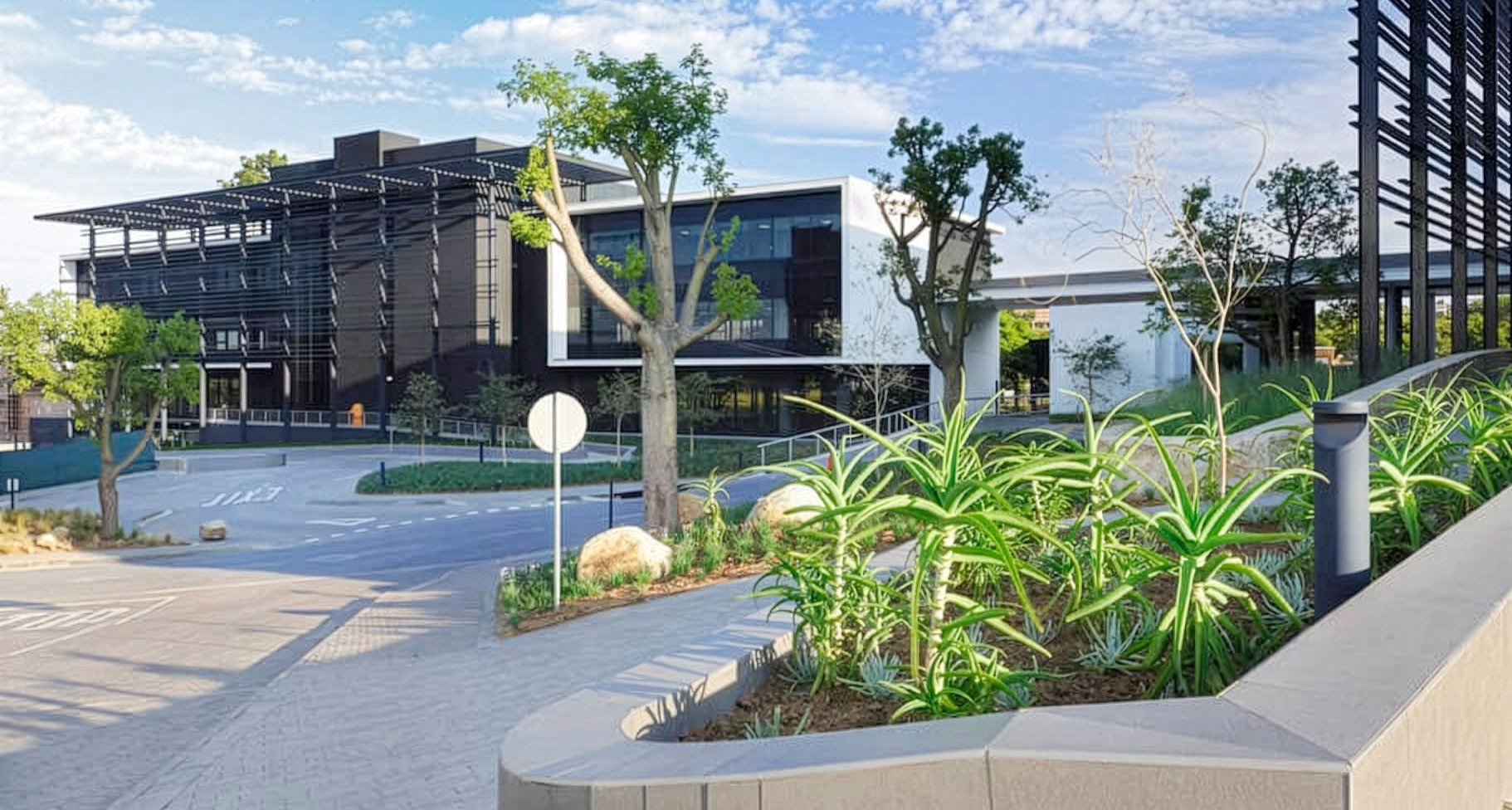
 Knightsbridge Office, one of Emira Property Fund’s 4-star green-rated office parks situated in the heart of the Bryanston business node. (Image: Sourced / Emira Property Fund Website)
 On the surface, Emira Property Fund’s market cap of R6.7-billion makes it look like a typical mid-cap real estate investment trust (Reit). The current dividend yield of 9.3% suggests it trades at a modest valuation vs some of its larger peers, which isn’t unusual for a fund of this size.
The share price is up 14.6% over 12 months, with the dividend taking this to a meaty total return of 25%. The returns also look solid over three and five years, with Emira rewarding investors who took a punt on it.
But if you dig a bit deeper, you’ll see that Emira is different from most property companies. Instead of just assessing the current state of the portfolio, investors always have to wonder what the next capital allocation move might be.
A pre-close update for the five months ended August 2026 provides a good opportunity to take a closer look at what you’ll find in this fund.
Standard operation
Let’s begin with the usual types of assets you’ll find in a South African Reit: local directly held commercial properties. Emira has 29 such properties on its books.
This includes nine retail properties with a focus on neighbourhood and community shopping centres, seven office buildings (mainly P- and A-grade) and 13 industrial properties split across single-tenant light-industrial and warehouse facilities and multi-tenant industrial parks.
The retail portfolio saw an uptick in vacancies from 4.2% as at March 2026 to 5.3% as at the end of August 2026, largely due to Pick n Pay reducing its footprint. This is a good reminder of the risks landlords face when there’s an upheaval in the retail market.
Office vacancies improved from 9.9% to 7.7% over the same period, but reversions were a nasty -8.6% due to the renewal of a major seven-year lease in Bryanston, Johannesburg. A negative reversion (a lease concluded at a lower rental than the outgoing lease) is common when offices have been occupied for several years.
Although industrial vacancies increased from 0.7% to 1.1%, the good news is that reversions improved from -6.6% to -2.2%. Industrial portfolios have generally been solid performers in the South African market, although that doesn’t make them immune to negative reversions.
Emira rarely sits still, with the period under review seeing the disposal of six commercial properties for total proceeds of R531.8-million. A further two disposals are expected to be finalised by December.
Non-typical
This brings us to the end of the typical stuff that you’ll see in a JSE-listed Reit. From here onwards, it gets spicier.
Firstly, there’s a massive residential portfolio of 1,737 units. That’s proper nightmare fuel for anyone close to managing a buy-to-let investment and dealing with tenants. The portfolio has been reduced from 1,970 units back in March. After selling 233 units for R125.3-million in this period, a further 311 units are expected to transfer by March 2027.
If you’re wondering what the backstory is, Emira invested in Transcend Residential Property Fund in 2018 and eventually took the company private in 2024. This brought it a portfolio of thousands of units at a juicy price, as Transcend had been trading at a discount to book value.
Actually turning that value into cash takes time, especially with such a large portfolio that needs to be dripped carefully into the market to avoid putting pressure on property prices in the area. An added complexity is that 95% of the current units are in Gauteng, while only 5% are in the more lucrative Cape Town market. Emira is one of many companies that would benefit from an improved day-to-day reality in Joburg.
The portfolio may take time to sell, but at least it generates decent rentals in the meantime. The vacancy rate (excluding held-for-sale units) sits at just 2.0%. And, unlike the commercial portfolio with lumpy leases, there’s no key-tenant risk in a residential portfolio of this nature.
As you would’ve noticed in the reference to Transcend Residential Property Fund, Emira has a history of building up stakes in other listed companies and treating them as active opportunities. This is why the market pays attention to the capital allocation decisions made by Emira.
/file/attachments/2998/Codera_Propage-1-1024x757-1_376824.png)
Emira currently has stakes in two peers on the JSE.
The first is a 6.9% interest in SA Corporate Real Estate. This doesn’t give it any meaningful influence over governance at the company, with Emira describing this position as diversifying its earnings base.
But the stake in Octodec has raised eyebrows this year, as Emira acquired a 23.6% shareholding in the company during April and May and then took it to the current level of 23.9% with further share purchases. That seems too high to be a passive portfolio stake rather than a broader play, but Emira’s intentions are not yet clear.
Polish portfolio
Adding to this smorgasbord of property exposure, Emira also has a 45% interest in DL Invest. This is a portfolio of 43 properties in Poland (excluding those held for development). There’s a strong focus on logistics and industrial properties, contributing well over 80% of gross lettable area. It is also looking at the potential development of data centres.
While Eastern Europe may not be an unusual choice for a South African Reit, a portfolio of five retail centres in the US certainly is. These are grocery-anchored, value-oriented malls with a vacancy rate of 2.6% (up from 2.3% in March). Emira has agreed to sell one of the investments at an 8.1% premium to the March book value.
This isn’t a simple group, but the management team has a solid reputation, and the balance sheet is in great shape with a loan-to-value ratio of 31.3%. Management has noted that the fund is on track to achieve its objectives for the full financial year, with interim results due to be released at the end of November.
With several macro risks on the horizon, the bigger question is whether we will see more capital allocation action from Emira in the months to come. DM
Comments
Scroll down to load comments...