



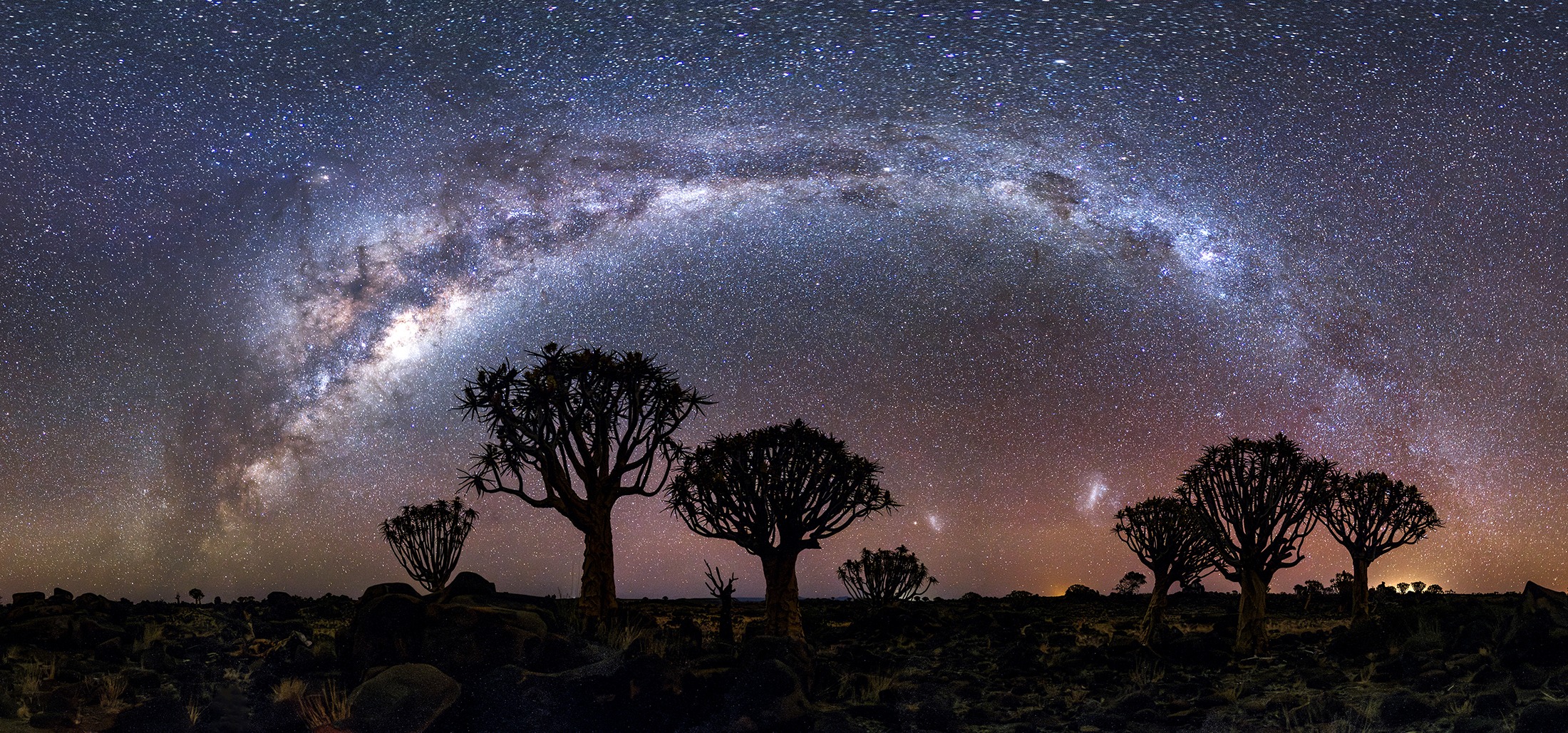
 Inspired as a boy by dark, star-crowded skies and a dream of becoming an astronomer, Oxford’s Professor Yadvinder Malhi ultimately turned his physicist’s lens down to Earth to decode the energy flows of the living world. Pictured: The Milky Way over quiver trees near Keetmanshoop, Namibia. (Photo: Jianfeng Dai / IAU OAE (CC BY 4.0))
Under the heavy heat of rural Punjab, a six-year-old boy lay on a rope mattress on a flat brick rooftop, staring up into the night. In the mid-1970s, Yadvinder Malhi’s grandparents’ village had no regular electricity, and the sheer abundance of stars offered a stunning contrast to the sodium-lit suburbs of Essex where he grew up. For the young boy, sent from England to connect with his heritage, the experience was profound.
By day, the sky gave way to the vibrant chaos of the Punjab countryside. His cousins, sensing the boy’s awe of the living world, would run through the fields and return with wild birds and other small animals for him to examine.
“That year opened up the world for me,” recalls Malhi, now a professor of ecosystem science at the University of Oxford. “I think a lot of my early interest in natural history comes from that early immersion. Also, it made me much more aware of the richness and diversity of cultures ... the multitude of ways of seeing the world has shaped me ever since.”
A few years later, back in Essex, a teenage Malhi often sat transfixed in front of a television set, watching Carl Sagan’s landmark series Cosmos. Sagan was an eloquent communicator who “made science not just about the technical science; he made it about literature and art and all of human creativity”, says Malhi.
The Cosmos series presented the exploration of the universe as “something far more epic and romantic” than a dry search for facts. This shaped his view of the scientific enterprise as “something quite noble and grand, overall, equal to the arts and literature”.
Inspired by this vision of science, Malhi resolved to become an astronomer and went to Cambridge University to study physics, intending to spend his life studying the stars.
Perspective shift
But during his undergraduate years at Cambridge, his perspective began to shift. He discovered that studying physics involved a lot of sitting in labs, and the practice of astronomy, sitting before the “early computers in the late 1980s”.
“I was not surrounded or immersed in things I was fascinated by,” says Malhi.
To find a way outdoors, he began taking side-options in geology. It was during these university field trips that he discovered how much he enjoyed fieldwork, and that he had a knack for going out and trying to take measurements in “tricky places” where “maybe instruments wouldn’t work and stuff like that”.
In the late 1980s, as climate change was just emerging as a widely recognised issue, Malhi realised he could use his training in physics to get involved. He pursued a PhD in meteorology at Reading University, which led to his first experience of Africa. Working in Niger in west Africa, he spent months collecting data on how water flowed through crops and natural vegetation in the semi-arid Sahel, trying to understand how land use change could contribute to the droughts the region was experiencing. It was a challenging environment, but he loved the experience of doing science in a place so “geographically and culturally fascinating”. Thereafter, he was hooked on the challenges of outdoor science.
Into the forests
In March 1995, Malhi, then a 25-year-old postdoctoral researcher at Edinburgh University, arrived in Brazil for his first visit to the Amazon. It was a scouting trip with his supervisor to build relationships with local partners and identify where they would conduct their research. Up to that point, he had never stepped inside a tropical rainforest.
/file/attachments/orphans/Roving-YavinderMalhi3_898195.jpg "In 1995, Malhi was “utterly bewitched” after climbing a research tower above the Amazon canopy. Pictured: the 325-metre Amazonian Tall Tower Observatory in Brazil, inaugurated in 2015. (Photo: Wesley Sousa (ASCOM / SEAPC / MCTI) / Flickr)")
“It was a whole new world,” Malhi recalls. “Slightly claustrophobic in its darkness and intensity, but also absolutely fascinating in how little I understood of what was going on there. I wasn’t an ecologist ... I had no formal training in ecology.”
Climbing up through a slightly rusty steel tower on the site, he transitioned from the dark, claustrophobic forest floor into the open air above the canopy, where the horizon suddenly opened to an ocean of green.
“I stood on this tower and saw rainforest for what I knew stretched 1,000 miles in every direction.
“The diversity – every tree looked different. There were insects all around... I was utterly bewitched. This idea that we were so small in this huge biological, ecological world was overwhelming. I became convinced that this is what I wanted to study.”
He returned later to begin his actual postdoctoral research. His task was highly technical: install new, experimental sensors on a tower to measure the invisible flows of carbon dioxide and water between the rainforest and the atmosphere. But before the science could begin, his equipment was held up in customs for a few months.
Rather than wait idly, Malhi adapted. He learnt Portuguese and spent his days in the research institute’s library, reading his way into the tropical ecology he had never formally studied. This was where his self-taught ecological education truly began.
/file/attachments/orphans/Roving-YavinderMalhi1_484416.jpg "Measuring forest respiration: Yadvinder Malhi and student Filio Farfan record carbon dioxide emissions from a tree trunk in the Peruvian Amazon (2011). (Photo: Jake Bryan)")
Once the equipment cleared, the stakes were high. At the time, global carbon studies showed that huge amounts of human carbon dioxide emissions were disappearing somewhere on land. While some speculated that tropical forests might be acting as this carbon sink, classic ecological theory held that mature, old-growth forests should be in balance – releasing as much carbon through decay as they absorbed. There were simply no direct measurements on the ground to prove it either way.
It was during his long stays in Brazil, standing on the tower and looking down at the forest beneath, that he also realised he wanted to better understand the rich, living dynamics of the ecosystem rather than just the equations and physical flows.
Where traditional biologists were naturally drawn to unique differences and individual species, Malhi’s physics training pushed him to look for simplicity within the complexity. Using what he calls a “physicist’s eye”, he sought to understand the big systems, the flows and the interactions.
His technical airflow measurements above the canopy, however, proved problematic. The technology was new and unreliable, but the biggest obstacle was the air itself: at night, instead of rising to his sensors, it would accumulate beneath the forest and drift sideways down the valleys.
Rather than give up, Malhi partnered with foresters who were physically measuring the girth and biomass of trees on the ground. By compiling and standardising forestry data from across Brazil, Peru, Colombia and Bolivia, Malhi and his colleagues built a continent-scale forest network.
In 1998, Malhi and his colleagues published their findings in the journal Science. The data revealed that the mature Amazon forest was actively gaining biomass and absorbing carbon dioxide from the atmosphere – a massive natural sink that was effectively slowing down the pace of global climate change by about 10%.
For Malhi, such discoveries remain the ultimate appeal of field research. “You have a rough idea of what you might expect,” he says, “and more often than not, nature surprises you.”
/file/attachments/orphans/Roving-YavinderMalhi6_698544.jpg "A ‘lost world’ vantage point: Yadvinder Malhi atop a plateau in Bolivia’s remote Noel Kempff Mercado National Park during a 2001 RAINFOR field campaign, where researchers spent two weeks camping and tracking long-term forest plots across the Amazon basin. (Photo: Supplied / Source)")
Congo Basin story
But Malhi soon learnt to be wary of short ecological studies. A forest can appear to take one trajectory over five years and look completely different two decades later.
“Our first papers came out after about five years of observation, showing a very clear increase in biomass,” Malhi explains. “But our colleagues have continued these observations for almost 30 years now. What we’ve actually seen is that the annual increase in biomass is going down over time as the Amazon gets drier and is hit by more frequent droughts.” While the Amazon remains a carbon sink, its capacity has halved, says Yadvinder. A 2020 study in Nature, using statistical models, projected that the Amazon’s sink could reach zero by 2035.
Intriguingly, the Congo Basin tells a different story.
Up to that point, aside from his early PhD work in Niger, Malhi’s research had centred on Latin America. Then, in 2009, his wife, Rachel, working for the British government’s overseas development department, was offered a diplomatic posting in Ghana.
With a young family and a desire for a new adventure, Malhi negotiated a temporary relocation with Oxford University. The family moved to west Africa for three years, where Malhi got involved in tropical forest monitoring.
“The African forests were just not being studied anywhere near the level of detail that South America’s forests were,” says Malhi.
What began as a three-year family break quickly expanded. His work spread across west Africa, then into Gabon and the Congo Basin and eventually to the savannas of eastern and southern Africa, where Malhi’s team began setting up the same rigorous plot networks they had built in South America.
And when they began analysing the African data, researchers ran into another major scientific surprise. While the Amazon’s carbon sink was weakening under the strain of frequent droughts, the world’s second-largest rainforest was holding its ground.
“It seems to be holding on and maintaining its carbon sink,” says Malhi.
/file/attachments/orphans/Roving-YavinderMalhi7_615461.jpg "Yadvinder Malhi using a specialized \"tree stethoscope\" in the Tambopata region of the Peruvian Amazon (2011). His team gathered canopy leaf samples to measure functional traits, laying the groundwork to describe and map rainforest canopies worldwide. (Photo: Jake Bryant)")
But the picture is not static. The same study, drawing on 244 African forest plots across 11 countries and 321 in the Amazon, found that Africa’s carbon sink was stable for the three decades to 2015. Its most intensively monitored African plots, however, suggested a rise in carbon losses after 2010, and its modelling projected that Africa’s sink could be 14% lower by 2030 than in 2010-15.
This matters for reasons that extend far beyond carbon. Malhi describes the Congo Basin as a “fountain of water in central Africa” – its forests pumping moisture into the atmosphere and helping sustain rainfall across the continent.
His close friend and collaborator, conservation scientist Lee White, uses a different metaphor. He calls Congo “the pumping heart of Africa”.
“If we lose the Congo Basin,” White warns, “I do not believe the African continent is viable.”

More than trees
Moving through west Africa also shifted Malhi’s ecological perspective. In Gabon, he encountered a forest inhabited by elephants, gorillas and chimpanzees – animals on a scale largely absent from the Amazon he had known.
“Until then, all of my research had really been about trees and plants,” he says. “Then I started seeing animals not as passive parts of an ecosystem that just eat what the plants provide, but as active shapers of ecosystems.”
/file/attachments/orphans/Roving-YavinderMalhi2_316026.jpg "Gardeners of the forest: A family group of forest elephants in a rainforest clearing. Forest elephants (Loxodonta cyclotis) travel considerable distances through rainforest eating fruit and then dispersing the seeds in their dung. Some large rainforest trees depend heavily on this process. (Photo: Richard Ruggiero / USFWS / Flickr)")
It made him look at the Amazon differently, too. Until about 12,000 years ago, South America was home to giant sloths and elephant-like animals that disappeared around the time humans arrived.
Malhi began to see the modern Amazon as a kind of “ghost forest” – an ecosystem still carrying the legacy of its lost megafauna and perhaps missing some of the ecological functions they once performed. In Brazil, he later gave a talk titled “The Lost Elephants of Brazil”, bringing ideas about animal-driven forest dynamics from African ecology back to South America.
/file/attachments/orphans/Roving-YavinderMalhi4_858369.jpg "Yadvinder Malhi at Danum Valley, Malaysian Borneo (2005), site of a major research programme examining energy flows between plants, birds, and mammals in tropical forests. (Photo: Supplied / Source)")
Nature surprises
To illustrate how “unpredictable and beautifully complex” nature remains on the ground, Malhi points to an experiment he conducted with colleagues from the universities of Pretoria and Liverpool at the Wits Rural Facility near Kruger National Park. The team established plots in which they eliminated termites and ants to see how this would affect nutrient cycling.
The hypothesis was straightforward: because termites drive decomposition, removing them should slow the nutrient cycle, leaving plants with fewer nutrients. In a separate set of plots, they eliminated ants, which Malhi describes as “lions in the little layer”, keeping the “zebra” termites in check. Without the ants, the termite population boomed.
But when they analysed the plants in the termite-free plots, they got a massive surprise.
“Without the termites, the plants seemed to be richer in nutrients, rather than poorer,” Malhi says. “We still haven’t worked out what the answer to that is.”
For Malhi, this unresolved mystery is not a failure, but the very heart of scientific inquiry.
“It’d be very boring if all you were doing in research was just validating hypotheses you’d already worked out,” he says. “I think that, to me, is part of the deliciousness of science.”
The Covid-19 lockdowns gave Malhi a new focus: how to restore nature closer to home.
/file/attachments/orphans/Roving-YavinderMalhi5_948642.jpg "A physicist among the trees: Oxford’s Prof. Yadvinder Malhi inspecting a weather station in Wytham Woods—the university’s ancient woodland laboratory — in 2021. The field campaign monitored how ash dieback disease alters forest microclimates and overall ecosystem function. (Photo: John Cairns)")
Confined to Oxford and unable to travel to Gabon or Peru, he spent his daily walks exploring the intensively farmed and deforested landscapes around the city.
Nature recovery
“There’s so much that needs to be done here to improve our relationship with the living world,” says Malhi. This sparked the creation of Oxford’s Leverhulme Centre for Nature Recovery.
Crucially, Malhi wants to move past the traditional, doom-and-gloom conservation narratives that leave students feeling overwhelmed.
“My students would come out of lectures informed, but increasingly depressed by the state of the world,” he says. “I felt, actually, that there are many more positive stories to tell about how we can build from where we are, and tell a better future.”
For Malhi, this means rejecting both “parachute science” – where wealthy Western researchers extract data from developing countries without building long-term local relationships – and the colonial-era model of conservation that seeks to fence off “pristine” wilderness while keeping local people out.
“We have to get away from this dichotomy of humans being one thing and nature being something else,” he argues. “We evolved from the natural world. We are entangled in lots of ways.”
He champions “mosaic landscapes” where humans and wildlife coexist, and points to his recent visit to India, where dense human populations live alongside migrating elephants and tigers, a prime example of this coexistence.
Much of his team’s research also involves learning from the deep, ecological knowledge held by communities. In Peru, Malhi recalls being profoundly influenced by local community members who served as guides.
“To see somebody who could read the complexity of these forests I was walking through, and see it as a pharmacy ... was really, really insightful,” he says.
This personal experience highlighted the vast depth of ecological knowledge held by local communities.
At the 15th Oppenheimer Research Conference in Midrand from 7 to 9 October, Malhi’s presentation, “An energy flow view of African terrestrial ecosystems”, will draw on his physics background to examine how energy moves from plants through mammals, birds and, ideally, invertebrates – and what this can tell us about the health of ecosystems.
It is a concept that brings his career full circle. The six-year-old boy staring up at the Punjab stars and the teenager inspired by Carl Sagan could scarcely have predicted the life he has led, but the underlying curiosity remains unchanged.
And while he is now a senior academic at one of the world’s most prestigious universities, Malhi has no intention of retreating to a comfortable office.
“A big part of me always is being in the field,” he says. “It’s going into the field a few times a year, and being in the ecosystem, measuring things with your own hands, being dirty and sweaty, and bitten by insects, thinking about how the living world works and all those things – that’s the grounding. That’s the thing that reminds me of the wonder and the complexity of the world that I choose to study in. If something stopped me from going to the field, whether local or international, I think I would wilt away in six months.” DM
This story was produced by Roving Reporters in collaboration with Jive Media Africa, the science communication partner to Oppenheimer Generations Research and Conservation.


Comments
Scroll down to load comments...