



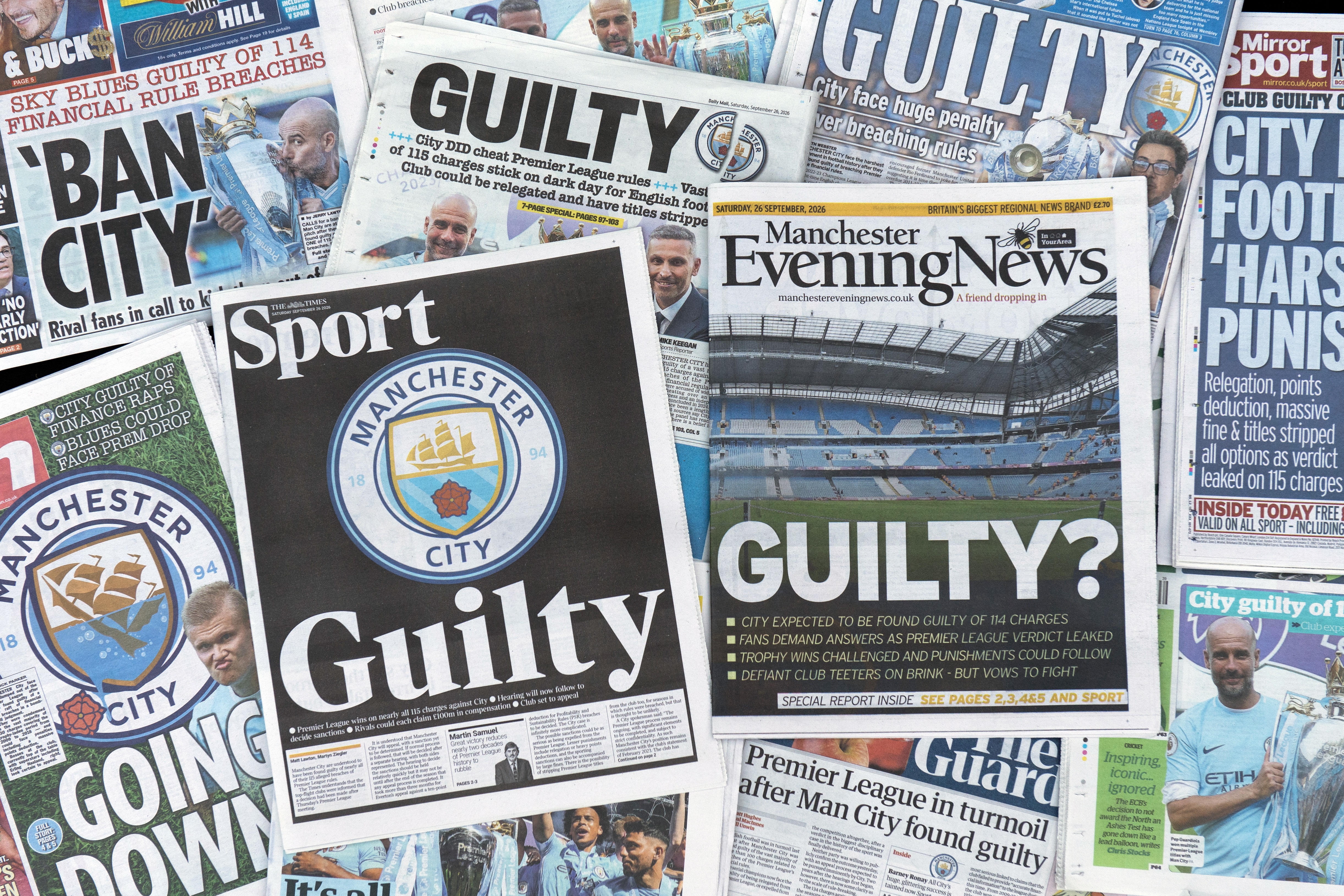
 British newspaper headlines after Manchester City was found guilty of breaching Premier League financial rules on 26 September, 2026. (Photo: Visionhaus / Getty Images)
“Football is the most important of the least important things in life” – Arrigo Sacchi, legendary Italian soccer manager
As someone who has followed an English Premier League soccer team for almost three decades (disclosure: Arsenal FC), I can confidently say that soccer is deeply unserious. Fans worldwide dedicate hours each week to watching, debating, tweeting and worrying about 22 athletes chasing one ball across a field, often thousands of kilometres away, as an escape from their daily realities. South Africa’s own levels of soccer fandom are arguably unmatched.
From childhood, we are promised that soccer is the most democratic of universally loved pastimes; that any child in any circumstance can pick up a ball, understand the rules, and easily set up a neighbourhood game. And this is the beauty at the core of the dream; anyone can be a soccer star. The rest of us live vicariously as fans.
And yet this week’s biggest story in world sport is not about the majesty or democracy of the game, but rather a narrative with which South Africans are deeply familiar: economic crime. The English Premier League’s Abu Dhabi-owned Manchester City have been found guilty of 114 charges that, reduced to one word, amount to cheating.
Football Leaks
In 2018, German newspaper Der Spiegel published Football Leaks from hacker/whistleblower Rui Pinto, demonstrating the extent of corruption across much of European soccer’s elite clubs.
One focus of the leaks exposed how Manchester City, effectively bought by the Gulf emirate in 2008 (the club’s owner is Sheikh Mansour, brother of the United Arab Emirates’ president and himself vice president), had hidden and obfuscated sources of funding to avoid revealing their violations of the league’s financial regulations.
The Leaks demonstrate how City, historically Manchester’s second team behind the far richer and more successful Manchester United, sought to use their new owner’s funds to accelerate their climb up England and Europe’s elite club ladder by spending far more than they were ultimately bringing in. That project culminated in a historic English and European treble achieved by Pep Guardiola’s City in 2022/2023, a castle built on the earlier foundation of misstated funding and expenditure.
This occurred despite the Premier League, the world’s richest soccer league, having instituted its Profit and Sustainability Rules governing how its clubs are financed, in 2015. These rules, adopted by consensus among the clubs, sought to ensure that a club’s spending is directly related to its income from sources independent of its owner’s wealth, such as that generated from sponsors and from selling players, and set an upper limit for a club’s financial losses over three years.
Those rules sit alongside Financial Fair Play rules imposed by European soccer’s club competitions from 2010, including a “break-even” requirement that ensures that clubs do not exceed a financial limit for the difference between their income and expenditure.
The objective of such rules is both fairness between clubs and sustainability of clubs. Fairness is achieved where parties to a competition are operating under similar constraints, such as needing to first raise any funding that they spend towards winning the competition.
For sustainability, the rules seek to insulate clubs from any ownership change that might uproot a total reliance on an owner’s wealth, thereby protecting the interests of club employees and fans more generally. Both these objectives underpin a competition that is enjoyed as both competitive and of the highest technical quality, and this generates legitimacy and the trust of the millions of fans who then spend their time and money following these competitions.
The 115 charges
After the Football Leaks’ revelations, in 2023 the Premier League instituted 115 charges against Manchester City for various violations of the rules across the 2009/2010 to 2017/2018 seasons, to be determined by a three-person independent panel under a strict confidentiality regime. The Premier League regarded City’s conduct as having involved –
“extremely serious, significant, sustained and intentional or reckless breaches of rules critical to the proper and fair operation of the PL’s league competition.”
City denied – and continues to deny – all the charges.
Almost two years after a hearing to ventilate the charges, on Tuesday the Premier League released a redacted summary report which finds City guilty of 114 of the 115 charges, and for the first time details the extent to which City’s management “cooked their books” to obscure the source and extent of the funds they used to reach soccer’s summit.
The decision refers to a “Disguised Funding Scheme”, in which many sponsorship agreements –
“were (as a matter of law) shams and/or arrangements whose economic substance was very different to the appearance given in the [sponsorship agreements] themselves.”
In this way, the club disguised almost £900-million of Abu Dhabi-based shareholder funding (which was above the permissible threshold) as unrelated “commercial partner revenue” and incorrectly recorded this in its annual financial statements across the years under scrutiny.
In doing so, the club sought to minimise its dependence on its owners and mislead the Premier League into believing that its financial position was better than it truly was. Manchester City accordingly failed to act in good faith and breached the Premier League’s rules.
And yet this is only the beginning of what is likely to be an even longer-term process; City has a right to appeal against the decision, and any sanctions are yet to be determined. In the meantime, City will continue to compete at the top of the Premier League despite this finding, which has already drawn the ire of fans across England’s soccer stadiums and the world’s sports bars.
Why does this matter?
Following soccer is a wonderful pastime; it is escapism and community building on a global scale. Premier League clubs are literally engaged in playing just a game. Why then should ordinary soccer fans – and the public more broadly – care about the wealth pumped in to arguably make the spectacle even greater?
There are many reasons.
Clubs employ thousands of workers across their operations, most of whom are neither involved in financial decisions nor remunerated at nearly the scale of their top stars. The knock-on effect of a club failing would thus destroy their livelihoods, and fans pour money into the game through their physical support in stadia, media consumption of soccer content and many attendant micro-industries tied to club activity.
As mentioned, this is dependent on an understanding that the game, no matter the scale, is inherently fair and thus truly competitive. The extent of the global public’s interest in this story is indicative of its seriousness.
Moreover, modern economies have largely agreed that regulation is an effective method to protect the most vulnerable from corporate greed. When the Premier League imposed its Profit and Sustainability rules, it sought to achieve just that. If one club ignores and violates those rules, the Rule of Law dictates that punishment follows; that is simply how we have chosen to operate our industries, and this is no less important when that industry is centred around a game.
At a more macro scale, the effective ownership of an English soccer club by a foreign state has wide-ranging geopolitical ramifications. With Abu Dhabi investing more than £20-billion of its sovereign wealth in England, largely through the sovereign wealth fund chaired by Manchester City’s own chairman Khaldoon Al Mubarak, disputes over club operations could have serious consequences.
Pay attention when corporations cheat
Much work has been done by civil society and investigative journalists to demonstrate how multinational corporations use the exact modus operandi adopted by Manchester City to cheat individuals and the national fiscus out of billions each year, largely with impunity.
So much so that we are exhausted by the daily reporting of corruption across our country and the world. And yet we cannot afford to ignore it, given the extent to which corruption is demonstrated to affect the provision of basic human rights and service delivery.
If we simply dismiss the significance of corruption when it occurs in the most “unserious” of arenas, how can we expect to take it seriously when it impacts on lives and livelihoods?
To fight economic crime and overcome corporate impunity, we need to understand how corporations operate, and Manchester City provides the perfect test case for doing so. DM
Ariella Scher is an attorney and Head of Legal at Open Secrets. She leads work on the organisation’s push for legal accountability for unjust profiteers, working across regulatory bodies, litigation and other legal mechanisms. Scher has a particular interest in harnessing worker and social movement power to hold corporations to account through partnerships across the Global South.
/file/attachments/orphans/OpenSecretslogo_965844.jpg)
Comments
Scroll down to load comments...