



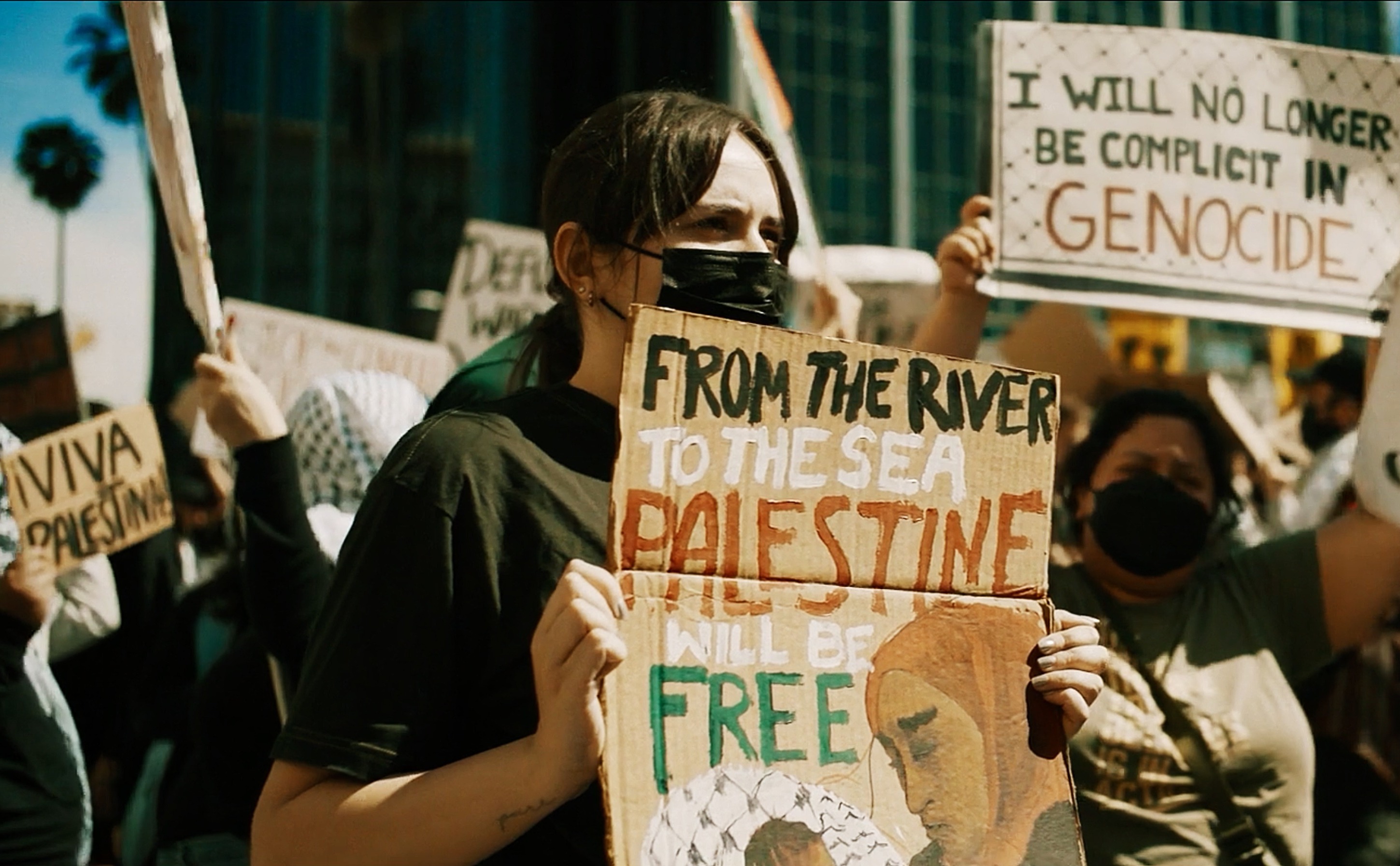
 One of the protests documented in Shoot the People. (Photo: Watermelon Pictures)
“What is unique about South Africa more so than many other places around the world is we’ve seen what change looks like through protest,” says documentary filmmaker Andy Mundy-Castle. “It’s like a living example, a living embodiment.”
Protest is at the centre of Mundy-Castle’s documentary Shoot the People, which follows photographer and activist Misan Harriman as he documents global campaigns for social change through his signature black-and-white portraiture. The film travels from movements like a pro-Palestine march in London to a memorial for George Floyd in Minneapolis, while also turning its lens to South Africa.
“South Africa is almost like a political hotbed for protest. It’s embedded into the fabric of the society and of the people,” Mundy-Castle says. “And I think it’s a very unique country in terms of how issues erupt… the pros, the cons, the strategy – the kind of process that’s needed for effective protest.
“I don’t think there’s anywhere in the world that rivals South Africa on that basis and shows what the potential of a positive outcome could be.”
Despite Mundy-Castle being British, he has a personal connection to South Africa that predates the film by decades. He describes frequently visiting South Africa as a young boy, which kindled in him an awareness of the country’s social and political fabric.
A memory he hasn’t forgotten was from his time living in Hout Bay, where a single highway becomes a class division of people.
“It’s a very visible and visceral idea of inequality,” he says. “A visual, living example of people being disenfranchised.”
As a filmmaker, Mundy-Castle sees documentary work as an act of custodianship.
“When you are documenting anything, be it protest or someone’s life, or something as delicate as human rights and social justice, the onus is always on shining a light on the people and the stories that are at the core and at the centre of that.”
That recognition of responsibility shaped not only how he worked with Harriman himself, but also how he approached documenting the protests, including those filmed in South Africa.
/file/attachments/orphans/mundy-castle-interview1_968092.jpg "Director of Shoot the People, Andy Mundy-Castle. (Photo: Watermelon Pictures)")
“When you’re trying to navigate such big themes and big political issues, you have to do that with some level of integrity and some level of care,” he explains. “Because [I’m] speaking about a nation, and a nation that’s not mine, so I have to respect that.”
The South African chapter of Shoot the People unfolds across two protests: a pro-Palestine march at the University of Johannesburg, and a demand for reparations for apartheid-era crimes led by senior citizens on the steps of the Constitutional Court in Braamfontein.
For Mundy-Castle, these events became an embodiment of just how deeply rooted protest is in the country. The resilience of the older activists outside the Constitutional Court, for example, “spoke to yesteryear”.
“They spoke to the culture of dance within protest, the culture of song within protest – how people choose to show up,” he says.
The student activists at the University of Johannesburg are then “the direct descendants of that community, and they are still showing up”.
Entrenched
“They didn’t need to choose to protest for a cause that isn’t their fight. But there is something that is obviously entrenched in the mind and the psyche of South African people that they know that the reason the country is functioning in the way that it is right now is because of protest. It’s because people stood up for something, and so I think that’s interesting for me to see how that’s passed on through the generations.”
This sense of lineage – of inheritance – is one that runs through the film, which ends with words from anti-apartheid photographer Peter Magubane, who is also one of Harriman’s inspirations.
“A struggle without documentation is no struggle at all,” Magubane’s words read before the film’s credits roll.
“You need to document these times so that people understand when they have the privileges and the rights that they do in the future that they have those rights and privileges because someone somewhere at some time fought for them,” Mundy-Castle says.
The archival footage woven into the documentary, he adds, is about a “handover from generation to generation”. In this way, the film itself becomes a part of that passing of the torch.
“What [has been] truly rewarding is also people being activated after they’ve seen the film, like they might feel the need to help someone less fortunate,” Mundy-Castle says of the film’s public reception.
“Somebody who wants to lend their voice to someone else who’s less fortunate than them is a real powerful act of kindness and love if it’s done with the right intention.
“It’s almost like an anointment to anyone who comes to the film – to hear that you’re not alone, you’ve never been alone in your search for this. It’s something that is a constant battleground.” DM
This interview has been edited and condensed for length and clarity. Shoot the People will air on Al Jazeera on 30 September.
Comments
Scroll down to load comments...