


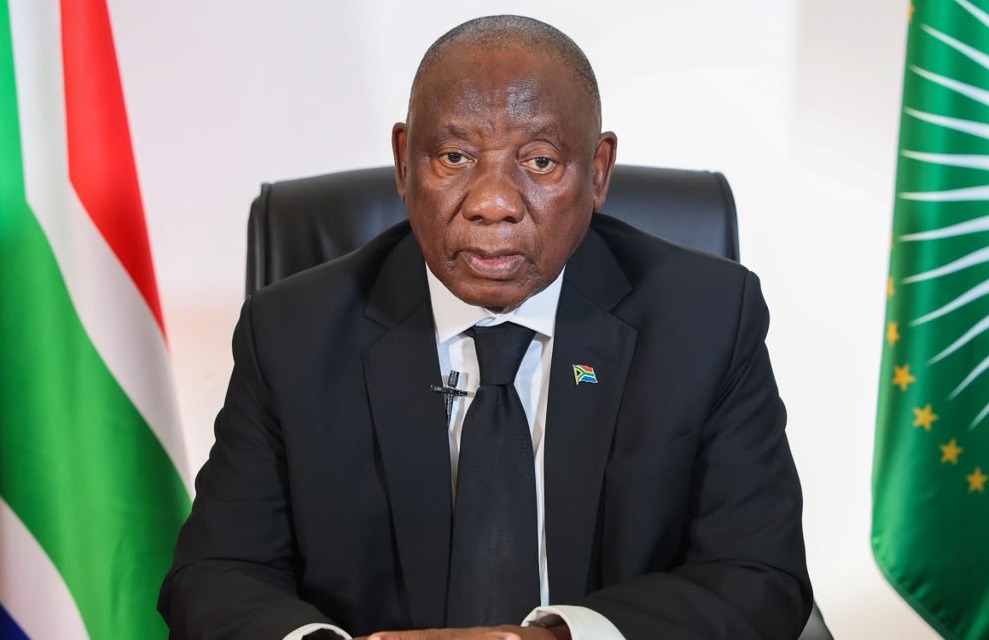
 President Cyril Ramaphosa at the virtual meeting of the AU’s C5 on Tuesday. (Photo: Jairus Mmutle/GCIS)
The African Union (AU) has decided that South Sudan should press ahead and hold its first democratic elections on 26 December, despite widespread fears that elections under present unfavourable conditions would lack credibility and could provoke further violence.
The AU’s C5 committee on South Sudan, chaired by President Cyril Ramaphosa, held a virtual meeting on Tuesday, 29 September, to review the country’s readiness for elections, which have been postponed five times since 2015. The other members of the committee are Algeria, Chad, Nigeria and Rwanda, but Ramaphosa was the only president of the C5 members present.
South Sudan’s President Salva Kiir also attended.
/file/dailymaverick/wp-content/uploads/simon-kiir-subbedm.jpg "South Sudan's President Kiir speaks during a news conference in Juba")
The deputy chairperson of the AU Commission, Selma Malika Haddadi, told the meeting that the South Sudan government had expressed its commitment to elections on 26 December “and it is important that the necessary momentum be maintained”.
Ramaphosa, however, said that the committee was “mindful of the many challenges and tremendous work that still lie ahead”.
He noted that the transition to democracy required more than just elections. It also required the creation of the conditions to make elections free, fair and credible.
“We urge the government of South Sudan to work with speed to resolve the challenges that remain,” he said.
The committee’s recommendations
To address those challenges, the committee recommended:
“That all parties comply fully with the provisions of the [2018] Revitalised Peace Agreement and demonstrate their commitment to its full implementation.
That all parties immediately cease hostilities, uphold the Permanent Ceasefire and refrain from unilateral measures that could undermine the Revitalised Peace Agreement.
That, while respecting the sovereignty of South Sudan and its judicial processes, the government of South Sudan release all persons arbitrarily detained on political grounds and guarantee the rights, humane treatment and due process of persons facing judicial proceedings, thereby contributing to an inclusive political environment.
That the government of South Sudan adopts a feasible, consensual and time-bound electoral roadmap that clearly sets out the legal basis, scope and sequencing of elections.
That the government of South Sudan provides predictable, adequate and timely domestic financial resources to the electoral and transitional institutions to enable credible preparations.
That the government of South Sudan works in earnest towards addressing the political, legal, technical, operational, financial and security requirements necessary for a peaceful, credible, inclusive and transparent electoral process.
That all parties protect civilians, humanitarian and medical personnel and United Nations peacekeepers; ensure safe, rapid and unimpeded humanitarian access to affected communities; and ensure accountability for attacks against peacekeepers and humanitarian personnel.
That the AU, C5 and Igad (the Inter-Governmental Authority on Development which represents regional governments) should coordinate voluntary and needs-based technical assistance in support of the electoral process and the implementation of the Revitalised Peace Agreement.”
As Ramaphosa’s statement indicated, one of the main obstacles to free, fair, credible elections is that President Kiir last year placed his arch-rival, First Vice-President Riek Machar, under house arrest. Several other political opponents are also in detention.
/file/dailymaverick/wp-content/uploads/south-sudan-rebel-leader-talks-terms.jpg "South Sudan's Vice President Riek Machar speaks during a news conference after meeting north Sudan's Vice President Ali Osman Mohamed Taha in Khartoum")
Fears of violence
Kiir has resisted several previous appeals by the AU to free Machar and other political prisoners, so he is unlikely to agree to do so now. That raises the real concern that Machar’s supporters could violently disrupt the elections.
Ramaphosa said the primary responsibility for implementation of the agreed measures lay with the government and parties of South Sudan. But he said the C5 countries and the AU would support South Sudan and he appealed to the international community to do so too.
Guyo Chepe Turi and Said Abdullahi, researchers at the Institute for Security Studies in Nairobi, wrote earlier this month that “credible elections are no longer possible in South Sudan” and recommended instead that “attention should shift to preserving the peace deal that underpins the current government and is key to averting large-scale violence”.
“Over the past year,” they wrote, “Kiir has undermined the accord’s power-sharing arrangement through unilateral cabinet dismissals, the replacement of opposition lawmakers, and delays in security sector reforms. Considering that the country’s transitional government is anchored on the agreement, abandoning it would dismantle the political settlement that ended the conflict in 2018.
“If Kiir pushes ahead with polls, the outcome will be an illegitimate political dispensation that deepens instability,” they concluded, noting that Machar’s forces had already joined forces with other opposition militia to attack state forces.
The researchers advised the AU to postpone elections until the right conditions to hold them had been created. But it seems the AU has decided to press ahead, hoping to help create those conditions in less than three months when they have not been achieved in the eight years since the Revitalised Peace Agreement was signed. DM
Comments
Scroll down to load comments...