


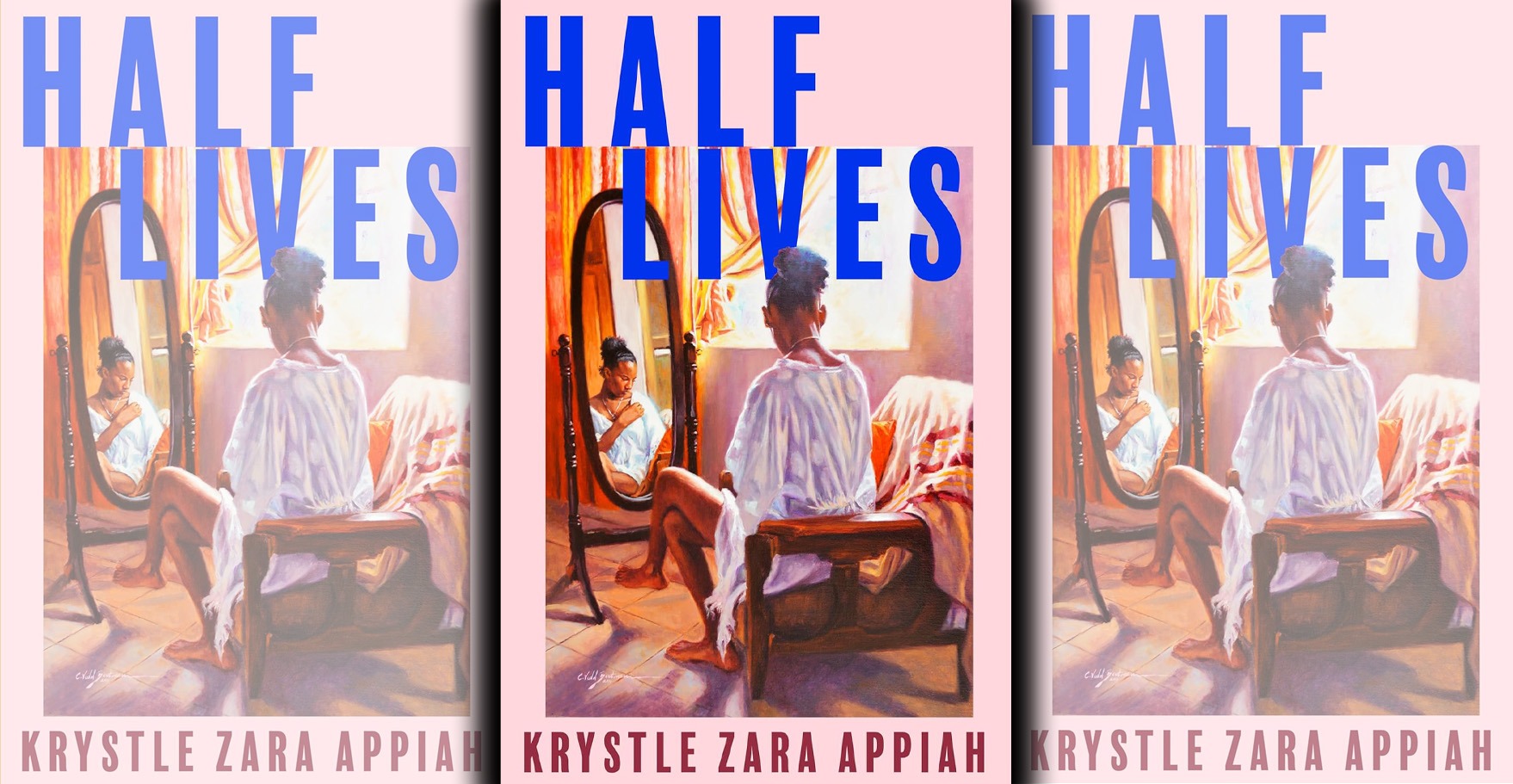
 Half Lives by Krystle Zara Appiah. (Photo: Harper Collins Publishers)
I almost didn’t pick up Krystle Zara Appiah’s Half Lives. Not because I had heard anything bad about it. Quite the opposite: several people whose reading I trust had recommended it.
But my work is related to gender-based violence, and there are times when I feel saturated by stories about intimate-partner violence. I wasn’t sure I wanted to spend my reading-time there too. But I am so very glad I picked it up. Half Lives is one of my highlights of the year so far.
The story begins in Ghana in the 1970s. Evelyn and her sister Maggie dream about boys, about getting married, about one day living a “big” life in America. Appiah takes us into Takoradi through its smells, colours, food and people. She is adept at making us experience place through the senses.
The food in Half Lives is extraordinary, not simply because of the descriptions, but because of what Appiah does with it. Food locates people in culture and community.
“Food is communal,” she tells me during a conversation at the Open Book Festival, and it becomes one of the ways she establishes the world of the novel: what people have access to, how they gather, what they remember and what changes when they move somewhere else.
The same is true of the sounds and textures of place: the feel of the air, the details of domestic life. Ghana is present on the page without the novel ever having to announce itself as a “book about Ghana”.
Then Evelyn marries a doctor and relocates to New York to set up home with him. Maggie is left behind, devastated and wanting a part of her sister’s new life. The sisters love each other, irritate each other, protect each other and betray each other. They carry different versions of the family story, and sometimes those versions collide.
Nuanced portrayal of migration
The novel’s treatment of migration is layered and nuanced. Evelyn and Maggie both look beyond Ghana towards the possibility of a different life. The Global North represents opportunity, a chance to build something new. But Appiah refuses to present migration as the uncomplicated solution to the limitations of life at home.
“There are opportunities there,” she tells me. “There’s a chance to better yourself, go to school, or to live in a different way. But it’s not without its flaws.” That tension matters. Ghana is not romanticised, and neither is the Global North. The novel allows both places to be complicated: home can be beautiful and constraining; while “elsewhere” can offer possibilities that demand enormous personal costs.
Half Lives is a novel about sisters, family secrets, motherhood, love and the complicated ways women survive the lives they find themselves in. It is also, in significant part, a novel about intimate-partner violence.
But Appiah writes about violence without making the violence itself the spectacle, and that was one of the things I appreciated most about the book. In conversation with Appiah, I tell her this.
“I didn’t want the book to be sensational or melodramatic,” she explains. “Violence is integral to the story. But it is not the whole story.” The book, she says, is also about a woman building a life.
That distinction matters, particularly when we have become so accustomed to representations of violence that the violence itself can become the story. Appiah doesn’t allow that to happen. She gives us enough to understand what Evelyn is experiencing without requiring us to sit inside the violence with her.
There is fear, isolation and the slow erosion of certainty, but there are also dreams, aspirations and the possibility of another life. Evelyn remains a person rather than becoming a vehicle for a story about violence.
There is a tendency, particularly in the language on women and gender-based violence, to celebrate women’s resilience without asking what it is that women are being required to be resilient against.
“We are pretty good at enduring,” Appiah tells me. “But just because we’re really good at enduring doesn’t mean we should have to.”
Half Lives understands that endurance can be a strength and a burden at the same time. Just because women have learned to keep going because they have had to, does not meant that they should have had to endure what they did.
That messiness is part of what makes Half Lives feel palpable.
Its women aren’t symbols of resilience or cautionary tales about bad choices. They are people who make decisions with imperfect information, who want things they shouldn’t want, who love people they shouldn’t love and who sometimes hurt each other while trying to work out how to live.
What I loved about Half Lives is that it kept catching me off guard. Every time I thought I knew where the book was going, something would shift. There are moments that feel almost thriller-like, although this is not a thriller.
Appiah understands that the reader doesn’t need to be told everything at once. The result is a novel that keeps creating those small moments of: Wait. What? DM
Joy Watson is Daily Maverick’s Book Editor-at-Large.
Comments
Scroll down to load comments...