


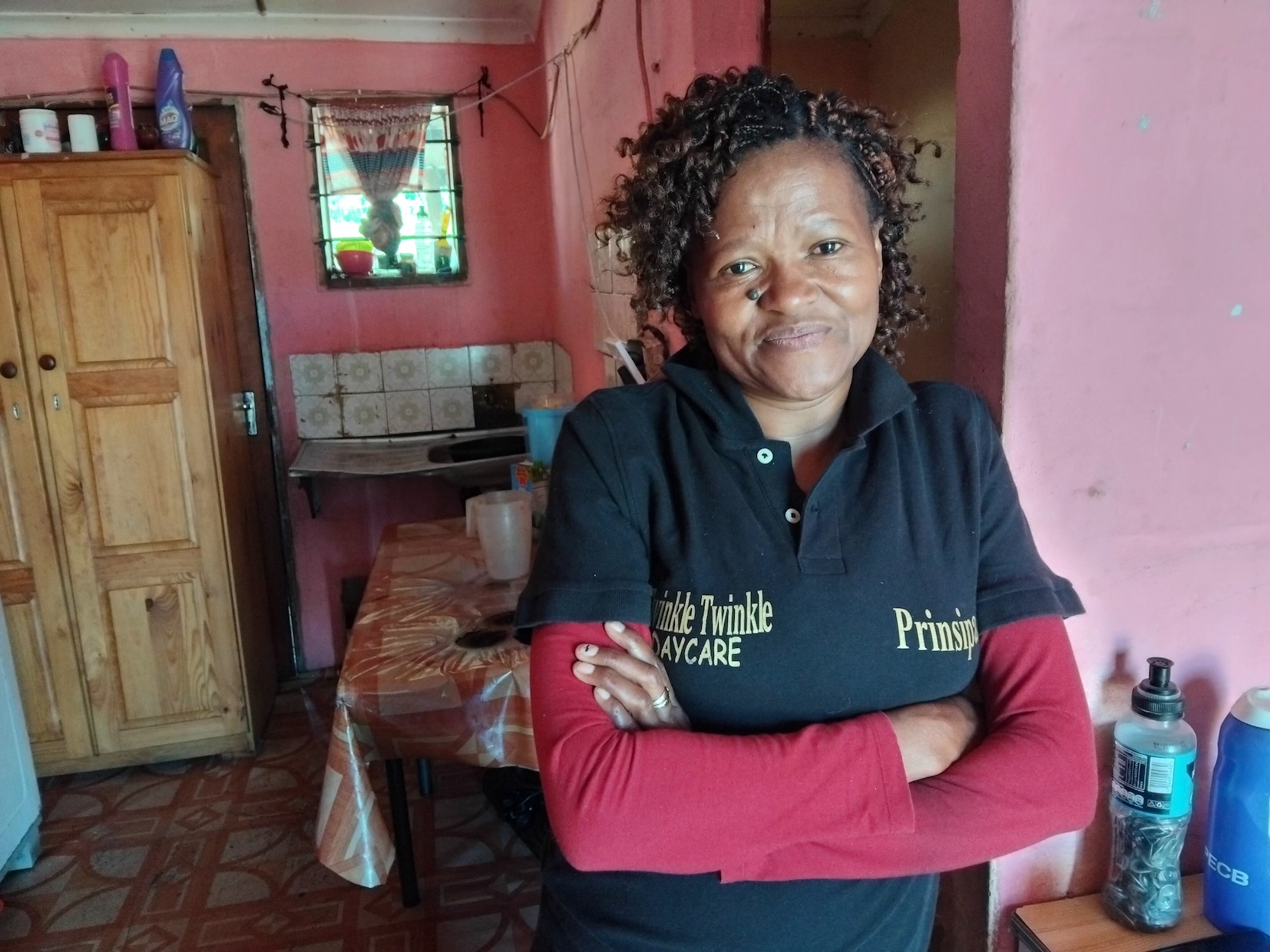
 Elize Berries, the principal of Twinkle Twinkle Daycare in Misgund, a farming settlement in the Eastern Cape’s Langkloof, says the lack of water means they have to store and refill bottles to flush the toilets. ‘When you open the taps there’s no water,’ she said. (Photo: Marecia Damons)
Residents of Misgund say they struggle with an unreliable water supply, with households only getting water for an hour or two a day and sometimes going for days without it.
Misgund is a small rural community in the Langkloof, Eastern Cape. The region is known for its apple, pear and peach farming. The settlement is home to about 500 households, mainly RDP homes, and due to its proximity to farms many residents are current or former farmworkers.
Residents say getting enough water to meet their basic needs has become a daily struggle since 2011.
At Twinkle Twinkle Daycare, staff store water in containers for the children and carry buckets to flush the toilets when the taps run dry.
Crèche owner and principal Elize Berries said they cater for children aged four months to five years old.
“Every day we get water for about one hour. Some months there isn’t water for several days. We’ve never had continuous running water,” said Berries.
Water is needed throughout the day for drinking, preparing food, washing hands and flushing the toilets, she said.
Taps have water from about 5pm to 7pm, and sometimes for two or three hours over weekends, she said.
“Sometimes it’s on during the day, but that’s a problem because people are at work so they cannot fill up their containers.”
She said the water has a brown colour and “does not taste good”.
“We can’t wash our white clothes with this water because there will be brown marks,” said Berries.
/file/attachments/2998/GroundUp-water-Misgundinset1_159399.jpeg)
When GroundUp visited the crèche, water drawn the previous night was murky, and all the taps we opened were empty.
At the crèche, tap water is used mainly for flushing toilets and mopping floors. For drinking and cooking, Berries relies on rainwater and water from a staff member’s tank. She buys five litres of water for R20 about four times a month when the stored supply runs out.
The water shortage adds yet another cost to a crèche that survives on thin margins. Though registered as a nonprofit, Berries said her applications for government funding have been unsuccessful. Parents pay R280 per child a month, covering rent, electricity, porridge and other costs. The crèche currently has 18 children, down from the roughly 40 it sees in peak farming season. Berries pays about R500 a month in rent and R300 for electricity.
“At the end of the day, I have the minimum,” she said.
/file/attachments/2998/GroundUp-water-Misgundinset2_511149.jpeg)
Living nearby is 69-year-old widow Litesia Kiewiets. She was born in Misgund and has always lived here. In 2011 she received an RDP house.
“When we moved in we had water and it was clean, but as the years went by things just became worse and worse,” she said.
Kiewiets collects rainwater in a tank and several containers and drums to use for cooking and drinking. She has to buy water if it has not rained and the tank is empty. When the taps have water she fills her bath to store water.
“We’re having a hard time here… The tap water is brown. When it rains, we catch the water in containers and store it so we can use it. That’s what we have that’s drinkable,” she said.
Kiewiets lives with her two daughters and four grandchildren. She relies on the older person’s grant of R2,400 and two of her grandchildren receive the child support grant of R580 each. She rents out draping for functions to supplement the household income.
/file/attachments/2998/GroundUp-water-Misgundinset3_140782.jpeg)
Sarah van Rooyen lives nearby with her husband and children.
“We are struggling. There are times when for two or three days there’s no water,” she said.
Van Rooyen said it has been this way since she moved to the area in 2011.
Her husband has a permanent job on a farm, and her daughter and three sons are seasonal farmworkers. Her youngest child, who attends school in George, receives a disability grant. When municipal water fails, her husband sometimes brings water home from work.
Residents have raised the problem with the municipality before, Van Rooyen said. “They know what’s going on here… You can go without food, but not without water.”
“Every time it’s elections, these people come and give empty promises about how the water issue is going to be fixed, so residents wait for that. But once you’ve voted and the elections are over, everyone is gone. We don’t see them again and we’re back in the same boat where we started.”
Kou-Kamma’s 2025/26 draft annual report states that 12,820 households across the municipality have an adequate water supply, while 873 fall below the minimum service level. It does not specify whether those households are in Misgund. The report acknowledges that unreliable supply affects poorer households most, since wealthier households and firms can install their own reservoirs, boreholes or recycling systems.
It attributes some of this to an uneven split of water between poor settlements and the agricultural sector.
The report also says non-revenue water (water lost before it reaches a paying customer) costs the municipality millions, partly because many poor households use more than the free six-kilolitre monthly allowance. Efforts to enforce its indigent and free basic services policy have had limited success, and “unrestricted water access continues”.
/file/attachments/2998/GroundUp-water-Misgundinset4_856256.jpeg)
What the water quality data shows
Data from the Department of Water and Sanitation’s regulatory dashboard shows that over the past 12 months, water tested in Misgund met acute health microbiological standards only 50% of the time. Acute health microbiological compliance measures whether drinking water contains faecal bacteria above a specified limit that can pose an immediate health risk.
Aesthetic compliance, which relates to the water’s colour, taste and odour, was 0%. Disinfectant compliance, which measures whether required disinfectant levels, including residual disinfectant in treated water, are maintained, was also 0%. Zero percent means the testing is not being done.
Operational compliance, which assesses how efficiently treatment systems are run and the risks to infrastructure, stood at 67.9%.
The Minimum Requirement Programme (MRP) measures whether the municipality carried out the number of water tests it was required to, with full compliance set at 100%. In Misgund, MRP compliance was 39.2%, meaning only that share of the required tests were actually conducted.
/file/attachments/2998/GroundUp-water-Misgundinset5map_745250.jpeg)
Drought, floods and shared resources
The municipality’s draft 2025/26 annual report described water scarcity as “a norm” in Kou-Kamma, particularly in the Langkloof. Heavy rainfall and flooding in May had damaged infrastructure but replenished raw water sources. The report noted that the situation is worsened by sharing resources with the surrounding farms.
To cope, it said, water is trucked daily to critical areas using two 12,000-litre tankers owned by Amatola Water and a 6,000-litre tanker owned by the Department of Cooperative Governance and Traditional Affairs, with residents collecting it.
In the foreword to the report, acting municipal manager Ntombikayise Mnyengeza acknowledged that residents have “borne the brunt of collapsing wastewater systems, unreliable water supply and deteriorating infrastructure”, and she said addressing this is “not optional; it is an urgent imperative”.
She said the municipality is prioritising infrastructure refurbishment for water purification and sanitation this financial year, working with provincial and national departments for technical and financial support, and will implement a detailed infrastructure recovery plan with clear timelines.
/file/attachments/2998/GroundUp-water-Misgundinset6_772318.jpeg)
Kou-Kamma’s own reporting suggests it has limited capacity to address the backlog. The report says the municipality has a “stagnant and low revenue base”, with a collection rate of 45%, well below the 95% norm. It attributes this partly to 31% of households being indigent. Indigent households include unemployed people and seasonal workers on low wages in agriculture, forestry and tourism.
The municipality’s limited revenue streams also make it reliant on national grants to expand housing and basic services. As a result, the report said, the municipality can only run a “reactive maintenance and servicing programme”, lacking an asset management plan or a proactive maintenance strategy.
The municipality says roughly R210-million is needed to upgrade and maintain water and sanitation infrastructure across Kou-Kamma. It lists ongoing challenges including health and safety concerns, a lack of access to basic water and sanitation services in some areas, constant sewer blockages from the small-bore (usually pipes with 5-10cm diameter) system, collapsing septic tanks and pollution of waterways and the environment.
/file/attachments/2998/GroundUp-water-Misgundinset7_563734.jpeg)
Misgund’s bulk water supply was upgraded with funding from the Regional Bulk Infrastructure Grant to address water shortages in the town. Kou-Kamma Municipality carried out the upgrade with Amatola Water as the implementing agent. The upgraded plant is intended to treat both groundwater and surface water and was handed over to the municipality in March 2026. The municipality’s annual report says the borehole water was tested and basic disinfection through manual chlorination was being done at the main reservoir.
We asked the municipality why residents continue to experience intermittent supply, the discoloured water, recent water-quality testing, emergency water provision, and the reasons for the short supply periods reported by residents. Several attempts to get their response went unanswered. It will be added when received. DM
First published by GroundUp.
Comments
Scroll down to load comments...