



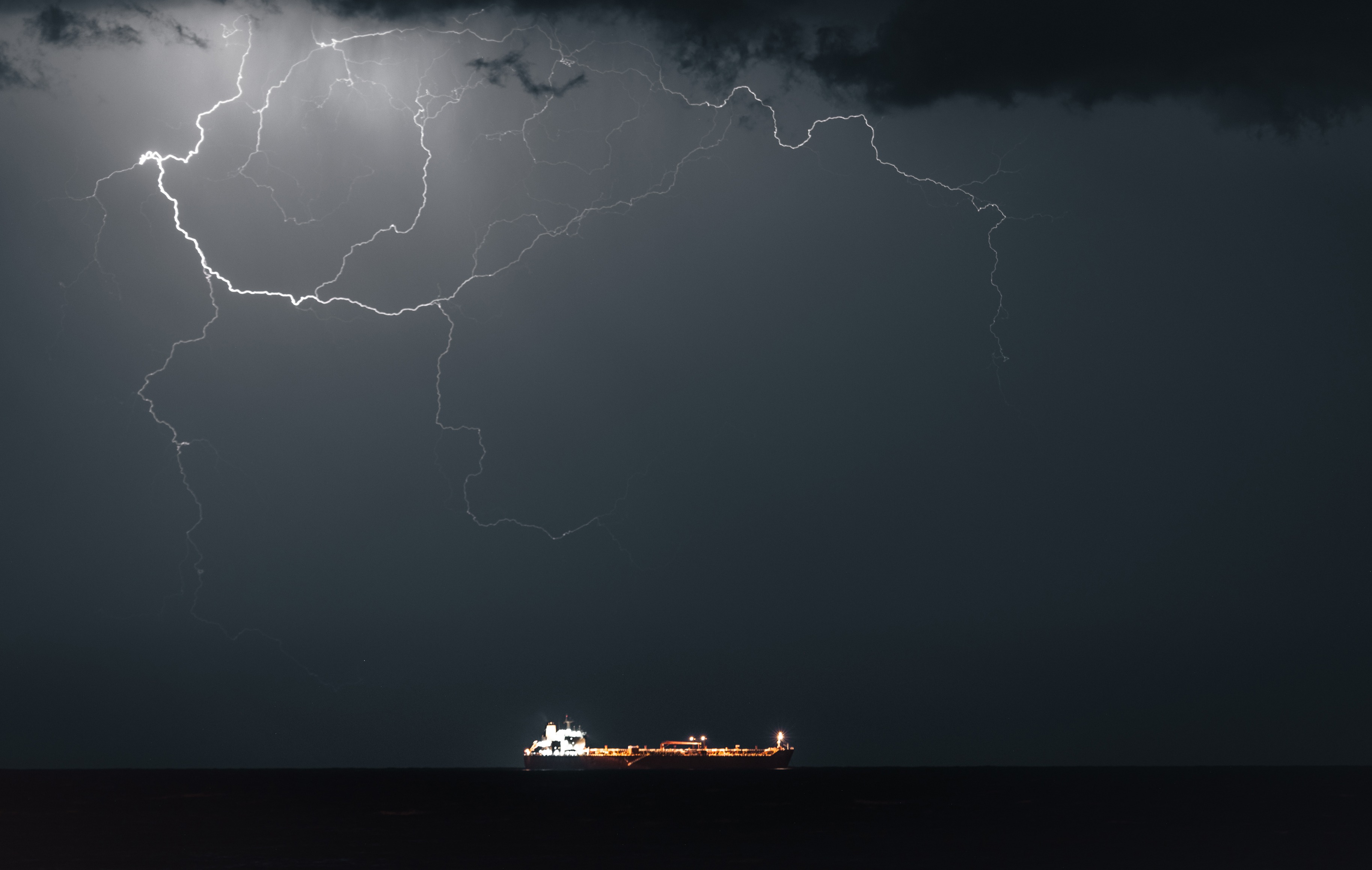
 Lightning occurs when META 4, an Oil Products Tanker, sails into Muscat Anchorage on March 21, 2026 at Sultan Qaboos Port in Muscat, Oman.President Donald Trump had threatened to attack Iran's energy infrastructure if it did not end its de facto blockade of the Strait of Hormuz by just before midnight GMT of March 23. A subsequent statement from President Trump said the U.S. and Iran had held "very good and productive conversations regarding a complete and total resolution of our hostilities in the Middle East," and that he would postpone any attacks on Iranian energy infrastructure for five days. Maritime traffic through the strait, which conveys about 20% of the world's oil and gas, has mostly come to a halt after the joint U.S.-Israeli war with Iran that began on February 28. (Photo: Elke Scholiers/Getty Images)
By Florence Tan and Jonathan Saul
The move followed the collapse of weekend talks between Washington and Tehran, prompting President Donald Trumpto say on Sunday the U.S. Navy would enforce a blockade targeting vessels entering and leaving Iranian ports, even as Washington stressed it would not restrict transit through the strait itself.
Trump's announcement effectively slowed oil tanker movements in the strait, with just two Iranian-linked tankers leaving the Gulf. In normal trading conditions, crude and products loaded from Iranian ports are typically headed for China, with India a recent buyer of Iranian crude.
The tanker Auroura is laden with Iranian oil products while the New Future vessel is carrying diesel loaded from the Hamriyah port in the United Arab Emirates and is heading to Sohar, Oman, Kpler and LSEG data showed. Both are medium-range tankers carrying about 330,000 barrels of oil.
U.S. Central Command said U.S. forces would begin implementing the blockade of all maritime traffic entering and exiting Iranian ports at 10 a.m. ET (1400 GMT) on Monday.
It would be "enforced impartially against vessels of all nations entering or departing Iranian ports and coastal areas, including all Iranian ports on the Arabian Gulf and Gulf of Oman," it said in a statement on X.
U.S. forces would not impede freedom of navigation for vessels transiting the Strait of Hormuz to and from non-Iranian ports, and additional information would be provided to commercial mariners through a formal notice prior to the start of the blockade, it said.
Iran's Revolutionary Guards said on Sunday that any military vessels attempting to approach the Strait of Hormuz would be considered a violation of the ceasefire and be dealt with harshly and decisively.
PAKISTANI TANKERS HEADED INTO GULF
Prior to Trump's announcement, Pakistan-flagged tankers Shalamar and Khairpur entered the Gulf on Sunday, data from LSEG and Kpler showed.
The Aframax tanker Shalamar is heading to the United Arab Emirates on Monday to load Das crude, the data showed, while the Panamax-sized Khairpur is heading to Kuwait to load refined products, according to the data.
Pakistan National Shipping, which manages Shalamar, did not immediately respond to a request for comment outside of office hours.
Liberia-flagged very large crude carrier (VLCC) Mombasa B, which also transited the strait earlier on Sunday, is sailing empty in the Gulf and heading to Basra, Iraq, according to the data.
Malta-flagged VLCC Agios Fanourios I, which attempted to enter the Gulf on Sunday to load Iraqi Basra crude for Vietnam, has since turned back and is anchored near the Gulf of Oman, the data showed. The tanker plans to head to Iraq.
Eastern Mediterranean Maritime, which manages Agios Fanourios I, did not respond to a request for comment.
CMB.TECH NV, listed in LSEG data as the manager of the Mombasa B said it no longer manages the ship. The current manager Sinokor did not immediately respond to a request for comment.
Despite the stalemate, three supertankers fully laden with oil passed through the Strait of Hormuz on Saturday, shipping data showed. They appeared to be the first vessels to exit the Gulf since the ceasefire deal was struck last week.
(Reporting by Florence Tan in Singapore, Jonathan Saul in London and Ariba Shaid in Islambad; Editing by Muralikumar Anantharaman and Louise Heavens)
Comments
Scroll down to load comments...