


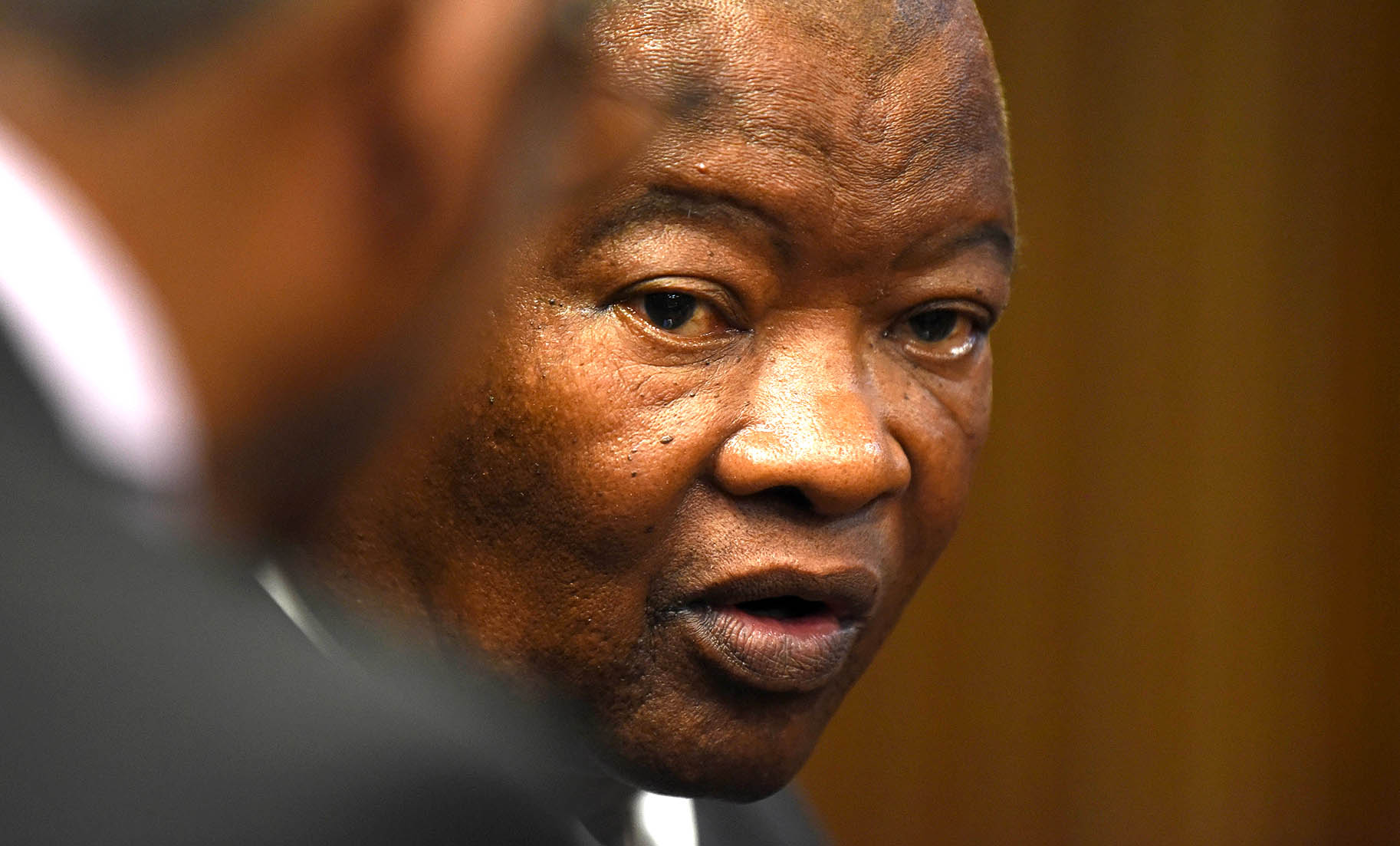
 Deputy Minister of Defence Bantu Holomisa took to the stand in the Gqeberha High Court on Tuesday, 14 October 2025 at the inquest into the murders of the Cradock Four. (Photo: Deon Ferreira)
While he had no personal knowledge about the plot to have the Cradock Four killed, Deputy Minister of Defence Bantu Holomisa was drawn into the case seven years after the fact when he was asked to arrange a clandestine meeting between a South African military official and former president Nelson Mandela.
/file/dailymaverick/wp-content/uploads/2025/10/DSC_1494-copy.jpg "Bantu Holomisa told the court he was handed a copy of the signal containing the orders that resulted in the arrests and deaths of anti-apartheid activists Fort Calata, Sicelo Mhlauli, Sparrow Mkonto and Matthew Goniwe in 1985. (Photo: Deon Ferreira)")
Colonel Lourens du Plessis had told Holomisa that he had sensitive information he needed to share with Mandela, including a half-page document in Afrikaans – a copy of the signal containing the orders that resulted in the arrests and deaths of anti-apartheid activists Fort Calata, Sicelo Mhlauli, Sparrow Mkonto and Matthew Goniwe in 1985.
During his testimony, Holomisa shed light on the apartheid government’s underhanded tactics to “manufacture conflict” in attempts to further its own agenda.
The court also heard that the much-anticipated testimony of former Vlakplaas commander Eugene de Kock would not proceed this week due to the 76-year-old suffering from ill health.
Holomisa and De Kock are testifying in the third inquest into the deaths of the Cradock Four. They were returning to Cradock from Gqeberha (then known as Port Elizabeth) on 27 June 1985 when they were arrested at a roadblock manned by members of the Security Branch, assaulted and murdered.
Read more: Matthew Goniwe was threatened with death by gun-wielding police officer, court hears
The first inquest, in 1987, concluded that the men had been killed by “unknown persons”, and a second inquest, in 1993, implicated several high-ranking police and military officials. No one was prosecuted.
Eight former police and SA Defence Force officials applied for amnesty before the Truth and Reconciliation Commission for their roles in the Cradock Four killings. They were:
- The “masterminds”: Hermanus Barend du Plessis, Nicolaas Jacobus Janse van Rensburg and Harold Snyman.
- Three of the killers on the scene: Johan Martin “Sakkie” van Zyl, Eric Alexander Taylor and Gerhardus Johannes Lotz.
- Two others who played peripheral roles: Jacob Jan Hendrick (Jaap) van Jaarsveld and Eugene de Kock.
/file/dailymaverick/wp-content/uploads/David-TRCfailures1.jpg "Former police colonel and apartheid assassin Eugene de Kock. (Photo: Leon Botha)")
All but Van Jaarsveld and De Kock were denied amnesty in 1999. Yet no further legal steps were taken.
On Tuesday, during his testimony in the Gqeberha High Court, Holomisa gave an account of his interactions with the apartheid government leadership after he took control of the former Transkei.
At the time, Holomisa was the head of the Transkei military and overthrew the ruling government. He said his actions were taken not out of ambition, but an attempt to restore dignity to the country that had suffered under a corrupt government.
He could no longer stand by and watch Transkei support the South African apartheid government, and under his leadership, they supported the ANC and South Africa’s liberation movement.
/file/dailymaverick/wp-content/uploads/2025/10/DSC_1497-copy.jpg "Holomisa survived an assassination attempt and a failed coup, which he said had been ‘sponsored by Pretoria’. (Photo: Deon Ferreira)")
Holomisa recalled a meeting in January 1990 with former president FW de Klerk, who called for the Transkei military government to be disbanded, and how a furious De Klerk left the meeting when Holomisa refused.
Later that year, Holomisa survived an assassination attempt and a failed coup, which he said was “sponsored by Pretoria”.
When asked why the SA government wanted him dead, Holomisa said De Klerk could not accept a black political leader giving him “the middle finger”.
While he knew Matthew Goniwe as a teacher and political activist in the 1980s, Holomisa had no in-depth knowledge about his murder until 1992, when he received a call from Colonel Du Plessis about “sensitive and deeply political” information.
At the time, Du Plessis was a liaison officer between the Transkei Defence Force and the South African Defence Force.
He wanted an audience with Mandela to discuss two matters – the destruction of his chicken store in Alice, allegedly by ANC allies, and the credible evidence that what was commonly referred to as “black-on-black violence” was in fact sponsored and directed by elements within the apartheid government.
As proof of his claims, he met Holomisa in Mthatha, where he gave him a copy of the “chilling” signal that stated Matthew Goniwe and others had to be “permanently removed from society”.
Holomisa and Du Plessis later met Mandela in Johannesburg, where the president instructed Holomisa to hold on to the damning document, which was later leaked to the press.
Holomisa said this was proof that the apartheid government was negotiating a transition with the ANC in bad faith and that the “black-on-black violence” between Xhosa and Zulu people, or the ANC and IFP, was not organic, but rather orchestrated chaos to destabilise politics.
He was asked to shed more light on attempts by the apartheid government to destabilise the old Transkei and Ciskei and referred to documents detailing plans from 1986 to assassinate former chief minister of Ciskei Lennox Sebe and other members of the Sebe family.
While these events were not directly relevant to the inquest, Holomisa said that it was important to note the language used in the plans and how it confirmed that the same organisations involved in these plans were also behind the plot to kill the Cradock Four.
He said terms such as “permanently remove”, “take out” or “make someone disappear” were recurring euphemisms for killing those in opposition to the government’s agenda.
Following his testimony, the court was told that De Kock, who was expected to give evidence this week, would be unable to attend proceedings.
While the full doctor’s report was not read out in court, it was mentioned that he suffered from “heart failure” and his doctor instructed that he rest for two to four weeks before undergoing a follow-up evaluation.
Only after a second visit to the doctor will it be made clear when De Kock will be able to testify and whether he will do so in person or virtually.
Legal representatives for former police and military officials implicated as “persons of interest” at previous inquiries said their clients would be prejudiced if asked to testify before De Kock gave testimony.
They argued that they needed insight into De Kock’s evidence to better prepare their own testimony should he implicate them further.
Judge Nomathamsanqa Beshe said it would not be in the interest of justice for proceedings to be delayed indefinitely, depending on De Kock’s health. She ordered that the people, should they be implicated by De Kock, would have the opportunity to return to court to respond to his testimony.
The matter was postponed until Wednesday for the State to make arrangements for its next witness. DM