



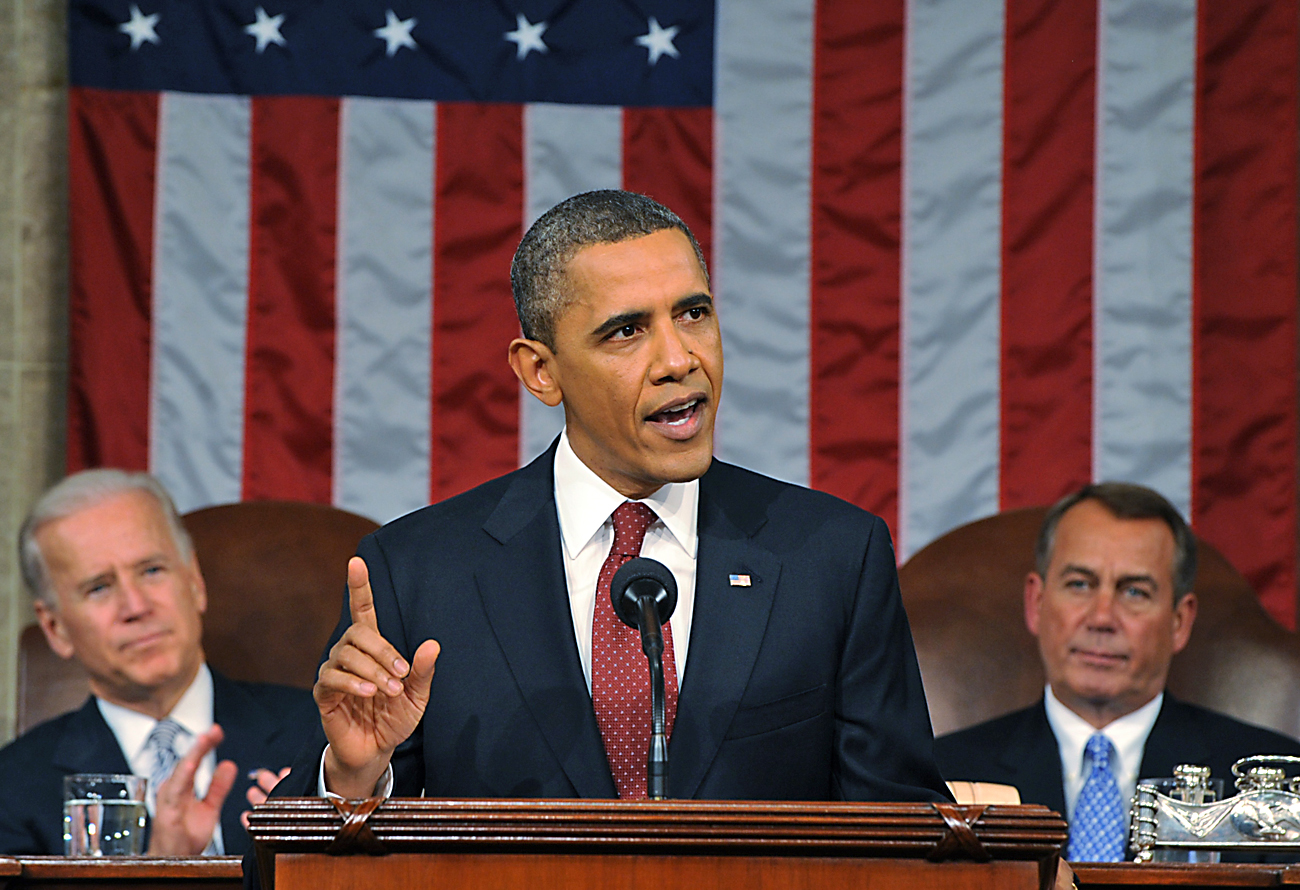
In his constitutionally mandated annual speech to Congress, Obama pledged to use the power of government to rebuild an economy into one that is “built to last” and to blunt the Republican argument that the country would benefit from less – rather than more - federal intervention.
Obama put his core economic principles up against those of his Republican rivals when the country is still in an economic trough. In the words of veteran of four different White House administrations, David Gergen, Obama has “doubled down” on his proposals and core positions rather than dialling back, to persuade Americans his proposed solutions are more in tune with the ideas of independent voters than much of the Republican platform, setting up a sharp debate for the election.
Obama argued ordinary Americans have the right to expect, if not a helping hand from their leaders, then at least a field in which everyone plays by the same set of rules. “You can call this class warfare all you want. Most Americans would call it common sense.” He insisted the choice facing the country is one between whether “a shrinking number of people do really well while a growing number of Americans barely get by” or his own vision — “where everyone gets a fair shot.” While he was at it, he also argued it was time to end oil industry tax credits, insisting that a century of gentle tax treatment had been long enough.
Despite his generally combative tone, Obama also reached back to his 2008 campaign motif that his positions are “not Democratic values or Republican values, but American values” presenting a long list of domestic economic proposals. Many of these focused on tweaks in the federal tax code, including limiting deductions for companies that move jobs overseas, rewarding companies that return jobs to the US and increasing taxes on those millionaires who pay less – as a percentage of income – than their secretaries. This last was graphically underscored by having Warren Buffett’s secretary, Debbie Bosanek, sitting in the audience for a now-obligatory visual “shout-out” during the speech. Billionaire Buffett had himself made this same point publicly about the rich and their income tax rates.
Although congressmen and senators, by and large, did not sit in bipartisan arrangements this year, as opposed to last year in honour of Gabrielle Giffords, the Arizona Democrat who was wounded in the Tucson shooting, Giffords attended the speech prior to her imminent resignation to concentrate on her recovery and the president embraced Giffords for a long 10 seconds as he came into the House.
This speech was largely aspirational, although some proposals can be carried out by executive action. Nonetheless, many of Obama’s proposals require Congressional approval – something unlikely to be achieved at a time when political partisanship and political gridlock have never been deeper. One obvious test case would be his call for the Senate to change its rules to give presidential nominations an up-or-down vote within 90 days. Don’t bet the farm on that one, or many of his other ideas, in an election year.
Taking it right to the Republicans, Obama’s income tax proposal had a particular charge to it. It has come less than a day after would-be nominee Mitt Romney had released his tax returns showing he and his wife paid their federal income tax at the rate of less than 14% and that their income placed them among the top one-10th of 1% of US taxpayers. Remember, this is an election year, right?
As Obama said, “Millions of Americans who work hard and play by the rules every day deserve a government and a financial system that does the same. It’s time to apply the same rules from top to bottom. No bailouts, no handouts and no copouts.”
The speech was largely about domestic economic affairs, in an interesting conjunction of domestic and foreign affairs, Obama said Congress should take half the savings from the Iraq war and use it to pay down the national debt, and use the other half to invest in innovative projects to rebuild the country.
Indiana governor Mitch Daniels gave the now-traditional opposition party’s rejoinder and argued it had been congressional Republicans who had acted to improve the economy, only to be thwarted by that man in the White House. “It’s not fair and it’s not true for the president to attack Republicans in Congress as obstacles on these questions. They and they alone have passed bills to reduce borrowing, reform entitlements and encourage new job creation, only to be shot down nearly time and again by the president and his Democrat Senate allies.” Republicans, watching and listening to Daniels must now be ruing the fact that Daniels took a pass on this year’s fight for the nomination. Daniels looked and sounded presidential, in contrast to Newt Gingrich’s anger and grandiosity or Romney’s rich man’s above-the-crowd noblesse oblige.
The US constitution gives only the barest outline of the requirements for what has become a key part of every president’s calendar. In Article II, Section 3 it reads “He shall from time to time give to the Congress Information of the State of the Union, and recommend to their Consideration such Measures as he shall judge necessary and expedient….” That’s it, eccentric capitalisation and all. Thirty-one words and what became an annual message.
In an age of 24/7, electronic political commentary, the SOTU speech has become an annual rite of passage and the supreme moment of American pomp and ceremony, except, perhaps for the quadrennial inauguration of the president. In the Capitol’s House of Representative are assembled virtually the full membership of both the Senate and the House, all of the cabinet save for one previously selected member (should everyone else in the line of succession suddenly die), members of the Supreme Court, the Washington diplomatic corps and a few select guests of Congress and the White House.
This is one of those moments of American public life where nothing else is going to compete – all of the major broadcast TV and cable news networks cover it live, many radio stations broadcast it and cyber-media carry the full text which was already on South African blogs and websites before 4:00 today.
In the 19th century, presidents departed from George Washington’s initial practice of delivering his speech in person, choosing instead to convey their thinking to Congress in printed form – at great length. However, in 1913, Woodrow Wilson reverted to the practice of personally delivering his presidential words and that became standard practice thereafter.
Since Ronald Reagan’s time, presidents have made a routine out of adding a couple of “shout outs” to people seated in the gallery overlooking the chamber floor, often sitting next to the First Lady. Early on, such memorable moments included Reagan’s recognition of passing motorist Lenny Skutnik who had literally jumped into the Potomac River from his car during a swirling snowstorm, to rescue passengers from an airplane that had just crashed into a bridge after takeoff, or other notable civic leaders and military heroes over the years. This year, of course, it was Warren Buffett’s secretary who got the spotlight.
While these speeches are important civic moments, generally they are not filled with the kinds of detail the president will include in the annual budget speech that comes two or three weeks later. There, the emphasis is on the details and numbers to give Congress a heads-up on what the president will propose in budgetary and tax change submissions and that Congress then gets to bicker over for the rest of the year. Unlike parliamentary democracies, the president cannot simply count on his budget requests being passed for the simple reason there is no guarantee Congress has to go along with the president’s budget – even if his party has majorities in both houses of Congress.
This year the Republican politicians who would be that party’s candidate for president have been attacking each other with unusual fury over how best to reignite the country’s economic growth and manage the government’s spending and taxing powers. Obama and his administration have generally stood back a bit from this squabbling so far. But now they are joined.
Within the Republican Party itself, this has, rather unexpectedly, become a debate about the propriety of becoming wealthy via leveraged buyouts, the role of Wall Street in generating increasing economic inequality – and Mitt Romney’s place in all this. Moreover, Romney’s critics on the right have taken aim at his relatively meagre tax burden as expressed in percentage terms against John Q Public’s much higher marginal rates, by virtue of the fact that most of his income comes from investments rather than salaries.
Now Obama has had to lay out his ideas with the best ceremonial fanfares a republican government can produce. And so Obama’s advisors and supporters have already been busy the past several days in setting out the logical contents of this year’s State of the Union speech.
Reading the tea leaves from the Republican struggle so far, and bringing that together with the Obama administration’s natural inclinations, supporters who were busy giving advance peeks of Obama’s main points had already been telling their media interlocutors Obama’s speech would fasten on to the issues of lowering unemployment, creating new jobs, good jobs, jobs for the future, and high tech jobs that won’t get exported to Chengdu next year and greater tax equity for the rich and poor. And so he did.
This task is simple – to keep the Republicans pulling each other’s hair and creating enough of a gap between Obama and those Republicans in the minds of voters that Obama starts to look more and more like the inevitable choice to thinking people of both parties. The only fly in that ointment, of course, is that a Republican-dominated Congress will be rather less likely to make it easy for Obama to make these ideas tangible. As such, Obama’s likely choice now would be to make his campaign about a do-nothing congress that thwarts the public’s will. Harry Truman is already nodding from beyond the pale. DM

For more, read:
- Obama Speech Makes Pitch for Economic Fairness in The New York Times;
- A G.O.P. Counterweight to Obama, but So Far Just in Speech Response in the New York Times;
- 2012 President’s State of the Union Speech in Enhanced Livestreaming from the White House.
Photo: Reuters.