
PayPal co-founder Peter Thiel invests in radical science innovation

The Republicans are anti-science. That’s hardly a secret. With the US facing a staggering deficit and the recession rolling on, science funding in the States is in decline, while venture capital investments into technology moves to later stages. Bad news for emerging science and technology innovations deemed radical or risky. But billionaire investor and philanthropist Peter Thiel has come to the rescue with an early stage fund that invests in garage science and tech start-ups both in and outside America. By MANDY DE WAAL.

It’s been ten years since George Bush first coined the phrase “War on Terror”, naming his administration’s frenzy to begin a war that would not end until “every terrorist group of global reach has been found, stopped and defeated”. War is an expensive business and the war on terror cost Americans between $3.2 and $4 trillion according to a non-partisan report called “The Costs of War”.

Where will all that money come from? In the past, the US financed wars by selling bonds or through increased taxes, but the war on terror was different. It was financed by borrowing, and the US chalked up a monster deficit in the process. Unsurprisingly the 2012 federal budget was notable for its cut backs, and science wasn’t spared. With government and grants makers under pressure, risky scientific research has been a casualty. Programmes that haven’t met with Obama’s objective “to out-innovate, out-educate and out-build the rest of the world” have fallen off lab tables.

As science research in the US (the UK, Japan and too many other parts of the world) faces an age of austerity, the research community should thank people like Peter Thiel. One of Forbes’ top 400 richest people, Thiel’s got cash to burn and isn’t averse to risk. Thiel invested $500,000 in a little social networking start-up called Facebook in 2004 which hasn’t done that shabbily. In 2010 that investment was calculated to be worth $1,7 billion. Thiel also made good dosh from starting up Confinity, the company that created PayPal.
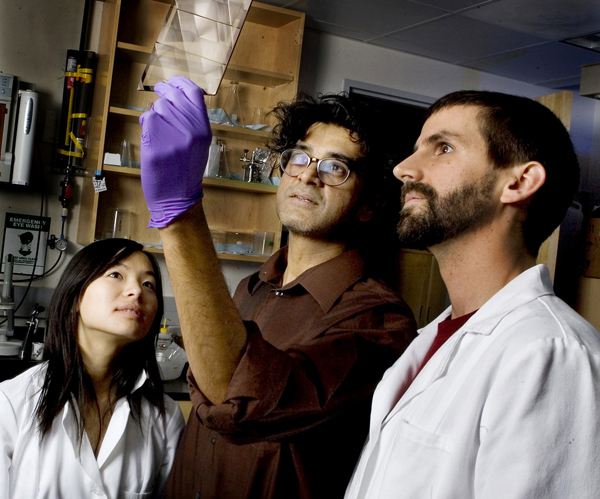
Students in a science lab at the UC Davis College of Engineering

There are a couple of other things you should know about Thiel. Firstly he’s not your common or garden variety big bucks investor. He does things differently. In September 2010, he ticked off deans at Ivy League colleges across America when he invited 20 people under the age of 20 to quit university and start a business with $100,000 from his foundation instead.

Secondly, it would be an understatement to say that Thiel’s fond of science. In his essay called “The End of the Future” for National Review, Thiel says that modern Western civilisation stands on the twin plinths of science and technology. And to the PayPal founder, these twins are the saviours that will drag the US out of its economic despair.

“We need science and technology to dig us out of our deep economic and financial hole, even though most of us cannot separate science from superstition or technology from magic. In our hearts and minds, we know that desperate optimism will not save us,” Thiel writes in his essay, taking what can only be a dig at Republicans who have a hate-hate relationship with science. They hate to spend on science because they hate science which debunks so much of what Republicans fervently believe in.

But Thiel has sharp words for Democrats too. “Most of our political leaders are not engineers or scientists and do not listen to engineers or scientists. Today a letter from Einstein would get lost in the White House mail room… I am not aware of a single political leader in the US, either Democrat or Republican, who would cut health-care spending in order to free up money for biotechnology research — or, more generally, who would make serious cuts to the welfare state in order to free up serious money for major engineering projects,” Thiel writes.

Fresh from incentivising smart graduates to quit college, Thiel is putting big money into “radical” science with Breakout Labs in a bid to push for more rapid innovation in science and technology. “Breakout Labs was conceived in response to both an opportunity and a need,” says Lindy Fishburne, co-creator of Breakout Labs in an email interview with Daily Maverick. “Thanks to advances in technology (for example, the plummeting cost of genome sequencing) and the increasing availability of scientific tools and resources (for example, the rise of laboratory incubators like Genspace and QB3 and contract research organisations (CROs) for outsourcing of specialised procedures), independent scientists and early stage companies have unprecedented opportunities to drive scientific innovation and to take risks that may be unpalatable to larger institutions.”

“The funding available for this kind of entrepreneurial science has always been scarce and is increasingly so in a world of shrinking basic science funding and investors turning to later and later stage research.  We want to drive innovation by addressing this funding gap,” she says.

With science funding under pressure, grants are going to programmes that guarantee success while venture capital funding is moving to later stages where start-ups are established and more commercially viable. "Venture capital firms look for research that can be brought to market within five to seven years, and major funders like the National Institutes of Health have a low tolerance for radical ideas,”  Fishburne says. "At Breakout Labs, we're looking for ideas that are too ahead of their time for traditional funding sources, but represent the first step toward something that, if successful, would be ground-breaking."

Breakout Labs is looking for research that is independent, entrepreneurial and at an early stage. Here the labs say they’d even look at funding before proof of concept, as long as the work accelerates innovation.

With research tools becoming increasingly more affordable, Breakout Labs believes that entrepreneurial science is on the cusp of an explosion, and the early-stage investors want to offer funds that range from $50,000 to $350,000 to enable visionaries who could change the world.

Watch: Peter Thiel speaking at the 2011 Singularity Summit 2011:

“We are prepared for the risk that many of the projects we support will fail,” says Fishburne. “But, there are plenty of funders and investors that will support me-too science and technology.  Just look at the never ending variations on internet companies and the stream of minor drug variants from big pharma. Radical innovation and revolutionary science has paved the way to the modern world."

“Humanity did not always know that the earth revolves around the sun, that atomic physics reached beyond Newton's laws into quantum mechanics, that microbes cause disease, that we inherit traits through DNA that RNA is more than just a passive protein template.  Each one of these advances and countless more were met with resistance before being heralded as revolutionary and opening the way to technological progress,” she says.

A revolving fund in return for investment, Breakout Labs guarantees must agree to return a modest percentage of gains made through warrants or royalty streams. This provides revenue for the investment in future innovation, however grantees are under no obligation if their research fails to reach ultimate profitability.

“The response has been very gratifying. In the first two weeks of operation, we have received 30 full proposals and 40 pre-proposal enquiries, plus several more informal queries about our potential interest in specific topic areas,” says Fishburne. “Proposals range from biosensors and nanofabrication of biomolecules to artificial intelligence and space debris management.”

The good news for local scientists and technologists who’ve conceived innovative projects or radical research is that Breakout Labs is receiving applications from outside the States, and welcomes them with open arms. DM



Read more:

Main photo: Peter Thiel. Photos courtesy of UC Davis College of Engineering

Monday 21 November, 2011
 
Top Stories

You must be logged in to leave a comment. Please login or sign up.
Republicans seem to be against *federal* funding of science. Not against state or private sector funding. Which is where funding for R&D should come from
Is such a blatantly biased, false and crude generalisation about "Republicans" really necessary?

At FreedomFest 2011, which I attended, the audience consisted largely of Republicans and third-party libertarians. There was hardly a Democrat in sight. Peter Thiel, whom you celebrate for his investment in science, was a star keynote speaker on Austrian economics to this supposedly anti-science audience.

As Joel Basson rightly says, many Republicans oppose public spending on anything, including science, but strongly support private investment in science and technology. It reveals a clear political bias to describe what is really a public/private distinction as "anti-science".

It is true that the political right includes religious conservatives, some of whom might arguably be described as "anti-science", or at least "selectively unscientific", because of their disbelief in evolution and belief in divine miracles. But then, the left includes a great number of crystal-healing organic-eating aura-reading homeopathy-believing astrology flakes. By your standards, that makes Democrats "anti-science" too.

A little less lazy generalisation and overt partisanship would be welcome.
I agree that it's dangerous to generalise, but I would like to offer some arguments in mitigation, the first from New York Times's Paul Krugman (op ed) http://www.nytimes.com/2011/08/29/opinion/republicans-against-science.html?_r=3

"Jon Huntsman Jr., a former Utah governor and ambassador to China, isn’t a serious contender for the Republican presidential nomination. And that’s too bad, because Mr. Hunstman has been willing to say the unsayable about the G.O.P. — namely, that it is becoming the “anti-science party.” This is an enormously important development. And it should terrify us."

The rest of this excellent article paints a dismal picture of the Reps.

Next: My skeptical favourite Phil Plait writes at Bad Astronomy on Discover Magazine (http://blogs.discovermagazine.com/badastronomy/2011/08/29/the-increasingly-antiscience-republican-candidates/):

"... Each candidate on the right is simply scrambling to be even more antiscience than the next.

"Of course, if that "next" is Rick Perry, then I doubt anyone could sprint away from reality more than he does. He’s a dyed-in-the-wool creationist who apparently has no problem narrowing or stepping well over the line with separation of Church and State, and when it comes to denying climate change he also apparently had no problem with simply making things up (Krugman calls his statements "vile", and the Washington Post blog The Fact Checker rated his claims as "whoppers"). Perry’s stance on other big issues is similar.

"And he’s far and away the front runner, which leaves me shaking my head.

"Where Michele Bachmann and Rick Santorum stand is obvious. Newt Gingrich — who claims he’s a fan of science — equivocates when it comes to Intelligent Design and evolution as well as global warming, and was instrumental in defunding the House Office of Technology Assessment in 1995.

"Even the candidates people are calling "moderate" are falling over themselves to appease the base when it comes to science and the lack thereof. Mitt Romney tried to eat his cake and have it too about accepting evolution, and even Ron Paul has now distanced himself from evolution.

"Which brings up Jon Huntsman, which is where things get truly maddening. He recently said he thinks both evolution and global warming are real. This makes me sad, and scared. Why? Because this statement is considered bold..."

And there's more (with appropriate links). So perhaps this is a generalisation, but it is based clearly on a trend that is becoming ever more apparent - and something to be concerned about - in the current political landscape of the USA.

Agreed, there are "flakes" at all levels of the political spectrum, but I wonder how many crystal-healing, aura-reading homeopathic advocates would make it into positions of leadership and influence to compare with Perry? I haven't researched the personal beliefs of the Democrat front-runners, but I would be interested to see some specific examples.

As a caveat, I think what *is* of some concern is some of the left-wing hystericals, who decry anything that is not "natural", such as GM foods, nuclear power and vaccinations. These people would probably vote Dem. in a two-horse race, but do they represent the "ture heart" of the party? I think not.
Oops - that should have been "true heart".
Well-said, Ivo.

I am annoyed by the way in which "science" is fed into the political machine gun on both sides, and I find it even more annoying when the media takes a partisan line on it.

Bad science is particularly dangerous political ammo, because it's much more expensive to debunk than religious doctrine, but it has the capacity to be just as catastrophic. This is why it's little comfort to me when one party takes "science" under its wing, while the other clings to ordinary religion.

I think the only safe generalization we can make is that all politics is anti-science, or at least, unscientific: and this practically by definition.
Ivo

With respect Joel Basson is a pro-Bush; pro-Republican spin bot so your borrowing his ‘argument’ to raise a defence against what you find distasteful in this piece is in itself lazy and flawed given that Basson’s thinking on all matters Republican and Bush are crude, biased, partisan and false.

You then go on to offer one anecdote to support your view? How is that evidence Ivo? Seriously I expect something a little more from someone of your intellectual capacity.

I know that the Republicans have fallen in love with Ayn Rand and libertarianism – but Ivo, that’s not enough reason to lose objectivity or your capacity for critical thought.

But let’s deal with the matter of those Republicans and science shall we?
I refer you to Chris Mooney’s book “The Republican War on Science” which contains ample evidence that strongly supports the Republican onslaught on science, Bush being the number one culprit in this regard. Mooney cites evidence of a co-ordinated Republican war against science with evidence gleaned across government and from virtually every arena of public policy. The book (which albeit clunky from a writing perspective; is incredibly well researched and indexed) details damning evidence of powerful conservative Christians in America (Republicans) who have perverted objective truth for their own political, ideological and commercial self-interest. This has included suppressing or distorting scientific debate on evolution, climate change, biodiversity, contraception, drug abuse, air and water pollution, missile defence, reproduction health, abortion, stem cells, sexual conduct and a plethora of other issues that threaten Christian dogma. Bush in particular politicised science by putting Christian ideology above objectifiable truth with damning consequences.

Here’s an example of the common practice in the Oval Office under Bush. In 2004 the Republican government evicted eminent cell biologist Elizabeth Blackburn (a proponent of embryonic stem-cell research) from the President's Council on Bioethics. The replaced her with a pro-Christian political scientist who declared: "Every embryo for research is someone's blood relative."

Two years earlier that same administration appointed Kentucky gynaecologist/obstetrician W. David Hager to the Reproductive Health Drugs Advisory Committee of the Food and Drug Administration. Hager denounced birth control pill and advocated treating premenstrual syndrome with Bible readings.

Let’s not even begin talking about federally financed "junk science" and government sponsored scientists who toed a party political line to avoid punishment, exile or financial sanction.
And what about the Union of Concerned Scientists who in 2004 issued a report “Scientific Integrity in Policymaking: An Investigation into the Bush Administration's Misuse of Science” which charged: "A growing number of scientists, policy makers, and technical specialists both inside and outside the government allege that the current Bush administration has suppressed or distorted the scientific analyses of federal agencies to bring these results in line with administration policy. In addition, these experts contend that irregularities in the appointment of scientific advisors and advisory panels are threatening to upset the legally mandated balance of these bodies."

Or the February 2004 petition signed by over 9,000 scientists (49 of them Nobel laureates and 63 National Medal of Science recipients) that stated: "When scientific knowledge has been found to be in conflict with its political goals, the administration has often manipulated the process through which science enters into its decisions. This has been done by placing people who are professionally unqualified or who have clear conflicts of interest in official posts and on scientific advisory committees; by disbanding existing advisory committees; by censoring and suppressing reports by the government’s own scientists; and by simply not seeking independent scientific advice. Other administrations have, on occasion, engaged in such practices, but not so systematically nor on so wide a front. Furthermore, in advocating policies that are not scientifically sound, the administration has sometimes misrepresented scientific knowledge and misled the public about the implications of its policies."

Or Dr. Richard Carmona, the first surgeon general appointed by President George W. Bush who publicly accused the administration in July 2007 of political interference and said: "Anything that doesn't fit into the political appointees' ideological, theological or political agenda is often ignored, marginalized or simply buried,"

There is ample and irrefutable evidence that the war the Republicans have waged has been to replace rational science with conservative religious ideology, particularly in those areas where science has proved a threat to religious dogma. The book also cites numerous examples under the Bush administration where science conflicted with business, and where the Bush administration used its political might to supress that science that would undermine Christian capitalist profits.

But Bush isn’t the only Republican bad guy, when it comes to the matter of the perversion of science in favour of Christianity and crony capitalism; let’s not forget Ronald Reagan and his push for “Star Wars”; his doubt of evolution; and his attempt to manipulate views on abortion.

I could carry on forever Ivo… but you get the point. Don’t defend the indefensible just because those Republicans have embraced Ayn Rand, libertarianism and some of the ideologies that are important to you. That doesn’t make them the good guys when it comes to science. The facts speak for themselves.
You confuse the religious right with "Republicans". The GOP is a big tent that includes them, but is not limited to them. It also includes fiscal conservatives and foreign policy hawks in equal measure, and a smattering of libertarians who don't consider a third party (the Libertarian Party) to be politically feasible. You appear to have a problem with Christians, not Republicans in general.

As for perverting science for their own vested interests, I could level the same allegation against climate change alarmists, and those, like Al Gore, who have hundreds of millions of dollars vested in a scientific "consensus" (a profoundly anti-scientific concept) that funnels subsidies to their special interests and promotes regulatory restrictions to curb competitors.

Scientific disagreement does not constitute being "anti-science". In fact, it is part of the scientific process.

As for my "anecdote", a large conference which offered a broad sample of both libertarians and Republicans strikes me as a useful place to observe the varied character (and sometimes surprising intellectual depth) of the political right. When last did you spend any time with thousands of Republicans and libertarians to discuss matters of economics, politics, philosophy and indeed science with them for several days?

Libertarians, far from being Republican (or vice versa), are typically opposed to BOTH political parties. For example, libertarians are strongly in favour of drug legalisation, and against interventionist war. In this, they clash severely with powerful interests in the Republican Party.

Conversely, claiming Republicans are all libertarians is just as false a generalisation as claiming that they are all creationists. For that matter, not all libertarians are Randian objectivists, which is another distinction you seem incapable of drawing.

At best, some libertarians view the GOP as the lesser of two evils on some matters of political significance, like smaller government and free trade. Most distrust the Republican mainstream's commitment even to those tenets, however, and oppose the crony capitalism of the military-industrial complex. All libertarians -- even Christian ones -- strongly oppose the moral conservativism that characterises a part of the GOP, yet they ally with the GOP when it makes political sense to do so.

As a libertarian, I too oppose the GOP on many issues, so caricaturing me as a defender of Republicans is just as false as caricaturing all Republicans as anti-science.

Simplistic caricatures don't make for astute analysis.
Actually, I'm pro-Libertarian. I'm only pro-Republican in as far as some of their ideals overlap (Small government, etc)
I am however against articles that are barely concealed love fests of the Democratic party, and especially so when when the said article is gushing about some or other aspect of socialism. Which doesn't match the Daily Mavericks stated "unashamedly capitalistic" nature. I'm not saying that is the case this time round, but it is often the reason for my criticism of some pro-Democrat articles
It's no secret that The Daily Maverick is not the place to read about American politics and that many of its writers do themselves no favours writing on such subject. One may as well peruse the New York Times from whence Maverick writers get their argument and get the opinions at their true source.
Repubs love military research surely? I vaguely recall reading that about 80% of US Fed research (by value) has military applications.
Makes sense. How else are you going to spread all that freedom and/from Democracy without the latest weapons?