
As the numbers still come in, a message is beginning to emerge. It’s not exactly loud and clear yet, it could still shift slightly as final results return, but it is a message the ANC needs to heed carefully. By a politically intoxicated STEPHEN GROOTES.
It’s a heady time for politics addicts. An election results centre is always going to be slightly intoxicating. It’s hugely tempting to jump straight into things, to form what turn out to be short-lived unions, to even swap ideas with people you normally wouldn’t touch with a barge pole.
South African politics is following a slightly Zimbabwean pattern. Don’t be alarmed, it’s just one of those laws of politics that happens. It’s that in South Africa, as in Zimbabwe before, the more rural areas are staying loyal to the liberation party for longer. The urban, denser areas, are first to be shifting to the DA. There are several reasons for this. The one is the poorer you are or the more you suffered under apartheid, the longer you are likely to remain loyal to the party that freed you. It’s also a function of your daily life. You make decisions based on the information available to your community. You speak to people who live around you, and that’s where the local ANC branch plays a bigger role. It’s about what’s really happening on the ground; about equating the ANC with government itself.
If you live in a city, the information available to you is more likely to be channelled through the media (no silly comments please) than through your community. You are more likely to be aware of contestation between parties, whereas in more rural areas, the contestation tends to happen within the ANC.
So, if the urban areas shift first, what next?
The first big question that needs to be asked is: Has the DA, and Helen Zille, managed to shift the debate from “liberation” and “history” to “service delivery”? It’s not just up to her, it’s also about the “post-colonial experience”. More and more people don’t see apartheid as the defining experience of their lives, and so they don’t vote accordingly. It’s also because these results tell us, that so far, those who’ve voted once for the DA, vote for them again. They like life under the DA. It’s also about the total incompetence of the ANC in opposition, but that’s a comedy for another time. The fact the DA has tightened its grip on Western Cape means it feels safe there, and can concentrate on other areas. It now has a launch pad. And that could matter.
The converse is true for the ANC. In the Nelson Mandela Bay Municipality (Port Elizabeth), for example, Cope was largely responsible for the ANC’s loss of support in 2009. Those voters have not gone back to the ANC, rather they’ve either just stopped voting, or plumped for the DA.
So if it is about service delivery, what does that mean for the ANC in general and President Jacob Zuma in particular?
First off, it increases the pressure on the ANC in several ways. It now can’t continue to make such mistakes in governance. Contracts can’t continue to be handled so badly. It will not be able to continue wasting our money. It will finally have to acknowledge that the word “infrastructure” actually exists. Which can't be bad.
But more interestingly, it now has to develop its capability to improve service delivery. This should be easy, it has experience in government. The fact is, it won’t be easy. For this to work, the ANC has to be able to make hard and fast policy decisions. The structure of the party works against this. There’s just no way.
For a start, its national executive committee is made up of a massive 80 people. That’s insane. It’s a sure way to design a five-humped camel. Its “streamlined” version, the national working committee has 20, give or take. That’s hardly going to work either. In the DA at the moment, we get the impression big decisions are made by three people. It shows. But the other problem is that no matter who is leading the ANC, they have too many factions to buy off and too many debts to pay. And when it comes to hard policy, making decisions that won’t piss anyone off and make you long-term enemies is hard. Particularly when the party is not nearly as disciplined as it used to be. The temptation to just take on any leader who pushes through an unpopular, albeit necessary policy decision will be huge. Look at what’s happened to Zuma’s plans to stop political officer bearers working for councils. He proposed it simply so the ANC could actually run a council, and Samwu is playing hardball over it. Now he’s dithering over whether to sign it at all. The message from the electorate in this election is that he must sign it and hang the political cost to himself.
Then there’s the issue of deployment. It’s not working. It’s making governance tougher for the ANC. But it’s too effective a patronage machine for any leader to stop. Which means more chaos, more Transnet, more SABC over time. The electorate clearly doesn’t want it to continue that way either.
Then we have the Malema factor. This is a conundrum for the ANC. The defining moment of the entire campaign was his soundbite at the FNB Stadium Rally last week, “The DA is for whites, it is not for you”. That made sure mlungus voted. But he was also the most popular leader there by a country mile, if the cheers were any judge. So Zuma, or anyone else, can’t take action against someone like Malema. And he’ll use any move by Zuma and Mantashe to implement policy decisions against them.
There is a bigger question to ask here. The ANC has stuck together through the incredible glue of power. That power is still massive, don’t make any mistake about that. But if that power wanes, at all, how strong is that glue? Does it weaken at the same pace as the ANC, in which case it hasn’t really lost any adhesion. Or does it weaken more quickly. If so, is it an unravelling or a slower harder process? These are hard questions to which, quite frankly, the answer is not known yet. But very clever people will be working within the ANC to find solutions.
There is a shorter-term prediction we feel we can make. Sicelo Shiceka is a political goner. Zuma is going to have to make this look like someone else’s fault, and he’ll be the fall guy. Someone has to pay the price and Zuma will not. But as always in our politics, predicting even the medium-term future is a mug’s game. But then again, it is intoxicating. DM
Grootes is an EWN reporter.
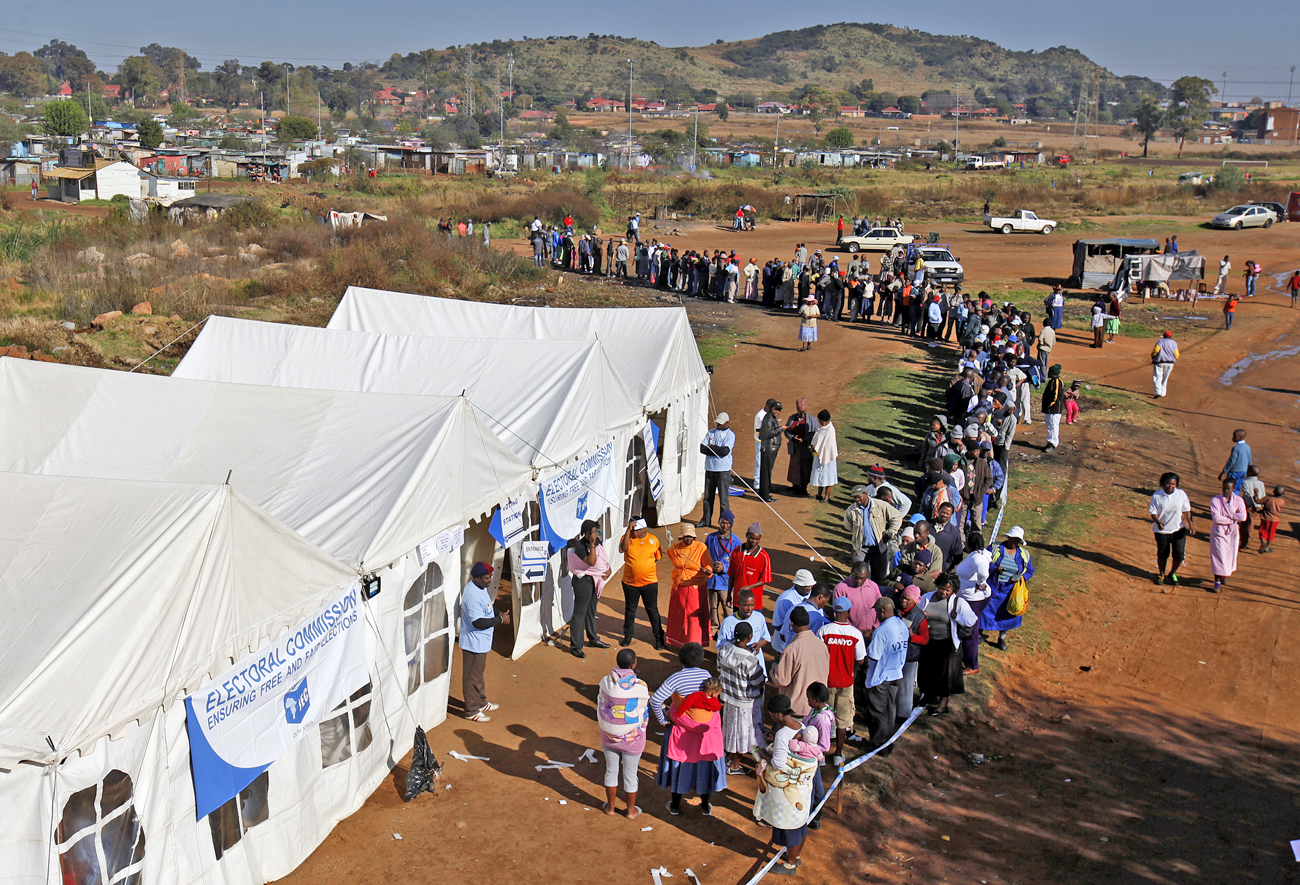
Photo: People queue to cast their votes during the South African municipal elections in Soweto May 18, 2011. REUTERS/Siphiwe Sibeko


Seemingly monolithic structures like the old Nats and the current ANC suffer from hidden fault lines along which they frequently fracture. Whereas I could see no bsaic difference between COPE and the ANC I do believe that COSATU and the SACP could coalesce into a another grouping siren calling to the poor. Malema would be part of this.
ANC heads will roll, a few scapegoats will be found, whereas their real salvation would be to crush corruption, stop the plunder and perform.
Will not happen of course, the gravy culture is too widespread and ingrained so will continue and accelerate.
If they cannot stop it they will have to pass some draconian press rules to stop the news from getting out to what is obviously an increasingly disillusioned voting population.
The people in the loser provinces such as Limpopo and Mplumalanga get what they deserve - a government as corrupt and uncaring as it was four years ago when they voted for it.
And before anyone leaps up and says that the ordinary voter wouln't know the difference if it jumped out and bit them - think again. SA's majority is highly politically conscientised, and understands the issues, even if it can't express them in these terms.
The failing of the ANC are clear for everyone to see - and the cadre deployment system is certainly highly problematic. The real problem is that all political parties essentially "deploy" PR candidates (and, indeed, mayors), so the perception that the ANC is the only party that does this is open to debate.
Finally, as for the ANC's arrogance - yeah, it's definitely an issue but, then, in my experience, the DA is no different ...
I would say that the party that unashamedly names its mayoral candidates BEFORE the election is more democratic than the one who foists their choices on the electorate afterwards to share the loot as any mafia does.
Perhaps it's time we considered the need for a more accountable form of people-centred democracy that allows for direct citizen oversight of public representatives, rather than simply making a mark on a ballot paper once every five years and then handing over the keys of government to political parties.
In all cases the the DA announced its mayoral candidates and if the electorate didn't like them it could choose to vote for someone else on the PR ballot (no choice in the case of the ANC).
The best way is to elect our representatives, give them a mandate for a few years and re-elect them if they perform or chuck them out if they do not. This is what happened in the Western Cape and Midvaal.
Suffice it to say, direct democracy has worked very successfully in the world's most stable democracy, Switzerland, for 700 years. At local level, it's being implemented equally as successfully in many countries around the world, including Finland, Brazil and Argentina.
In fact, Stephen Friedman, one of SA's most respected political analysts, has said that SA is lagging behind in terms of learning from these developments in other countries.
This all works wonderfully for the Swiss. They like it. I loved it for the time I was there. However you have to be Swiss to live with it in the long term. Won't work here, we are too fractious and economically unequal (hence our need to deliver services).
Haven't been to Argentina or Brazil yet, but their democracies are very young and have had a bumpy ride. Argentina have theirs thanks to Margaret Thatcher giving Galtieri a bloody nose and thus fatally weakening a military dictatorship.
Where democracy works, officialdom is accountable to the electorate not the other way round as the ANC seems to think. Democracy flourishes and prosperity follows where essential services are provided by and within the means of the electorate. Unpaid for handouts only result in dependency.
I don't crow about new DA municipalities. Their mayors and officials are going to have to make very hard choices. Choices the ANC failed to make and hence they are out because the majority of the electorate saw through their mendacity and cushy cronyism. If those decisions are not made by the new DA administrations the electorate are entitled to chuck them out. They have 5 years.
Secondly, citizens can't propose legislation or initiate a process that may result in draft legislation, something which would certainly allow for a deepening of democracy. And, finally, draft legislation is often presented as a fait accompli after initial implementation has already begun, and this leaves citizens in a very weak position if they wish to oppose it. The introduction of open-road tolling in Gauteng is one example.
Has it ever occured to you that maybe some people do believe in the ANC and that the ANC DOES deliver services to the people. But of course you wouldn't be hearing any of it on this. Focuses too much on the DA.
Has it ever occurred to YOU that perhaps the opposition (who have proven themselves BOTH in opposition and government) might after all this time deserve a chance to EARN your vote a second time? Bah! Question withdrawn. You don't want to hear any of this.
- The Braamfontein Precinct/Joburg Theatre project (in conjunction with corporate partners like Sappi and Liberty);
- Constitution Hill (in conjucntion with Blue IQ);
- Mandela Bridge;
- The Newtown development project;
- Social housing, parks and public facilities in places like Pennyville;
- The construction of Soccer City (obviously as part of a large consortium);
- A major upgrade to Orlando Stadium;
- The development of the Orlando West Regional Park (a City Parks project);
- The development of the Vilakazi Street precinct as a tourist hub;
- The construction of the Hector Peterson memorial;
- Improvements to the Joburg Market;
- Development of the Walter Sisulu Square in Kliptown;
- Development of Gandhi Square in the inner city;
- Construction of such primary healthcare clinics as Green Village Clinic and Sinqobile Clinic;
- Development of the Orland West Women's Hostel;
- Construction of the new Soweto Theatre (currently underway);
- Development of the Arthur Ashe Tennis centre in Jabavu; and
- Development of the Liliesleaf Farm in Rivonia (again, in partnership with others).
The ANC has made its mistakes, sure, but let's give credit where credit is due ...
Of course, the whole question about whether local government should be politicised at all is another debate entirely.
Firstly the cost of these projects, the benefit of these projects, and then consider what was not done that could have been done in their stead, and what benefits these other unrealised projects could have brought in comparison to what was actually done.
Secondly, did these projects you listed bring as much benefit as they could have done if undertaken without the ANC's crony-capitalist political patronage model? The ANC tendency to hand government contracts to underqualified, inexperienced contractors who because of their political patronage can overcharge and underperform without much risk of consequences is wasteful not just in terms of value for money, but also in the durability of the project and probably in terms of the social or economic value and suitability of the project too - if a politician has a crony who will build a stadium and give him a cut, the politician is likely to look very hard for a stadium to build...
As for the "crony-caplitalist political patronage model", I don't see how public/private partnerships with respected companies like Sappi and Liberty is a problem. I feel almost sure that a DA administration would work with big business in the same way. And it's probably worth pointing out that, until the last audit (2009 financial year), Joburg was only one of four municipalities in the country that obtained a completely clean audit (and yes, CT was another one - the others were district municpalities).
"...the ANC DOES deliver services to the people." Of course they do, it is unavoidable that they would deliver services of some sort, but the term "services" can be as loosely defined as you like - if your garbage was collected once a year, it would still be a service. The question is are the delivered services sufficient relative to a community's needs and the government's means? From everything that I have seen and heard, the answer has to be no.
Why then do the believers still believe after 17 years of steadily increasing disappointment? I'm sure there are people who are "gullible, illiterate and stupid" (and not just blacks and not just ANC supporters), but I think the two main factors are loyalty and fear - loyalty to the liberation party, and fear of a "white" party. Both are understandable reasons in the context of SA's political history, but a reason is not the same thing as an excuse...
By the way, the focus is as much on the ANC as on the DA, and the DA gets the attention because they are the only major opposition. It's like a vegetarian complaining that a discussion on food has too much focus on meat...
Read this: http://www.citypress.co.za/SouthAfrica/News/Service-delivery-failure-a-myth-survey-20110122
It appears that the majorities' vote is not really an exercise in democracy, but rather a pavlovian response to the election process. It seems that the "politically conscientized" majority are less versed in democratic process but rather they exhibit "Stockholm syndrome" like symptoms. They continue to vote for a party which breaks promises, supports corruption, avoids legal obligations and ensures that their office bearers are allowed to keep their snouts firmly in the trough. All the while living in poverty blah blah blah… need I continue?
Ultimately, you get the government you deserve.
Also, can we sincerely call a system which allows no public participation in the selection of candidates for election and absolutely no direct citizen oversight of either the processes of government or public representatives a democracy? If it is essentially controlled by small party elites, whether they're ANC or DA elites, doesn't that make it an oligarchy rather than a democracy?
Perhaps, as voters who refuse to see the implications of this (no matter where our personal political affiliations might lie), we are indeed getting the essentially unaccountable government we deserve ...
Re democracy: government by the people; a form of government in which the power is vested in the people and exercised directly by them or their elected representatives. Re oligarchy: a form of government in which all power is vested in a few persons or in a dominant class or clique; no free elections.
As for the definition of an oligarchy, Collins defines it simply as "government by a small group of people". And, when defining decisions are being made by small party elites, I'd argue that's actually the form of government we currently have.
Many forms of government masquerade as "democracies" and we need to be vigilant that it isn't a term which is used to hide a multitude of sins. Zimbabwe is a "democracy", for instance; and even the apartheid government claimed to be a "democracy" although the franchise only extended to white people.
And regarding democracy and the democratic process, it is implicit that elections are free and fair. If elections are not free, the voter does not exercise free will and consequently the integrity of the process is compromised. Zimbabwe is certainly not a democracy - for instance, if I call myself a giraffe, it does mean I am a giraffe.
You are right - that the idea of democracy has evolved - in Athens, where the idea came about, the franchise was limited to adult male citizens only. Modern idea of democracy would certainly include free fair elections and universal franchise.
More importantly, the political power of South Africa's people, as in Zimbabwe, is mediated exclusively through political parties, which leaves the system vulnerable to abuse.
The point I'm trying to make, I guess, is that the word "democracy" can be used to hide a multitude of sins, so we need to be constantly alert to whether our systems of governance are, in fact democractic. If civil society isn't alert to the inherent flaws in our system of governance, it's not beyond the realm of possibility that it could go the way that the Zimbabwean system has gone, and become a democracy in name only.
1. The DA as the official party running the country.
2. The Afrikaner broederhond as the office opposition party which may have coalitions with the DA in some municipalities.
3. Afriforum as the Human Rights Commission.
Did i get it right?
I'd like to see a ruling party that is not corrupt, nepotistic or authoritarian yes, the DA. In addition, I think that the ANC would make a very good opposition.
Oh my the power of 23.8% anybody who waxes lyrical because of such a percentage was desperate to begin with. Some reality please this percetage averages to 1.4% per annumb over the past 17 years at this rate it will take them the next 20 years to reach 51%. A wiser person would surely make a differet bet. However we are in a democratic country and everyone has a democratic right to be unwise.
In my opinion, were are very quick to cede all control of our lives to government in this country. Government should evolve as a result of community initiatives, that is, people appointing a government to drive their aims and desires. For as long as we continue to see government as initiator, driver and controller, no amount of voting is going to bring any of us a better life. The idea of government that we have seems to suggest we are incapable of running our own lives.
The reason our so called government is not accountable to the electorate, is because the electorate appoints them to rule, and not govern!
First of all, South Africa under ANC is not a democracy. It's monocracy or more accurately dictatorship of the majority. For democracy one needs to have all five legs of the democratic system: universal vote, parliament, independant judiciary, free press and lastly an ability to throw out the ruling party when it cocks it up. the last leg is missing in SA and as long as we don't have party duality (like all western democracies) than we don't have democracy.
I wish people STOP calling SA democracy.
On the question of local government election. It reminds me of a USA Governor who lost his election. He said "the people have spoken, the BASTARDS."
Don't forget that people who vote ANC in year after year are uneducated imbeciles, save for a few, in Lenin's term, "useful idiots" whites from Radio 702 and some shining examples in this forum.
Sounds a little like the fascist proclamation "we get things done" i.e through concentrating power . I think this is a spurious, badly phrased way of saying the internal ANC fracture has been debilitating.
"First off, it increases the pressure on the ANC in several ways. It now can’t continue to make such mistakes in governance. Contracts can’t continue to be handled so badly. It will not be able to continue wasting our money. It will finally have to acknowledge that the word “infrastructure” actually exists. Which can't be bad....But more interestingly, it now has to develop its capability to improve service delivery."
Actually, the word 'infrastructure' is bandied around all over government, (among other buzzwords). I also think your use of 'governance' here is implied to mean facilitating 'efficient' ("wasting our money") business: i.e a focus on eliminating corrupt tender practices and essentially giving the poor more things, better.
Besides being a narrow reading of government's relationship to the public (actual and normative), I see little here to suggest that the DA is somehow better positioned to represent the poor in an inclusive way (Hangberg showed otherwise). This is not to suggest that the ANC is doing fine (or acceptable). However I do not see anything to indicate that the DA is capable or inclined to transcend the ANC's paternal relationship to the poor, or that it is presenting a challenge to do so.
The very fact that the agreements were made means the community was included in the planning, although Helen Zille probably did not oversee the signing of each contract.
When the poor demand land, it is not always available in the right places. The reason so many shanty towns flood in wet weather is because they lie in unsuitable areas where there is no water run-off. Identifying the correct open spaces to build without moving communities vast distances is not always easy.
Forced, immediate movement by police should be avoided. Space for temporary despatch must be identified first and help given to move people and belongings.
Although I have used examples that apply to the DA, the ANC is implicated in many similar projects countrywide.