The metropolitan area of Tshwane has been redrawn and, incorporating two former separate municipalities, now forms the world’s third largest “city”. Citydex’s PAUL BERKOWITZ analyses the vast mishmash of new boundaries to gaze into the future of what this gigantic complex of wards may look like post-Wednesday.
The DA currently runs the legislative capital of the country, Cape Town, and has been talking up its chances of winning another capital, the administrative one of Tshwane. This Tshwane, to misquote a famous anti-drug campaign, is not your father’s Tshwane. It is a bigger and more complex municipality than the city of 2006.
The former district municipality of Metsweding and its two district municipalities, Nokeng tsa Taemane [Cullinan] and Kungwini [Bronkhorstspruit], are now part of Tshwane. The new Tshwane is the third-largest city in the world now, after New York and Tokyo. In 2006 Tshwane had 76 wards, but when its citizens, old and new, go to the polls on Wednesday they will do so in 105 wards.
The increase in the number of wards is partly due to the incorporation of Metsweding and partly due to new wards being created in the old Tshwane. Population and household growth in the metros are among the highest in the country, and new wards are split off from old ones as the population of registered voters grows. Each of the wards in the new Tshwane has a registered voters’ roll of about 12,000.
Seats by party in 2006
There were 96 wards between the three municipalities in 2006 and there will be 105 after Wednesday. There will be a total of 209 or 210 councillors in the new municipality, compared to 191 across the three municipalities before.
The wards seats are essentially a two-horse race. The ANC won 67 to the DA’s 29 in 2006. There were a handful of wards in 2006 where independent candidates made a solid showing without seriously threatening the winning candidates – for example, receiving about 1,000 votes to the ANC or DA’s 3 000.
The distribution of PR seats was more diverse. The ANC held 46 seats in 2006 to the DA’s 26. The FF+ had nine, the ACDP five, the PAC three, and the African-Christian Alliance, Azapo, Christian Democratic Party, ID, IFP, and UCDP each held one seat.
New and old wards
The growth in the number of wards is complicated by a comprehensive redrawing of ward boundaries in the former Metsweding area. The six wards of Nokeng tsa Taemane have been collapsed into four-and-a-half wards, and the 14 wards of Kungwini have been collapsed into five-and-a-half wards (the other halves in both cases are located in the “old” Tshwane).
The redrawing of the ward boundaries in Nokeng tsa Taemane favours the ANC. The two wards won by the DA in this municipality, former wards 2 and 4, are now parts of wards 99 and 100. These wards are much bigger and include the ANC strongholds of former wards 1, 3 and 6.
In Kungwini, it is a mixed bag. The DA won wards 1, 2 and 14 in 2006. Ward 1, a potential swing ward, is now part of ward 91 and includes a piece of ward 47 from the old Tshwane. This ward was a DA stronghold and the new ward should be won by the DA. Ward 2, a strong DA ward, has been amalgamated with Ward 3, a strong ANC ward, to form Ward 101. This ward should be closely contested. Ward 14 is a potential swing ward and this has been broken into two and combined with wards where the ANC has been strong historically. On the other hand, former wards 8 to 13, all ANC strongholds, have been collapsed from six wards into just two (wards 103 and 104), so the ANC is effectively losing up to four wards through the process.
In Tshwane, most of the redrawing of ward boundaries is due to registered voter population growth, and the results are again a mixed bag:
Parts of wards 13 and 14 have been combined to form Ward 95. Parts of wards 37 and 39 have become wards 89 and 90. Part of Ward 48 is now Ward 77. All of these old wards were ANC strongholds in 2006. This will obviously favour the ANC.
Parts of wards 57, 64 and 69 are now Ward 78. Parts of wards 42, 45, 47 and 65 are now Ward 79. Parts of wards 41, 43, 52 and 53 are now Ward 84. Parts of wards 5 and 59 are now Ward 96. These were all DA strongholds, except for wards 43 and 59, which were won by the DA with a narrow margin. These developments should favour the DA. In addition, the old Ward 73, an ANC stronghold, has disappeared.
Predictions and assumptions
Tshwane is a very difficult municipality to call, as evidenced by the extensive changes described above. We’ll have a go at it anyway. We base our predictions on a number of assumptions and observed trends:
The race for the metro will continue to narrow to a two-horse race. Based on the poor showing of the smaller parties (ACDP, FF+, ID, IFP, PAC, UDM) in 2009, power will be consolidated by the ANC and DA.
The DA, having lost a big chunk of votes to Cope in 2009 will recover most of these voters. The ANC’s voting numbers will grow modestly. Cope’s presence in 2009 didn’t appear to affect the ANC.
There will be few surprises. The new wards (some of them described above) will be won by the incumbent parties. The DA may pick up a handful of swing wards formerly held by the ANC (as many as five). DM
Based on the above assumptions, we predict the composition of the new Tshwane council of 209 seats will look something like this:
ANC: 116 seats (56%)
DA: 72 seats (34%)
Cope: 7 seats (3%)
FF+: 5 seats (2%)
ACDP: 3 seats (1%)
Indies: 2 seats (1%)
PAC: 2 seats (1%)
ID / IFP: I seat each
Citydex, a part of Empowerdex, was formed in 2009 and specialises in municipal government: analysis, research, consulting to individual municipalities. We help municipalities with everything from compliance issues to process engineering to local economic development.
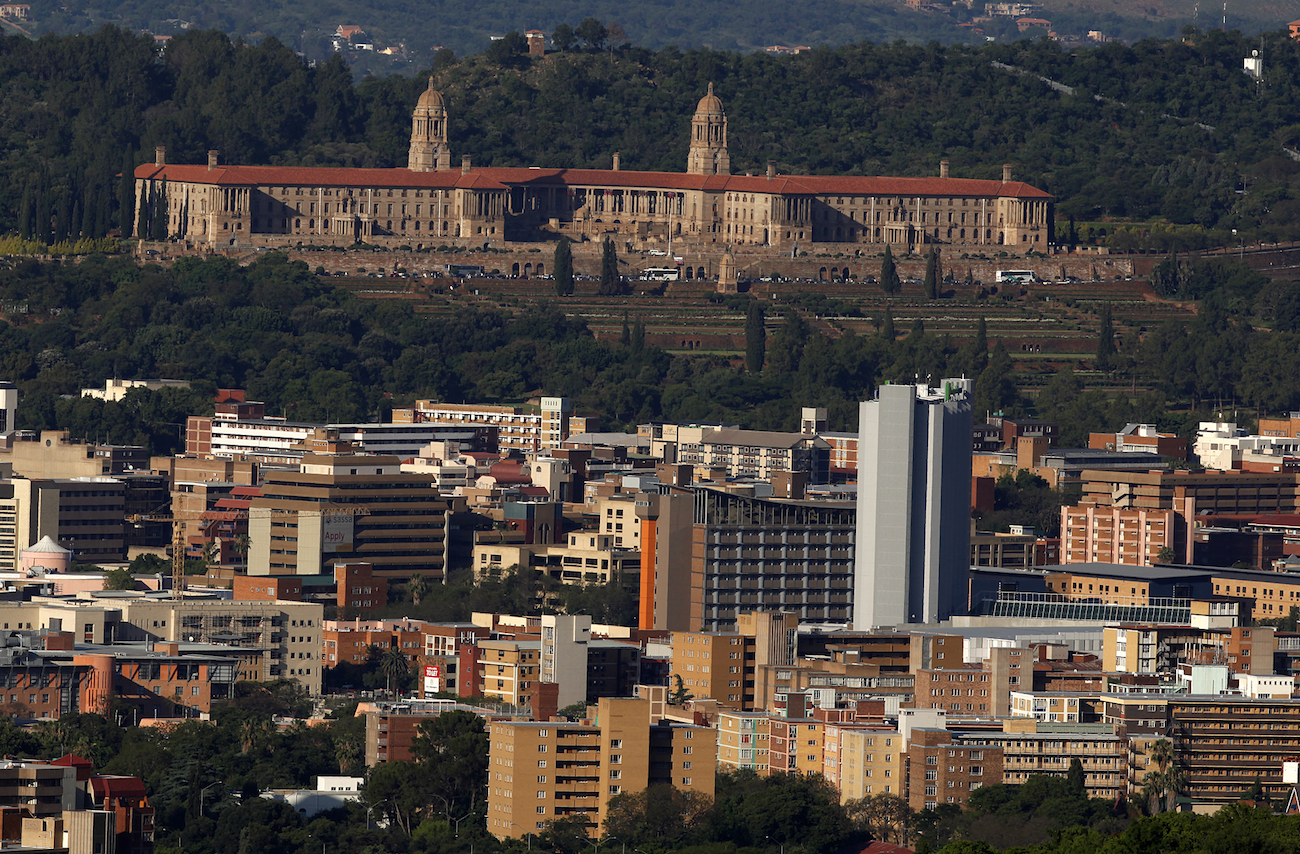
Photo: The Union building is seen behind the city of Pretoria November 24, 2009. REUTERS/Siphiwe Sibek.


This was done despite the communities of Kungwini and Nokeng opposing the merger with Tshwane in the first place - read the reports from community meetings (communities that were "consulted" only after a the decision was made without their permission 18 months prior)
I tried my hand at amateur cartography for the article, and I think the fairest thing that you can say is that the redrawing of ward boundaries has resulted in gains and losses for both the DA and the ANC. You could be right and the ANC could have fooled me, but the process looks kosher to me.
The second issue is contentious: the absorption of the smaller municipalities into Tshwane. Some see this as greater centralisation and less power to the people at the local level and they could well be right. I see this process as an attempt by government to improve things. They could very well be wrong and misguided and they might end up making things worse - only time will tell. But I don't ascribe any sinister motives to enlarging Tshwane.
The way the merger was pushed through, and how the new ward boundaries were drawn is a clear indication that there is political motive and not practical. Let me ask you, how is service delivery going to improve by creating wards that are 100kms across? Where communities are split up and pasted into wards with other communities 50kms away?
(eg. Ward 105: half of Bronkhorstspruit has been cut off and tossed into the basket with 2 voting districts from Ekangala approx 50kms away - Bronkhorstspruit used to be DA run, and you guessed it, the 2 VD's from ANC run Ekangala now hold the majority of votes)
I must say after observing what has happened here over the last two years - communities purposefully ignored, etc - I cannot share your sentiment that nothing sinister has occurred. Both municipalities that have been disolved have the capacity to function autonomously and function well, they have just been bent under bad management and corruption - Nokeng is brilliant case point where the DA took control and ran it well for 2 years (Incidently, I'm not a DA supporter, but I give credit where credit is due), but when the ANC took over again they successfully bankrupted it 1 year later.
There was no pragmatic reason for this merger, it was purely political, and we have come to suspect it was in part due the ANC's fear of losing Tshwane so they threw in a few more seats that they could comfortably gerrymander and control.
I am going to assume the ID in the report is for the Independent Democrats so have taken the liberty of adding that one to the DA. A 10% drop in ANC totals could see the a DA led coalition winning the city.
Then what we might see if the predicted stay away of ANC voters surfaces and the DA get the their GOTV campaign into high gear is:
ANC: 104 seats 50% Coalition
DA: 85 seats 41% 105
Cope: 7 seats 3%
FF+: 5 seats 2%
ACDP: 3 seats 1%
Indies: 2 seats 1%
PAC: 2 seats 1%
IFP: 1 0%
209
This is going to be an interesting one to watch.
Honestly, I think my final numbers are flattering to the DA and were nearer the top end of the range of what they can hope to achieve. They could get around 40% but I personally think it will take something very very special.
In a solid DA or ANC ward, you typically have the winner receive 3 000 - 5 000 votes and the other parties get fewer than 1 000 between them. The swing wards are in play but it would take something like a 70% stayaway (or a 70% swing) in the solid wards for them to change hands.
Also you seem to refer quite a lot to the 2009 election results when it is common knowledge that people vote differently on a national level than they do on a local level. This will both benefit and hurt the DA as traditional ANC votes may come there way because of service delivery issues, and DA votes that supported them in 2009 just to "stop Zuma" yet disagree with DA policies and moral values may vote according to their conscience benefitting smaller moral based parties.
Taking just these two factors into account could produce a very different picture from what you painted.
You are right that comparing 2006 and 2009 results is not straightforward (my colleague Thato Molewa makes reference to this in his Nelson Mandela Bay review) but our calculations were based primarily on 2006 ward and PR results, with a bit of voodoo maths thrown in.
We do stand by our predictions: I'm sure they won't be spot-on, and we might take some time to tell you, after Wednesday, just how and why we were wrong, but we are sticking our necks out. Won't you give us the Boy Scout badge for Bravery, if not for Accuracy?
Anyway, I'll give you the bravery badge now, and lets hold the accuracy one in reserve until after the elections. No offence, but I for one hope you are wrong...
Just a double check on the turnout for Tshwane in 2006 - according to IEC website it was 41% then...they expected it to be lower than that this time...
I should have drilled down into the turnout by municipality, but I stand by the numbers. Here's a brief summary of what you are seeing:
- There's about 12 000 registered voters per ward, give or take 1 000 in most cases.
- Most people who turn up to vote and vote for a legitimate party cast two votes. There is little voter differentiation between their party and their party's choice of candidates. This goes for all parties and supporters.
- About 4 000 - 6 000 voters turn up to vote per ward on the day (or did in 2006). 3 000 votes for one candidate / party is usually enough for us to judge the ward a lock-down for any one party, since there's normally not more than 1 000 votes to split among the losing parties.
- In split wards, you might see the ANC vs. DA at 2 500 vs 2 000. Or 1 500 vs. 2 000 or something like that. You get the idea.
- We've assumed that the DA has done their homework and identified these wards and has actively targeted them. We're further assuming (see my response to Chris above) that no safe wards will change hands. It is just too close to a demographic miracle either way. Where the ANC/DA has 3 000 - 5 000 votes, the opposition might not even get 200 votes.
- As I indicated to Chris above, my scenario is at the top end of the range of what I expect the DA to get. Of course they could do better but I would be very surprised if they do. It is more likely (in my opinion) that they'll do worse.