
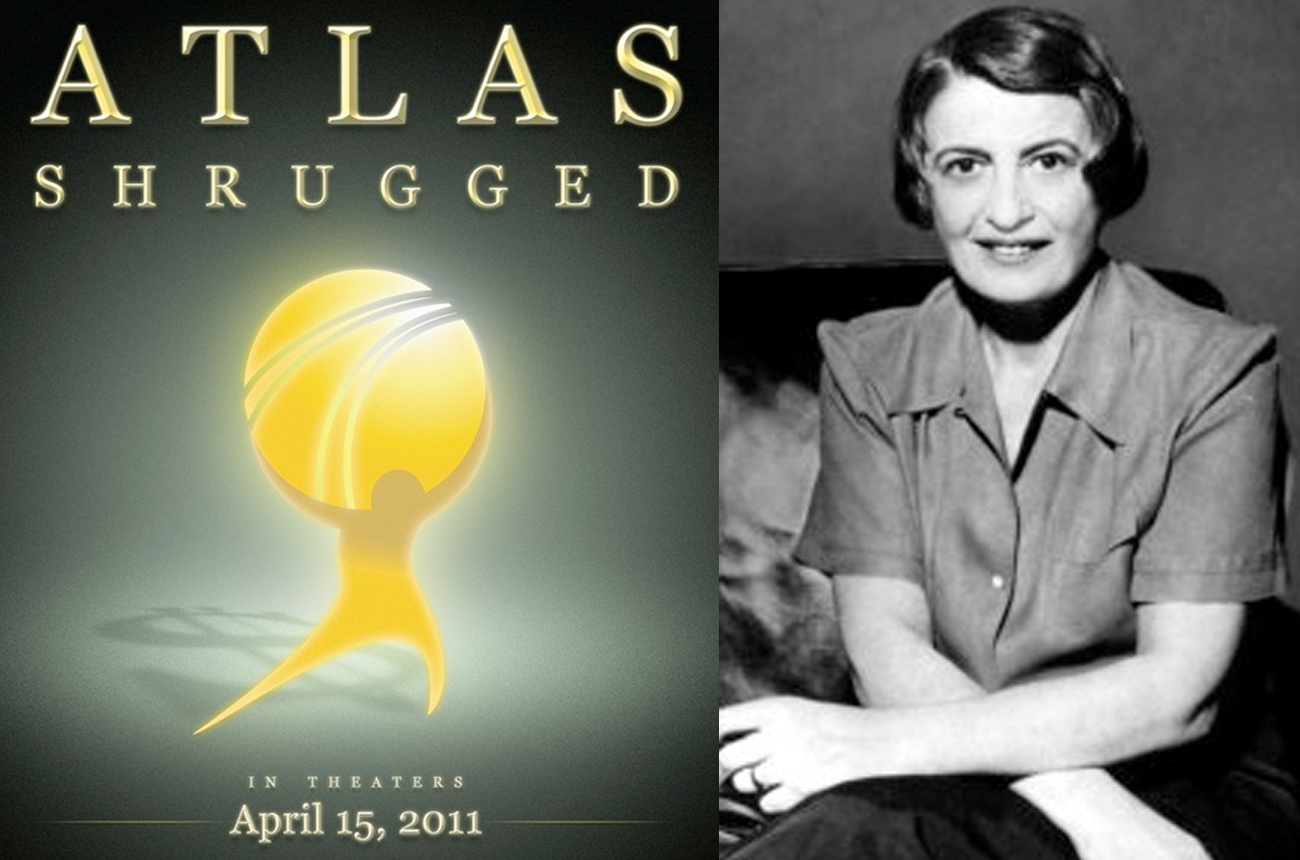
Shrugging off Atlas

Two weeks ago, the filmed version of Ayn Rand’s divisive mega-selling 1957 novel “Atlas Shrugged” was released in the US. Made on a small budget, without the backing of Hollywood’s marketing might, the independently financed film grossed $1,675, 917 for the first week at the box office, ranking it number 14th. What’s more, this is only Part 1—implicit in the title is the threat of sequels. Predictably, the film has divided critics along political lines. The right think it’s alright. The left think it’s bereft. By RICHARD POPLAK.

I remember reading “Atlas Shrugged”, lying on a filthy mattress I shared with my girlfriend and a family of mice in a disgraceful Toronto apartment. In this context — and only in this context — Ayn Rand’s opus made a lot of sense. Suddenly, it was clear who was forcing me to room with rodents. Unions, Big Government, Collectivists, Socialists, Commie goons. Like the mysterious architect-rapist who is the book’s main thesis, by which I mean character, what I needed was to get the vampires off my neck, take the world in my hands, have rough sex with my girl, and own!

I haven’t quite gotten around to this, but then again, I’m not John Galt, the anorak-wearing sociopath who proves to the rest of the book’s tropes, by which I mean characters, that not only is self-interest good, it is the only morality worthy of the name. The main reason for my lack of Galt-ishness is that it’s just so much damned work. If I were to meet Rand in an elevator, were she still alive, she’d beat me to death with her handbag. I’m not worthy. I’m one of the useless hordes.

In the current Blue State/Red State version of the US, which is almost perfectly split between the right and the left, there are your Randians and your anti-Randians, and I’ll let you guess where they respectively fall on the political spectrum. The book has not gone out of print for so much as a minute since it was published in 1957, and has, post the film’s release last Friday, clawed its way to fourth on Amazon.com’s bestseller list, a spot normally inhabited by the decidedly anti-Randian Stieg Larson. (I’m guessing here, but Swedish folk are government teat-suckers extraordinaire, and Larson seems far to the left even by Scandinavian standards.)

I know what you’re thinking. A million-and-change doesn’t exactly make for a box office smash. But if this flick does catch on in the blogosphere, promoted by the likes of Glenn Beck (whose last mass recommendation, Julie Taymor’s Broadway show “Spiderman: Turn of the Dark”, is perhaps the most legendary disaster in the history of musical theatre) and Pam Geller, then who knows? Besides, there’s always DVD, NetFlix and iTunes. If the movie just practices some healthy self-interest, its über-capitalist credentials will power it to sleeper status, and Part D’uh will be forthcoming.

Watch the trailer for Atlas Shrugged, Part I:

There is one slight problem here, of course, and that is the fact that Hollywood studio heads, the very folks this film must battle for a slice of the ever-shrinking box office pie, make the John Galts of the world look like a pinko pussies. Talk about self-interest! Talk about targeted greed! Is “Atlas Shrugged: Part 1” kidding? If the film does show any type of legs, other than those of the fetching lead actress, Taylor Schilling as Dagny Taggart, then a studio is sure to scoop up the reference material and cast Tom Hanks as railway magnate Hank Rearden, and Beefcake de jour as John Galt.

Which brings us to the small matter of the film. I haven’t seen it yet, so this essay does not count as a review. From what I have read, however, critics who write for Rupert Murdoch give the film a grudging huzzah merely for existing, while ever so gently reproaching it for its soap-opera acting and developing-world TV production values. Liberal critics intellectually contort like preteen Chinese gymnasts to try to be fair in their flogging of the film for its ghastly filmmaking and ghastlier politics, but not because it’s based on the anti-Liberal ur-text, you understand. 

It does seem like a stretch, adapting a book written in the 1950s, set in a not-so-distant future that hasn’t panned out, in any way, as Rand predicted. The Titans of Industry are hardly hamstrung by Big Government, Small Government or Any Government - all are in collusion in a way Rand could never have predicted, and probably wouldn’t have liked. Sure, the little guy still takes his government handouts, unions still exist (except in Wisconsin) and South Africa could certainly be categorised as a Nanny State, should anyone feel the need to bother. But if anything, it’s the John Galts of the world — the self-interested Objectivists — who now run the show. Their main allies? Fat-cat politicos, government hacks, the bureaucratic machine. There’s no such thing as an industry iconoclast. He has too many lobbyists on the payroll.

I don’t live with the mice anymore. My girlfriend has long since left. (No doubt because I wasn’t rough enough.) But “Atlas Shrugged” still occupies a niche in my consciousness, alongside some poorly digested Carl Jung, and some nibbled-at Wittgenstein. It’s a book that makes some powerful arguments, many of them hard to dismiss. But ultimately, it fails for its tiny worldview, it’s lack of empathy, its 10-page paragraphs and its poor characterisations. Not exactly the framework for a good film. Sound baseboard for the oxymoronic world of political philosophy. DM


Read more:

Tuesday 26 April, 2011
 
Top Stories

You must be logged in to leave a comment. Please login or sign up.
In 2009 GQ railed against the resurgence of Ayn Rand in a steaming jeremiad entitled "The Bitch is Back".

That is all there is to be said about that, I think.
For reference: http://www.gq.com/entertainment/books/200911/ayn-rand-dick-books-fountainhead
Delightful bit from that GQ article:

"As a fiction writer, she's absurd," says author and Vanity Fair columnist Christopher Hitchens, who is arguably the most opinionated Homo sapiens since Rand herself. "But if you're young and not particularly wanted and not particularly brilliant, reading Atlas Shrugged provides all the feelings of compensation one might need for any period of terrifying inadequacy."

I'm not intending to dismiss Rand via appeal to authority (and in particular, an authority that some might consider dubious) - the Hitchens quote does however capture the motivation for the missionary zeal of some Randians rather well.

Her argument for ethical egoism is, however, very unpersuasive in that it rests on a false dichotomy between complete sacrificing of self via altruism or being exclusively concerned with self-interest. In this respect, at least, I think she's done careful consideration of difficult issues absolutely no favours.
I only remember some points from this book, namely that if due to misguided politics, you leave the important social and industrial tasks to charlatans, incompetents and idiots, then the whole countrty will eventually go down the tube. I also remember the absence of maintenance and the crumbling of infrastructure, whcih were also the hallmarks of teh Soviet-sponsored countries, due to the lack of private incentives. I will re-pread thsi book!
What you describe sounds a lot like a place I know.
If you're going to spit venom at a film without bothering to watch it, may I suggest a quick visit to Wikipedia first?

The main protagonist of Atlas Shrugged is not an "architect-rapist". The main characters are Dagny Taggart, who runs a family-owned railroad company, and Hank Rearden, the owner of a steel mill. John Galt wasn't an architect either, though he was mysterious.

Perhaps you're confused. There was an architect in an different film, based on a different book by Ayn Rand, who had rough sex with a different character who, though she did not give consent, found the experience strangely fulfilling. It seems moot to discuss the complex relationship of Howard Roark and Dominique Françon, or to debate the philosophical or psychological import of such a scene, when it appears in The Fountainhead, and not in the present object of your disapproval.

Though the scene clearly left an indelible impression on your youthful self, is it reason enough to dismiss the work in which it is (not) contained? Would you reject, say, Vladimir Nabokov's body of work with such a superficial, inaccurate sweep, because in his book Ada, he addressed themes of incest and underage sex with less than outright condemnation?

Your admission that to rely on your own mind and body for your living is "just so much damned work" is revealing, however. No wonder you find Ayn Rand's ideas so threatening.
Atlas Shrugged made good points about the value of enterprise and hard work, but by god did Ayn Rand know how to labour a point. It should have been a 20-page essay, not several hundred pages of labyrinthine prose.
Ivo Vegter, a Randroid? Say it ain't so!
I am always so disappointed at the poor quality of the anti-Rand comments and debate. I'm genuinely looking for a well researched and formulated retort to the big ideas she defends, viz the free market, progress through science and individual liberty.

Perhaps it is a long winded book and not your average Joe is going to access it easily, however I've never come across other vaguely similar arguments or ideas. Would love to be pointed in new directions though!

Any form of fundamentalism is unhealthy, for a position or against it.
Actually, no I'm not, Greg. She was influential in the development of my thinking, yes, but no more. I would recommend her, not for literary appeal (there's very little of that in her laboured tomes), but for the power she has of opening eyes. That said, I believe Objectivism to be philosophically flawed, despite its instinctive appeal. It leaves no room for subjective valuations of human action. It would condemn, for example, private charity, although I can justify it perfectly well in the framework of the Mises/Hayek school of free-market economics, to which I belong. Besides, Rand was weird. However, if you're going to dismiss her, it would be nice to get the facts right and do so for the right reasons.
Taken from http://bit.ly/eUzAFY #in

"A somewhat well known quip by John Rogers:

There are two novels that can change a bookish fourteen-year old’s life: ‘The Lord of the Rings’ and ‘Atlas Shrugged.’ One is a childish fantasy that often engenders a lifelong obsession with its unbelievable heroes, leading to an emotionally stunted, socially crippled adulthood, unable to deal with the real world. The other, of course, involves orcs.

One might add that the story with Orcs emphasizes the roll of serving one’s community over one’s self. Sauron is the ultimate Randian Super-Hero."

I remember reading her stuff as a child. If she is a role model for the GOP be frightened, very frightened. Scorched earth policies beckon.

In short Heinlein without the cuddly bits.

If teh short url doesn't work: http://climateprogress.org/2011/04/24/video-the-truth-about-gop-hero-ayn-rand/?utm_source=feedburner&utm_medium=feed&utm_campaign=Feed%3A+climateprogress%2FlCrX+%28Climate+Progress%29#in
This is directly from Atlas Shrugged :

JUDGE: “Are we to understand,” asked the judge, “that you hold your own interests above the interests of the public?”

REARDEN: “I hold that such a question can never arise except in a society of cannibals.”

“What … do you mean?”

“I hold that there is no clash of interests among men who do not demand the unearned and do not practice human sacrifices.”

“Are we to understand that if the public deems it necessary to curtail your profits, you do not recognise its right to do so?”

“Why, yes, I do. The public may curtail my profits any time it wishes – by refusing to buy my product.”

“We are speaking of … other methods.”

“Any other method of curtailing profits is the method of looters – and I recognise it as such.”

“Mr. Rearden, this is hardly the way to defend yourself.”

“I said that I would not defend myself.”

“But this is unheard of! Do you realise the gravity of the charge against you?”

“I do not care to consider it.”

“Do you realise the possible consequences of your stand?”

“Fully.”

“It is the opinion of this court that the facts presented by the prosecution seem to warrant no leniency. The penalty which this court has the power to impose on you is extremely severe.”

“Go ahead.”

“I beg your pardon?”

“Impose it.”

The three judges looked at one another. Then their spokesman turned back to Rearden. “This is unprecedented,” he said.

“It is completely irregular,” said the second judge. “The law requires you submit to a plea in your own defence. Your only alternative is to state for the record that you throw yourself upon the mercy of the court.”

“I do not.”

“But you have to.”

“Do you mean that what you expect from me is some sort of voluntary action?”

“Yes.”

“I volunteer nothing.”

“But the law demands that the defendant’s side be represented on the record.”

“Do you mean that you need my help to make this procedure legal?”

“Well, no … yes … that is, to complete the form.”

“I will not help you.”

The third and youngest judge, who had acted as prosecutor snapped impatiently, “This is ridiculous and unfair! Do you want to let it look as if a man of your prominence had been railroaded without a –” He cut himself off short. Somebody at the back of the courtroom emitted a long whistle.

“I want,” said Rearden gravely, “to let the nature of this procedure appear exactly for what it is. If you need my help to disguise it – I will not help you.”

“But we are giving you a chance to defend yourself – and it is you who are rejecting it.”

“I will not help you to pretend that I have a chance. I will not help you to preserve an appearance of righteousness where rights are not recognised. I will not help you to preserve an appearance of rationality by entering a debate in which a gun is the final argument. I will not help you to pretend that you are administering justice.”

“But the law compels you to volunteer a defence!”

There was laughter at the back of the courtroom.

“That is the flaw in your theory, gentlemen,” said Rearden gravely, “and I will not help you out of it. If you choose to deal with men by means of compulsion, do so. But you will discover that you need the voluntary co-operation of your victims, in many more ways than you can see at present. And your victims should discover that it is their own volition – which you cannot force – that makes you possible. I choose to be consistent and I will obey you in the manner you demand. Whatever you wish me to do, I will do it at the point of a gun. If you sentence me to jail, you will have to send armed men to carry me there – I will not volunteer to move. If you fine me, you will have to seize my property to collect the fine – I will not volunteer to pay it. If you believe that you have the right to force me – use your guns openly. I will not help you to disguise the nature of your action.”
See what I mean about murky copy.
Well said Donovan Jackson

I have the peculiar habit of reading engrossing books cover to cover twice in a row. Length does not put me off and Bolano's 2666 and McCarthy's Blood Meridian are examples. Atlas Shrugged is sitting on my shelves with a bookmark at page 372 and I keep telling myself that I will tackle the remaining 796 pages at some stage. Maybe...... because at 63 life is becoming shorter rather quickly.
I read somewhere that in their polemics you'll learn more about the psychology of the critics of Ayn Rand than you'll ever learn about the woman or her work. Sadly, instead of offering us a sophisticated, nuanced take on the Russian radical, you've given us this cheap shot, which of course invites the anti-Randians (as annoying as the Randroids) to pile in with their predictable ejaculations.

I strongly disagree with Ayn Rand on many philosophical, moral, political, and aesthetic issues but having read all her fiction ('We The Living' is probably her best novel qua novel) and non-fiction (she was just as powerful a rhetorician as our man Hitchens - what a delight it would've been to have watched them debate in person), I remain perplexed at why it is so rare to find an even-handed treatment of her legacy.
Are we ever likely to see this movie in our cinemas, or will we have to wait for the DVD or BitTorrent?
To say the modern John Galt would be in bed with government today is ludicrous. No one was more aware than Rand of the unholy alliance between between many in the private sector and government and no one more critical. Also would be a good idea to read Larson before making ignorant comments on his books. He is also anti-government and pro-individual freedom.