Whenever and wherever the global economic rockstar Joseph Stiglitz talks, people listen. And when this eminent member of Ebrahim Patel's advisory panel held a public lecture in Pretoria on Monday, many were looking for clues to what will be next for South Africa. By STEPHEN GROOTES.
In any political debate it always helps if some kind of superhero jumps in, preferably in a dashing suit, says everything's alright and then flies away again. In this case it’s been Joseph Stigliz telling everyone our economy could jump over tall buildings in a single bound, if we just managed our currency properly. To listen to him, we’d create jobs faster than a speeding locomotive if only we’d engage in the “race to the bottom” that some say is this latest round of international competitive currency devaluation.
Joseph Stiglitz doesn't get calls from President Barack Obama that often lately, but doubt him or not, he is a man of impeccable pedigree. You don’t get to the top of the economic tree (Nobel prize, chief economist at the World Bank etc.) by being stupid or under-qualified. He’s one of those Americans who’s really travelled well, taken in what the world is, seen it all, spoken to those who really matter. And at the same time, he gets the other side. In short, he has a brain, and he has heart. It makes him a very well-rounded, articulate, brainy human being. And it is a pleasure to watch him speak.
His comments are going to be lapped up by the unions and the manufacturing sector. For the record, on this subject he spoke first about Chile, about how a government that was ideologically opposed to intervening in its currency had thrust that ideology aside and intervened. It was a simple choice, kill the economy and jobs, or manage the currency. Then came the full quote:
I think it's imperative that one manages your exchange rate to keep it competitive and stable. If we’ve learnt anything from the recent trouble, it’s that markets are not stable and self-correcting.”
Never mind how that could be interpreted, all our politicians are going to hear is “devalue the rand”. The exception of course will be our finance minister Pravin Gordhan. He seems to agree that there is a race to the bottom, and there lurks no value whatsoever. That being said, no doubt this argument has some way to run yet.
While that was the political headline, as the result of a question from Business Day editor Peter Bruce, the main body of Stiglitz’s speech was about climate change. It was what he had planned to speak on. And it is a fascinating stuff for an economist's look.
For a start, Stiglitz believes trade sanctions will have to be a part of any global agreement aimed at stopping climate change. In other words, if someone refuses to lower their carbon dioxide emissions, people will refuse to trade with them. Of course, how many people could put sanctions on the US or China is a question that hasn’t quite been answered yet. In fact, if you think how quickly sanctions are slapped on the Ivory Coast while nothing seems to happen to Vladimir Putin, you realise how important the issue of relative strength is in global politics, no matter the subject. However, the threat of sanctions did work when it came to banning CFCs that previously almost destroyed the ozone layer; Stiglitz is perhaps hoping they’d work in this fight too.
Then there’s the way this international debate is going. For Stiglitz, a global limit on emissions per person is possible by 2050. That’s not that long away nowadays. And he reckons this means the average American will be able to reduce the carbon dioxide emissions by 80% of the current level. That’s a big change.
But fear not, because, in his view, mankind has had incredible success in making labour-saving devices (which pretty much covers every invention, ever). Thus, if we “put the same ingenuity to saving resources we will have success, and will maintain our standard of living”. Or to paraphrase, at some point bright spark will finally develop that kick-arse solar panel and we’ll all be okay.
Quite frankly, it is easy to agree with him. Humans are clever and adaptable. It is also conceivable that what’s really missing is the proper economic structure. He says that to make anything today, or run anything, the carbon emission is free. If you change that, you create an incentive to stop emitting, along with demand to get people innovating.
Stiglitz also believes the current global crisis and the fight against climate change are complementary. In short, the world economy is not moving, because of low global aggregate demand. People in the rich world aren’t buying stuff. But if the Copenhagen climate talks had worked out, people would have had to buy stuff to “retrofit the old economy”. So there would have been more demand, and more jobs would have been created as people started to innovate, and thus have products to sell. Unfortunately, that’s not how things worked out in real life.
But it doesn’t mean it won’t be like that in the end. The climate change issue (whether you believe in it or not) is not going to go away. There are real changes happening in our climate, man-made or not. And we are probably going to have to adapt as a species (although not in a Kevin Costner/Waterworld way) to deal with it. The easiest thing to do is to think hard and come up with clever stuff to maintain our standard of living, but change the way we do it. Besides, who wants to drive when you could be reading this on the train on your mobile device anyway - that type of thing.
Which all brings us to the obvious question: What does all this environment-as-business talk mean for the good old SA? Well, the ANC's lekgotla, pretty much at the same time as Stiglitz was talking, has published the statement on how to create 5 million new jobs in the next 10 years. The ruling party's leaders believe that in biofuels, solar and wind energy manufacturing sectors as many as 300,000 jobs will be created by 2020 (and 100,000 more by 2030) The intent and commitment may be obvious, but the reality and results remain to be seen. DM
Grootes is an EWN reporter.
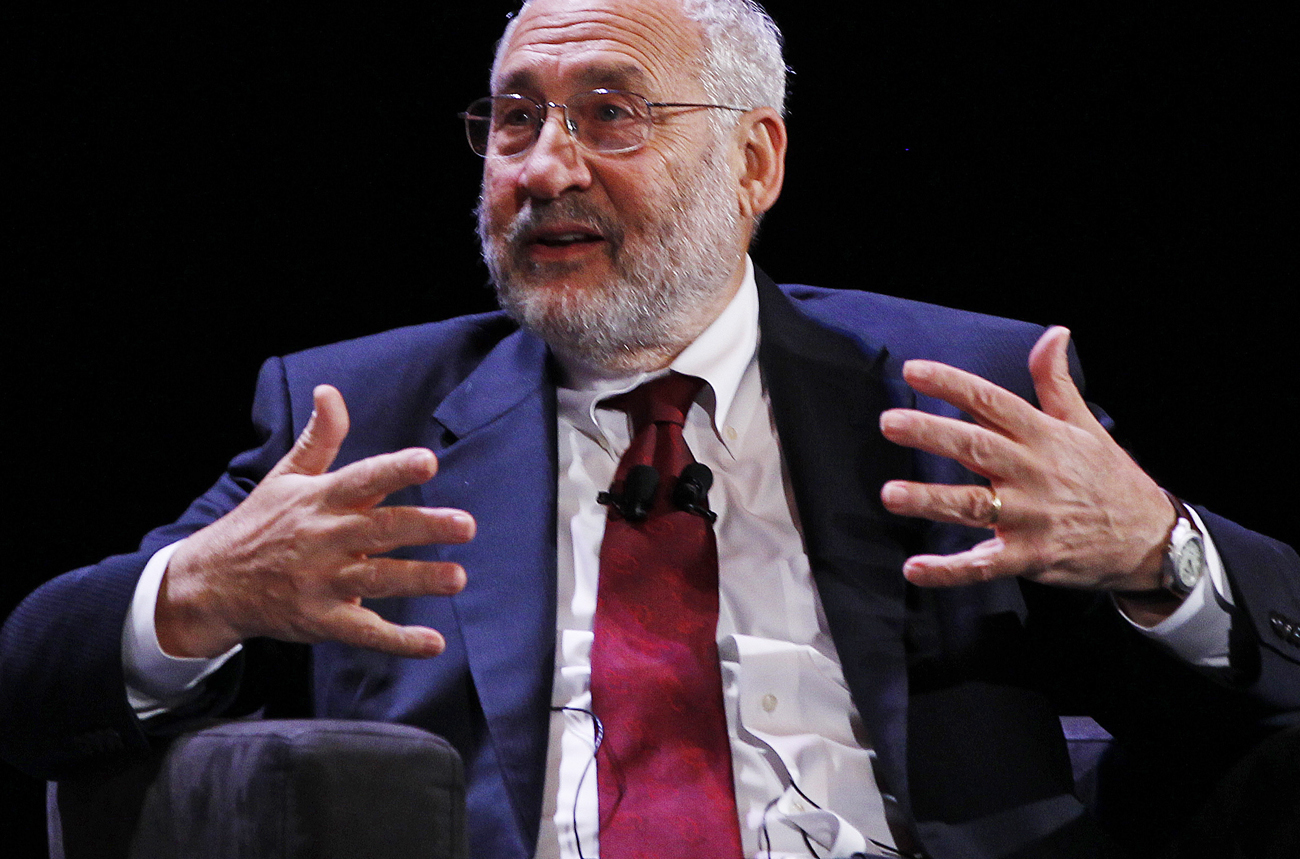
Photo: Economist Joseph Stiglitz speaks during the World Business Forum in New York October 6, 2010. REUTERS/Shannon Stapleton


While the scientists and technologies that will drive that greening of the economy are quietly bought up and buried (not the scientists hopefully), by Big Oil, Big Motor and Big Power, it ain't going to happen at any pace other than that dictated by them.
Fair enough, but being a clever, highly qualified Nobel winner and chief economist of the World Bank doesn't make you automatically right... particularly considering the state of the world is directly related to policies thought up by intelligent, qualified people (many with Nobel prizes), and implemented by such organisations as the World Bank.
http://www.abndigital.com/multimedia/video/featured-interviews/196315.htm
Why is it important for SA? Because we're one of the most carbon intensive economies in the world. We make all our energy from coal. And don't forget Sasol which even makes our petrol from coal (which is about 4 times more carbon intensive than regular oil refining processes). And all the export manufacturers and miners use this energy and use this fuel. Ouch. Seems like there's a pretty heavy layer of carbon embedded in our exports. So if you think the exchange rate is causing headaches, imagine the sleepless nights carbon taxes on exports will cause the captains of industry.
Not that they care. Like the rest of SA, they're ignoring the elephant in the global economy and carry on with BAU. But government knows what's going down. Remember that vehicle carbon tax Treasury imposed? Quite a few unhappy puppets in the automotive sector about that. Well, as far as I understand, Treasury was just testing the waters with that one. It's likely a precursor to a far more sweeping carbon tax on energy. (This journo in me suspects this is potentially a huuu-ge story)
So again, Stiglitz has a point. SA's got to break the stranglehold of Eskom providing us with hopelessly unsustainable energy. Get the private guys in who want to invest in renewable energy. But as long as Eskom's allowed to set the feed-in tariff the utility will ensure the little guys can't compete and thus won't invest. It's damn stupidity from the pov of the rest of us, if you ask me.
Give me a wee while and I'll dig up references to an Australian study showing just that.
Do the usual thing and follow the money. Who gains the most from raising a storm about climate change - Governments and the global corporations. We are talking immense amounts of new dosh from new climate taxation (you described a few) and significant increases in political and economic control.
Me I'm an agnostic. There are alterations in the global climate, but it's too early to tell whether these are the result of the normal climatic cycle or our tinkerings with things, or perhaps a combination of both.
As a result the low carbon-tax vehicles will not be sold in SA and we pay a higher rate tax for the dirtier vehicles. Bugger-all to do with carbon, more to do with increasing the tax take.
If they were serious they would ring-fence the tax take to upgrade the refineries. There is as much chance of that happening as the money collected from selling plastic packets in shops finding it's way to setting up and operating recycling centres.
On taxes and governmental greed I think your views on the political economy of these are somewhat contrived. Yeah, so govts like to bag more tax money. But they also run the risk of alienanting their electorate if they do. Maybe not in SA, where the ANC probably rightly reckons it will rule "till Jesus comes", but in real democracies you flippantly increase taxes and your electorate is going to soon boot you out of office. So there's actually a helluva conundrum for countries that do want to tackle climate change. If they do something at home (tax carbon) but then sacrifice competitiveness as a result in favour of one of their big trading partners (think US taxes; China doesn't) then their electorate is going to be seriously peeved. Hence the desire to get other countries to move on pricing carbon; or to force them to do this through trade measures. The big issue is this: that in the climate regime there's a provision that exempts all developing countries from making any reduction in carbon emissions. Only a few matter, really: China, India, Indonesia, Brazil and a couple of others. But they matter a lot, because they have competitive edge in manufacturing and agriculture. As long as this is the situation then clearly the countries that have to make carbon cuts will look at trade measures to level the playing field. So sorry, your view that it's just about governments wanting to increase taxes is nonsense.
And come on, you can't be serious claiming that global corporations will bag all this money out of climate hysteria. The powerful corporations as a rule are giants of the carbon-intensive economy (oil companies, steel makers, energy companies, mining companies ... ). These guys can only lose from carbon taxes. They want the status quo to continue. They will pay governments to do so. -- They'll even fund studies to show the status quo is okay :-) And the energy and oil oligopolies want to keep the new entrants out that can change the status quo. That's really Stiglitz's point. So indeed, I concur with one point: follow the money.
On the vehicle carbon tax: Interesting point about the refining capacity. I didn't know. In terms of us not getting low carbon emitting vehicles into the country I only thought of one reason: that our automotive industry is so heavily protected by government policy. Every time govt threatens to pull the plug on industrial support (which, among other incentives, entails us paying something like 20% import taxes on cars), then the automotive companies threaten to pull their investments out of the country. Read job losses, deindustrialisation in economically poor regions like the Eastern Cape and some very peeved voters in these areas who can canvass Cosatu etc.
No, I don't know, but on the whole you seem a little too singularly focused on this notion that governments just want to bag more taxes and don't look at the issues.
The two points I was trying to make, probably badly, is firstly that irrespective of the rights or wrongs of the climate debate, not every eminent scientist believes in the theory. To say it is proven is not correct. It may be the closest hypothesis we have that seems to match the limited facts at our disposal, but it is still just a theory.
The second point is that Governments have jumped on the bandwagon to use Climate Change as an excuse for screwing more tax out out of their constituents. Not just as direct taxation of the green vehicle type but as higher duties and levies on undesirable products like incandescent light bulbs cause retail price rises and the consequent increases in VAT take. Your scenario of applying punitive import levies takes this to unprecedented levels.
Global corporations, as you rightly pointed out will lose out if carbon taxes are implemented as things currently stand. So they fund studies, think tanks, research institutions to waste time while they organise themselves. Sometimes even paid for by Governments. Who funds Al Gore ?
They need time to get their ducks in a row with monopolistic control of the new technologies before they allow them to be released on an unsuspecting public.
Finally, alienation of the electorate. Most voters don't give a continental who is the government just so long as they can continue with their beer and skittles. Voter participation of around 40% or less at elections in most democracies tends to bear this out.
Add to that that most democracies work on a revolving door principle. Time in Government, Time in Opposition, Time back in Government again. Difficult to tell the difference sometimes.
I suspect that I have a more jaundiced view of politicians and their motives than do you.