
Analysis: A brutally simple and effective solution to SA's jobless emergency

As we’ve said before this is the year the economy takes centre stage. It’s jobs, jobs, jobs. This week, starting on Wednesday, the ANC’s NEC meets to unpack the issue. While we doubt all 80 members read this proudly capitalist website, we thought we’d propose some real-life solutions. By STEPHEN GROOTES.

And while this is all largely thanks to pressure from Cosatu, there’s also an election to win, and job creation and unlocking the economy are simply the right things to do.

The aim of every economy should be to get as many businesses going as possible so they can create as much value as possible and as many jobs as possible. In short, we need to start a virtuous cycle where the unemployed get jobs, become consumers and so create more jobs.

In our view, to do this, business needs to be freed. Freed from just about everything except the legislation that protects people from being completely unreasonably treated. This applies to consumers and workers.

Our motto would be: The harder it is to fire, the less business will hire.

It’s that simple. Abolish the CCMA. If you get fired, tough. As the economy grows, it will be easier to get another job.

People who currently have jobs in the formal sector can keep their benefits and pensions and the legal rights they had when they were hired. But for people hired under our plan, work or get fired. It may sound harsh - that’s because it is harsh.

However, it also means if someone doesn’t fit into a niche in a company, they will be free to find a niche into which they fit properly. They will be forced to search actively for the position that best suits them, while the firm will be able to find the right person to fit that niche. It’s about accepting the hard economic reality that protecting people who don’t perform hurts everyone; employer and employee.

We concede this will possibly lead to huge abuses, people will be fired because of vendettas, some will find themselves working 20-hour days just to keep their jobs. But if you go into Tembisa, where we’ve been assailed by people literally begging for a job, any job, or past any council rubbish dump where grown men fight with each other to be the first to your car door, you have to ask which is worse - a bad job or no job at all. Ask them. We’re pretty sure they’d take anything.

Until now the ANC has focused on “decent work”. For most, “work” comes first, the “decent” bit can come later. In the current atmosphere of joblessness, “decent work” sounds way too wishy-washy, way too much the convenient political slogan. And in the clash between slogans and reality, guess which side will win?

The second part of our plan would involve getting rid of all government red tape. Affirmative action reports can go out the window, hell, why should you have to register a company? For what? So that you can be inspected? No ways, let’s start the whole thought process again. And let’s make everything secondary to creating jobs. All government should be able to do is ensure no one is forced to work in dangerous circumstances. Health and safety should still be monitored. But it should not cost the company anything; government should pay for it. And any regulatory burden placed on business must really justify itself. It’s time to put jobs before any other aims.

The ANC and Cosatu have been banging on for ages about creating jobs. But it has yet to be treated as the big national emergency it is. Let’s have one person in government responsible for creating jobs, someone with seniority, with no other responsibility. Then let business also have one person with the same responsibility. Say, a team of deputy president Kgalema Motlanthe and Bobby Godsell. They must live in each other’s pockets, be on TV all the time, be the faces and eyes and ears of the great national project. We should have daily updates on jobs created, in which sectors, the companies that do it should be visited and heroes made of their CEOs.

Their first priority would be a trip to Transnet to sort out its problems. The CEO of the Chamber of Mines, Bheki Sibiya says, “We can’t move coal quickly enough, and this reduces productivity and impacts on employment”. Transnet is just one bottleneck caused by a government mistake (some would, quite rightly, use far stronger language). Electricity is, another. In fact, the entire parastatal universe acts as a giant brake on the growth of SA's economy.

The way to fix these fast is to simply depoliticise them. We would urge the NEC to fire the deployment committee. The ANC’s addictive habit of trying to circumvent the checks and balances in the Constitution by just appointing its own people to government jobs has brought down a plague on our entire house. Give it up! Get the best people, foreigners even, to run the companies. Get the knowledge and experience to supersede the cheap politics of power and money. All politics does is pollute the entire system anyway. It's time the ANC put the interests of the country first.

All our suggestions are anathema to the unions. Cosatu members are probably reaching for a bucket right now. But we’re not saying it should be disbanded. No, not at all. And we think it’s only fair its members, who are currently employed, should remain in their current conditions. But people joining the workforce under our plan would be free to join unions or not. And we’ll see how it ends up. Quite frankly, we think many will opt for a job, but not join a union. The one lever a union would have is that its members could refuse to work for certain companies. It should be a fun shake out.

The Economist recently ran an excellent piece on the battle between public sector unions and governments in the rich world. The resonance with recent strikes is striking. Recently the South African Municipal Workers Union has been able to demand and get higher-than-inflation pay increases, which have put government in debt. While we are talking about people who are still poor by any measure (many are rubbish collectors), the fact is Samwu increases are preventing other people being employed. It’s that simple

As one goes through life, there is one lesson that, if learnt early, will make one’s path slightly smoother. It’s this. Life isn’t fair. And until we, the ANC, Cosatu and the entire alliance realise that, we are all going to suffer.

Take the “decent” out of it. Let’s get the “work” first.

But don’t hold your breath. It ain't gonna happen, we know. DM


Grootes is an EWN reporter.

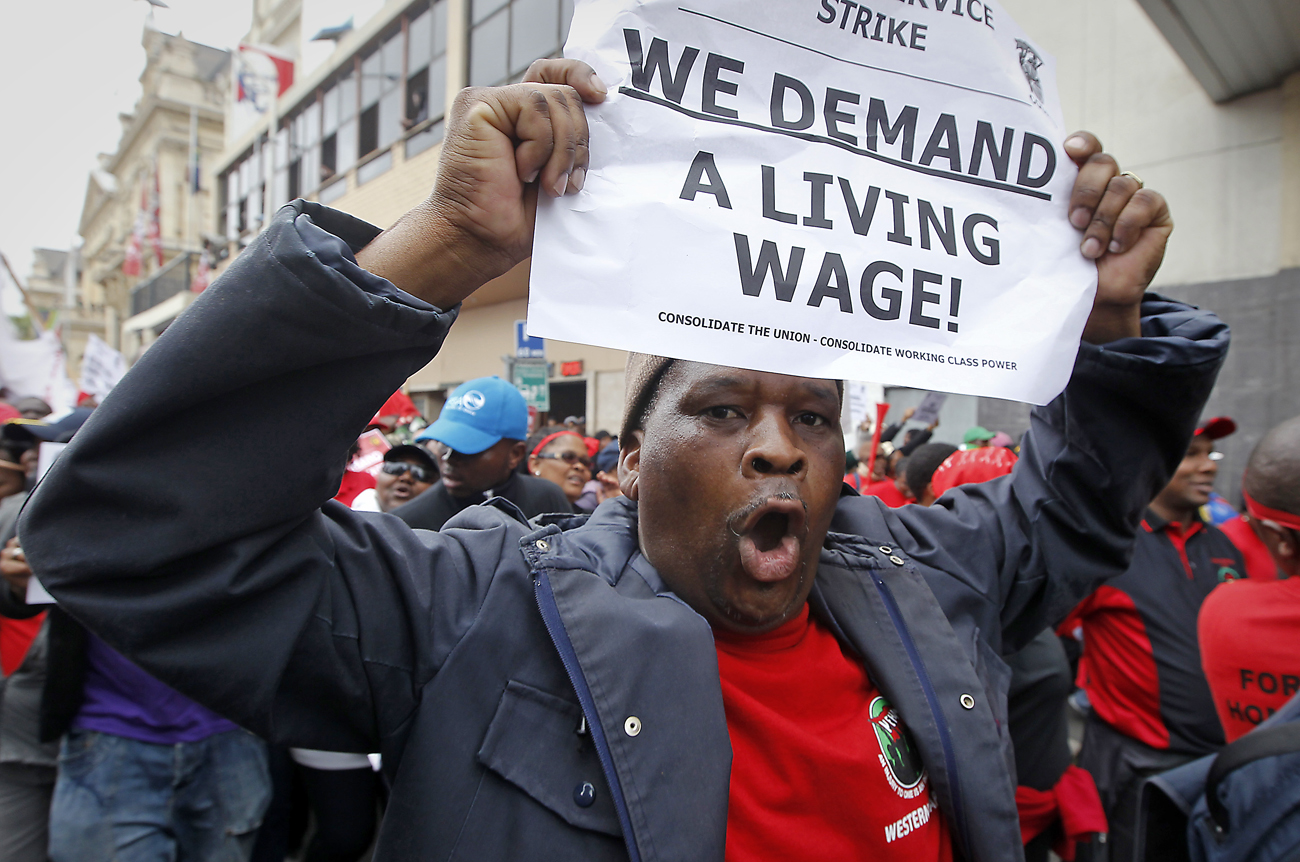
Photo: Striking South African public service workers march through the streets of Cape Town, August 26, 2010. The strike by 1.3 million state workers over higher wages has led to school closures, denied treatment at hospitals and put pressure on the ruling African National Congress to reach a deal quickly to limit damage to Africa's largest economy REUTERS/Mike Hutchings

Wednesday 12 January, 2011
 
Top Stories

You must be logged in to leave a comment. Please login or sign up.
Some pretty good points. Not too sure about this, though:

"However, it also means if someone doesn’t fit into a niche in a company, they will be free to find a niche into which they fit properly. They will be forced to search actively for the position that best suits them, while the firm will be able to find the right person to fit that niche. It’s about accepting the hard economic reality that protecting people who don’t perform hurts everyone; employer and employee."

Speaking as someone who was fired, once upon a time, this is kind of wishy-washy. People suddenly without a job, as you've so rightly pointed out, don't usually put as a priority "the niche into which they fit properly". Be nice if it worked that way, but it doesn't.

Still, some pretty solid ideas otherwise.
The reality right now is that it is far easier to employ an illegal immigrant in SA than a local. That is why there are millions of them here employed by SA companies and citizens. Free up the labour market and two things will happen, firstly the illegals will go home, and secondly, local people will be employed. Right now, employing a local means a marriage certificate, why on earth can the govt not see this ??
Steven, the elephant in the room here is that the majority of job-seekers are unemployable. They can't even cut it as ditch-diggers and gardeners. Joblessness is not because there are no jobs (there are thousands upon thousands of jobs available), it's because the skills are simply not there. Until the government ratchets up the education system, stops interfering in policy, spends money on adult education, and instills a culture of work and learning as opposed to entitlement, we will always have massive joblessness.
Bang-on. When you have more welfare beneficiaries than tax payers, you have an unsustainable economy. Currently there are about 5Million registered taxpayers. 1 Million work for Government, so they are merely shuffling cash from one pocket to another. Of the remaining 4 Million, 1 Million pay about 75% of the PAYE income. That economy is unsustainable.

The situation where it is more profitable to sit on your bum under a tree with your hand out waiting for it to be filled with a welfare cheque than work must change. The entitlement culture must go.
@Niki Moore: I see your elephant and raise you structural unemployment. I hadn't heard this term before but David Kirk writes about it in his blog- http://twentythirdfloor.co.za/2010/11/29/how-our-unemployment-is-not-like-that-in-the-us/. Interesting reading, I thought.
I have always felt that if the protection of workers was taken away we would have to give something back in return. Since the goal is to create more businesses to drive the economy and create better jobs, what better way than providing training and support for small business owners.

Since '94 there has been an explosion of people trying to run businesses. Whether it is the spaza shop on every corner or artisans going it alone, one gets the sense of people trying to help themselves. Seeing the queues of people paying VAT at the local SARS office is as encouraging as it is frustrating being stuck in the same queue.

Unfortunately many of these people just don't have the knowledge, experience or contacts to properly run a business. And that is before one adds the time sink of government regulation, including the onerous employment legislation.

But if they could be provided with mentoring as well as institutional support I believe that we would see a rapid growth in the number of reliable businesses, and this would go some way to offsetting any anger at the removal of employment legislation while actually fulfilling the promise of decent work.

Unfortunately that would require the current government to create functional organisations to support small business, and if they follow past patterns it is unlikely such support would amount to much.

Like you say: it ain't gonna happen.
@Mathew, Encore, Encore. I am a small business owner.

The stresses and strains of running a business are bad enough. Add to that the overweening pressure of compliance with Government registrations and regulations and you have a recipe for 18 hour days six days a week. It put me in hospital with a suspected stroke.

As a result, I changed from a supplier of physical goods, employing several people, to a sole-trader supplying time based services. What a pleasure it is not having to deal with staff.

Until the legislative landscape and to put it kindly, unfriendly financial environment become SMME friendly, the SMME sector will continue to shed labour and automate.
@ Rob - I agree. It can be tough to find a position and while employed, the last thing an employer would want is to have (current) employees actively searching for (future) niches. The labour market does not "clear" efficiently. Moreover, an employment contract is more than a series of legal rights/obligations, it also ought to be a sort of social compact between employer and employee.

That being said, the debate is not about capitalist or socialist approaches that can play itself out in theoretical debates (It ain't gonna happen), or even be reflected in whatever legislation is passed, it is about an effective 40% and growing unemployment rate. This fact plays out daily in a pre-capitalist way in the ways Stephen describes.

All that increased regulations does is to promote more informal, unregulated activity that is cash/barter based and very possibly linked to other criminal activity and stongly associated with undocumented foreigners. In this way, Mbeki's "two nations" analysis becomes more stark. In this second economy, labour legislation is irrelevant (as is tax, company and other legislation for a modern social democracy). What is equally true is that it is highly questionable whether the state has the capacity to ensure compliance. When you pass laws that cannot be widely enforced, your very legitimacy as a state and government is at stake. I am reminded of King Canute ordering the rising tide back. It ain't gonna happen.

The ANC's current Economic model is unsustainable in the long term.

According to SARS, there are 12.8 million people employed in some kind of remunerated legal employment and 7 million registered taxpayers (they aim to increase this number to 10.5 million).

These 7 million taxpayers support - amongst other things - 13.8 million welfare recipients.

People like Gorhan, Manuel and Motlanthe are not stupid, and they understand that the current model is unsustainable.
They also understand the "moral hazard" disncentive of welfare payments - once welfare payments approach the minimum wage, or market wage for unskilled work, the lame and lazy have a very powerful incentive not to do any formal work, and to engage in unlawful activity (why dig ditches and sweat buckets for R1,000 a month when I can draw a welfare cheque and sell some tik on the side for double that amount?).

Cosatu has become the dominant force in the ANC alliance, and whatever decisions are taken by ANC will be those that firstly favour Cosatu, secondly favour ANC members and last of all are in the country's best interests (if they were to co-incide, so much the better!).

Zuma can talk all he likes about creating jobs, but where are the practical realistic plans based on proven successfull strategies and given strict timelines?

We are part of the global economy and a very open economy, and need to compete with other nations.
The nature of work has changed in the world, and there will NEVER be demand for the volume of unskilled workers that we have - technology has aken care of that.

The reality is that "there is no such thing as a free lunch" (as long as a Doctor is paid, there is no such thing as free medical care - it is just that someone else is paying - "free to the users / consumer" is a more accurate term).

And you cannot have everything - full employment, "decent" work for all, above inflation wage increases without matching productivity improvements, lifetime employment, full rotection of workers from abusive employers.

I don't know why DM spends so much time reporting on what ANC Politicians say and their pronouncements - rather analyse and judge them on their actions - what they do.
@Dirk De Vos
You are so right about much of our legislation not being enforced (or enforceable).

In the labour field, this is not restricted to the informal or unregulated economy - this non-compliance is rife in the formal ecopnomy.

I would go so far as to say that only the big listed corporations get close to fully complying with our tax laws, labour laws, BBBEE / AA legislation.


A couple of examples:

MOST restaurant owners do not pay their waiters . waitresses a basic minimum wage, and fail to recognise that anyone that they employ for more than 24 hours per month is by definition no longer casual.

MOST restauarant owners deduct large amounts for breakages, theft by customers (bilking) etc - it is standard practice.
It is also unlawful - employers have vicarious libility for the delictual acts of their employees.

In other words, when the mechanic that services your Porsche takes it for a joy ride and totals it, the garage owner has to cough up (he in turn of course may havea claim against his employee).


In the Lewis Caroll world of the ANC, all your have to do to solve any problem is to enact a law - it matters not a bit if it is impractical, unenforceable or just plain unrealistic.

Where are these jobs to come from? The government can make some jobs, play-play jobs actually, which the taxpayer can fund. The real jobs can only come from newly dug mines, newly planted acres and tourism. Forget manufacture, the East has us licked.

Somebody above says education is the answer. It is unpalatable, and a fact never raised, to recognise that our South African I.Q. hovers around the 70 mark. This means that the majority of us are simply untrainable. Frankly, as a nation, we are too thick to compete with the East. Face it. A low grade matric pass does not even qualify one to be a nightwatchman.

BEE does not help. If I had a few billion to dig a new mine the fact that I would have to give away a third of it to some bloke with no boodle, but a black skin, would make me think twice. Especially if there is no guarantee the third would not be increased to 51% as in Zim. Yeah, on balance I would choose South America over S.A.

While we outbreed GDP growth we will have mounting unemployment. Tough, get used to it.
Ok so we all know that there is no chance of implementing these ideas – how about you come up with some ideas that just might work? Capitalism is great in theory but in practice it’s not going to happen, let’s start focusing on what will really work and just maybe something will happen. We need to work within our constraints. Look at China – hey they are communist or they were .... Otherwise you are just whining and that’s not going to earn you any points. If you want I could give you a few pointers .......
lets have another article with more realistic solutions .....
Talking about stuff you immediately concede ain't gonna happen is just mental masturbation. I agree with Fergus, rather talk about what can be done, than what can't.
1. More education is NOT the solution. Look at the complete and utter disaster of the SETA's and other training initiatives. Its just a time-wasting, tax-eating ploy to keep educators employed. Dismiss it!
2. Intelligence is NOT the problem. I have seen some amazing employment ideas coming from the poorest, supposedly stupidest sectors of our society. Most people will learn and innovate and prosper, given just half a chance. Look at the Chinese. Anyone over 40 will remember donating to the "starving millions in China". Anyone under 40 is happily sending half his disposable income there.
3. Government policy IS the problem. Like the 20 SS guards shepherding 10,000 Jews into the ovens at Auschwitz, our self-absorbed ANC government is destroying the economy of South Africa and the prospects of its citizens, with hardly a peep from we the sheeple. As has happened so often in the past, the well-educated and wealthy and law-abiding have no idea how to deal with a government out of control. We have to rely on those poor, stupid, brave people who put their lives on the line every day in township protests around the country. We're too busy with our intellectual masturbation to actually DO any thing useful.

What can be done?
1. Stop obeying stupid laws. Stop filing stupid returns. Employ who you need. Fire who you don't. Rally together to confront the state when they come to take you away. Burn a few tyres in your marble floored lobby.
2. Change stupid laws. We have a great constitution. Use it to repeal unconstitutional rubbish. Look at the courage of Hugh Glenister challenging the Scorpions closure. Forget parliament.
3. Use your power as taxpayers to influence policy. Stop paying to be raped.
4. Escape.
Stephen, you missed out my law of economic growth: “GDP will languish when property rents, profits, wages and salaries, interest and trade are taxed because their costs all rise. GDP will revive when land rents replace income taxes and VATas the costs then all fall.”
Good article but you've got lost...

Our life expectancy is now down to 50 years from 72 for males and 74 for females at the end of the Apartheid regime (refer to Stats SA). There are many causes including road carnage, murder and AIDS but I feel that if we don't keep South Africans alive, there is no need for employment. Right to Life must be our government's first focus

My second assertion is VERY CONTROVERSIAL - Work as we know it is rapidly becoming extinct.

Automation is following Moore's "computer memory" law but with a doubling in capability or halving in cost about every 5 years. In the last 35 years, I have watched as factories have become totally automated.

My biggest shock recently was watching a team of 4 earth movers modeling a road in Maryland US. There were only 3 men on site, the surveyor and one supervisor each for two shifts. This was hardly the orderly clean environment of the modern factory. The "dozers" were cutting the "muck" in 3 dimensions. They knew where to cut and where to add "fill". They started before first light and were still working when I left at 7 pm. The poor supervisors had to work shifts to keep up.

The very South African's we need so badly to kick start our economy were well represented by the Surveyor and the two supervisors, all three from Gauteng. They are part of the 20% of whites born in South Africa but now working elsewhere.

Some people work while others create work. Part of any successful jobs strategy will have to be more friendly to those that create work so that they do this within South Africa and not in other countries that are competing for jobs.
Preaching to the converted, becasue those who need to cannot, or will not, read.

I look around, and what do I see? Thousands of unemployed, many unemployable. What else do I see? The usual people trying to sort it out - and it is not the 1-party state government either.

I see the political have nots still trying to solve the painful dilemma, which is Africa's self-imposed desire to be sad, sorry people of this world. Yes, sorry to say, but the whites are the political have nots of South africa.

Off course there are exceptions to the rule of this incomprehensible choice to be poor and live in squallor till death us do part. Unfortunately, a black, emerging middle class was quickly stopped by the joke that is the NCA. They have been replaced by mostly corrupt black diomands - many of them government officials with grimy little paws.

Sadly, again, it was white leadership that brought about the NCA, which is now rapidly being eroded into a defunt state by the corrupt ones, many of the contributors being "ethical" corporations and institituions in positions of social "trust". Who said absolute power corrupts absolutely?

Recently, I asked one of these thousands of "want-to-be-employed" persons why she came to live in a squatter camp on the Cape Flats, when her home and family, and her social security and roots were in the Eastern Cape?

She was so candid, it took me days to recover from the shock. She simply said: "There are so many white people in Cape Town, and we all know that whites are rich."

Let's lead SA yes, but make sure we do not lead it into the barren hands of the tyrants.

PS: I do not stop to give people lifts to work anymore - for I am affronted by the view that whites are just there to take from and to provide a day's bread.
For only three years of a 38-year career I belonged to a union, not by choice. So for 35 years I worked for various companies without union representation. When I no longer enjoyed my working conditions, I sought and found other jobs with better prospects. I was treated badly in the one job that offered union representation. My employer was the government, but to be honest, I found no real fault with my employer (aside from a total lack of imagination and a propensity for wasting time), only with my immediate superior and the one next up; what one could call 'personality clashes'...actually, they were pretty clearly political/racial clashes.
Employees must have some form of backstop, be it the CCMA, a union, or legal advice, but they don't need them all.
Unions can be a drain upon the country. Without them, realistic increases would be offered and any unhappy parties would move on. That's the way things should work. It also gives those who put in additional effort the opportunity to receive additional increases if they impress. Minimum wages may sound fair, but why would I pay a domestic worker who cannot make a bed properly the same as one who could run my entire household? That's what's happening in SA today.