South African business needs to break its silence on government plans to gag the media and muzzle freedom of expression, say editors and a prominent political analyst. And not only because the issue needs to be championed by all South Africans, but because freedom of information is the lifeblood of the markets.
“People don’t invest in countries where they don’t know what is going on and they don’t invest in businesses where they don’t know what is going on,” said Mail & Guardian editor Nic Dawes in a call to marshal business to speak out against the attack on media freedoms.
“Business needs to make its voice heard very clearly. I know that some in business say they have concerns about the quality of South African journalism, and those are things that we are happy to discuss. There is serious work going on around strengthening professional standards, but they mustn’t let those concerns stop them from dealing with what is really a very major threat to the business climate. I hope that they aren’t focusing on a little bit of peeling paint on the house while its foundations are being undermined,” said Dawes, adding his voice to the growing weight of calls for business to break its silence on the threat against media freedom in South Africa.
Earlier, businesswoman and former World Bank managing director Mamphela Ramphele addressed businesspeople at a Discovery Leadership Summit and admonished them for not taking up the fight for media freedom. Where were the business leaders who would defend the freedom of the press, Ramphele asked.
Wits University's head of the School of Journalism Anton Harber, who was working with editors at the South African National Editors’ Forum to marshal a broad coalition to transform the media freedom fight into a more populist movement, said the issue affected all South Africans and demanded a broader response. “Business at the moment is silent on many issues of which the media is just one of them, but I can tell you that there is an attempt to talk to business leadership and draw them into this issue,” said Harber.
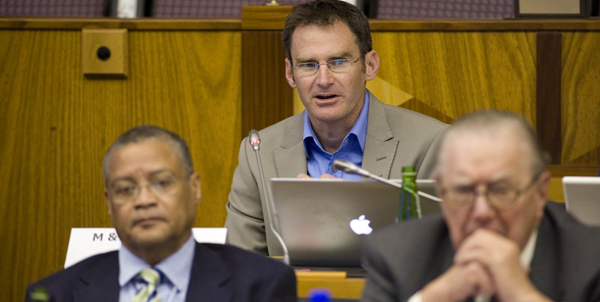
Photo: M&G editor, Nic Dawes.
Political analyst and media boss Justice Malala said he was disappointed in business. “I think business should say something. My view is that South African business has really become weak and it’s very scared of speaking up for good. I think business is also under huge pressure,” he said.
Malala pointed to the raids on mining companies highlighting the ArcelorMittal case at Sishen in Northern Cape and the Lonmin case as examples where business rules were being bastardised. “A cowboy culture is taking over, particularly in mining. Many of these companies should be standing up and saying that we won’t allow anarchy of this nature in mining, and business generally, to take place, but they are not even doing that,” said Malala. “Personally I am very disappointed in South African business. Their silence on this matter shows them up to be the weak-kneed people that they are.”
Malala said people needed to know that the Protection of Information Bill was not just about the media. “It is also about the fact that business will not be able to get information out themselves. The stories about the mining race that happened in Northern Cape and the story of Lonmin would not have been on the front page of Business Day if some guy in the department of minerals and energy thought the issue would destabilise the state.”
People needed to ask themselves how they would be affected by the media freedom issue, said Harber. “Ask yourself this question, if we have a media tribunal, where does its jurisdiction begin and end? You have a tribunal whose job it is to oversee compliance with a code, but is this limited to journalists writing for the mass media? If you produce a church newsletter does it apply? If you produce a pamphlet attacking your councillor in Kliptown in the run-up to the election does it apply to you?
“I don’t know the answers to that, but my guess would be that it would be very hard to make it not apply to everyone equally. It is likely to affect all sorts of people exercising their freedom in ways that people have not really even thought about,” said Harber, who believes the government moves were about isolating and making investigative journalism difficult. “That is at the heart of what we are talking about. All the laws and all the rhetoric are about making it more difficult for those stories which have been embarrassing political leadership to come out.”
Dawes, Malala and Harber stressed that the issue of media freedom needed to become a populist campaign because it affected the lives of all South Africans. “We need to communicate beyond the media elite and civil society to a much broader range of South Africans and show people how this affects their lives,” said Dawes. “Yes, it is an issue about which journalists feel particularly strongly, but this is not just an issue for journalists. It is critical to engage with broader audiences.”
Photo: Justice Malala.
The proposed Bill draws a veil of secrecy over a huge range of state activity, Dawes said, adding that the consequence would be endangering the very functioning of basic democratic accountability mechanisms. “You are going to find it very hard to know why your power is out, why you don’t have water, why your RDP house is falling down,” he said.
“If you want to take action on those things as a citizen, never mind as a journalist, you are going to find yourself potentially being made a criminal for trying to vindicate your basic rights.” Dawes said if civic-minded citizens obtained information about municipal tender irregularities or graft and this information was classified as sensitive, the only recourse for those people would be to go to the police and hand that information over. “You won’t be able to use any other mechanisms of discourse. I have said before that it criminalises journalism, but it also criminalises a huge range of civic activism,” said Dawes.
What was needed was for the entire communication industry to tell this story in a way that was accessible to everyone, not just journalists. “One of the things we need to be doing is using the tools of our own trade, including advertising, to tell that story and explain it. Not in the high-flown language of the Constitution and the rights discourse, but in terms of the real basic work of a democracy that is trying to overcome gross inequality and poverty. To say to people how this bill is going to limit their ability to ensure that both their basic rights, and their socio-economic rights are vindicated.” Dawes said a false choice between freedom of information and, for example, free water was being presented to people, and that what was needed was to show citizens how freedom of information was what enabled them to get water.
Photo: Anton Harber.
Dawes said he was disturbed by reports from Mpumalanga that showed how citizens were equating reporting on corruption with treason. “Clearly the suggestion that doing your journalistic work is unpatriotic is a disturbing trend,” he said. “We have to have an idea of patriotism that is about producing the kind of South Africa that we all want to live in, not about simply trusting a few politicians to produce it on our behalf. That version of patriotism is the refuge of the scoundrel.”
Dawes said the events in Mpumalanga should send a very serious warning to all South Africans. “You have a criminalised politics in Mpumalanga clearly and to the extent that that criminalisation seeks refuge in claims that any scrutiny of it is illegal, unpatriotic or treasonous must be repudiated very, very strongly.”
Business that remained silent would have blood on its hands following the killing of whistleblowers in Mpumalanga, said Malala. “What has happened in Mpumalanga is that law and order has collapsed and a cowboy culture has taken over, and (Premier David) Mabuza has done absolutely nothing himself to stop that.”
The arrest of Sunday Times investigative journalist Mzilikazi wa Afrika’s had nothing to do with what the journalist had done, Malala said, but was engineered to get his sources and to uncover whistleblowers. “Nine people were murdered in Mpumalanga and those guys have done nothing about it. They want to find the people who had been whistle-blowing, they want those people. That is what that arrest was about. The silence of business and the silence of national government only supports the killing of those whistleblowers in Mpumalanga.”
By Mandy de Waal
Read Barney Mthombothi’s FM editorial note “Deadly threat to all” (link to ), read Mail & Guardian’s “International media sound the alarm bells”, read the International Press Institute’s appeal to Jacob Zuma to desist from plans to restrict the press.


Why, if they are so concerned that getting justice is so expensive, do they not legislate that voters can sue the media at no cost should they be able to prove that the media had published rubbish.
It is strange that one expects a Steve Biko type story to emerge one of these fine days.
What is somewhat hypocritical is someone like Justice Malala only speaking out when media freedoms are under threat - freedoms that directly impact on his paymasters at Avusa. Prakash Desai is conspicuously silent as are ANC lackeys like Marcel Golding at etv, the head honchos (also deep in the power-pockets of the ANC) at Independent Newspapers, Naspers, SABC, Caxtons and Primedia. Where are their voices? Where is their outrage?
But it's a big fucking mess and it all goes back to CODESA and the negotiated settlement - the kind of society we are now was born then. Big business, including media, and all other ideological apparatuses were allowed to carry on as if nothing had changed. The ANC had then already sold itself and the country to big business; there were critics AT CODESA, but they were sidelined (like Barney Desai). Things had changed, but only on a superficial level. That's why transformation is window-dressing and, in some circles, a veil for excessive, obscene, rotting self-enrichment. From the media we get much of the latter, but little on the complicated story of transformation also gone wrong for many average black South Africans: representation and responsibility without authority. I understand that the complicated story is not convenient for media in terms of production and in the digital age: people want quick stories, big stories, etc. But surely the media, given what it is, given that it inevitably is an ideological apparatus (it shapes worldviews), cannot rely on the usual, disingenuous business imperative: giving the readers/consumers what they want. How about shaping also what those readers want?
Education has been fucked up. In terms of media - excepting of course those who make a real, sincere and deep effort to train - the upshot of fucked-up education is young journalists who can't think critically, who can't write (again, exceptions of course). When it comes to matters of race and representation, and in a misguided, uncritical, selfish 'rebellion' against anything that 'sounds' like political correctness, the way overwhelmingly white media portray its 'other' still leaves much to be desired.
Again, of course there are exceptions, but, for the most part, media just miss, constantly, the point about the politics of representation. It is ignorant or has a limited understanding of it. Add that to messed up education.
Example? Let's take an extreme one, Malema. Let's forget what he may or may not have done, etc. But largely, he has been demonised. That is to say, he has simultaneously been made larger than life (evil) and smaller than life (a buffoon); thus demonised, turned into something other than human. I'm not saying he should be treated with kid gloves and this is not to dispute that he has done wrong things or that he says foolish things, but the drive with which media cover him exhibits a delight in that coverage. He then reacts, gets his back up, providing more fodder to the media, who then cover it, with more glee. Eventually, it reaches resonance (http://en.wikipedia.org/wiki/Resonance) and something has to give.
But look at the different Malema that emerges here: http://www.mg.co.za/article/2009-10-09-inside-the-malema-machine
It's a portrait that considers not only his portrayal in the media, but also how he is seen by his peers: black youth from poor backgrounds (Yes, I know Malema is no longer poor, but I said 'background', so that's a cheap shot). For all the misguidedness in how such youth may look up to him because of his bling or because of how loyalty in the ANC may be [wrongly] rewarded and therefore they support the ANC, those youth, I am sure, also feel it when he is otherwise demonised in the media, when he is misrecognised. And so, to a very large extent, the media misrecognises poor, black youth.
It is then not surprising that the people so demonised and misrecognised by the media easily rejects the media as traitorous when the media would now seek their support.
Fucked up, well and truly...
Sue Grant-Marshall
On top of this a lot of the people cannot read. Word of mouth is by far the best method especially if one can find activists that have not been brain washed to do this.
These have been our finding in Du Noon, Doornbach and Witsand (Atlantis)when setting up soup kitchens in these impoverished areas.
"It is critical to engage with broader audiences.”
Indeed... so say the media, but they refuse to engage with the one culture in South Africa that -- unlike the media -- practices 100% transparency!
Charming...
Sounds like the Ministry of Truth's campaign for 'freedom of speech' is going well.., i.e. citizens must be punished with prison sentences and huge fines for simply telling another person their honest truth... but journalists must have no penalties and no punishment for printing lies and malicious slander and making up facts and refusing to correct them..
Let me repeat:
** Citizens get jail and huge fine punishments for simply telling the truth to another citizen whose dignity is offended, i.e. for practicing freedom of speech, founded on honesty.
** Journalists get no jail, no fine, no punishment, the right to print lies and lies and lies again tomorrow and tomorrow.. while printing 'sorry' in small little boxes on page 42 where nobody reads them, that is if the 'ombudsman' (ha ha, what a misnomer joke that is -- the ombudsman, who thinks that there is nothign wrong with the fact that 30 of SA editors endorse political and legal persecution of certain minorities, and censor this information from their readers!)
SA media (sic) can print lies with no accountability!
I suggest the media come up with a plan about how they will be held accountable by a really impartial tribunal or the courts. Accountability, not for the truth-tellers, who deserve to be recognized for their courage and integrity, but whose names are currently being dragged through the scum-sucking mud, by journalists with no ethics, who act as progapanda writers, with absolutely no concern for the evidence or facts before them on a story.
I also suggest you get off your high horses and remember the words of Martin Niemoller, because you have stood by while other people's freedom of speech was spat on, and many of you stood by and did the spitting. Many of SA's journalists are clueless, and I mean clueless about the principles of voltaire (I disagree with every word you say, but will defend to the death your right to say it). The recent Reitz Four come to mind. They were convicted by media sensationalism for a stupid student satire prank, the stuff that made Lenny Bruce famous! How many supported their freedom of speech, to make a non-violent movie to express their views. You may disagree with their views, but they did not go and buy a panga and chop a few people up and gangrape them to voice their 'protest'.
When I was a waitress, I served every single customer, if he was a member of the KKK, or the SACP, or the AWB, or pink with green strypes or very obnoxious or a plain idiot, with the same quality excellent professional service. My service did not depend on the persons ideology or race! If they wanted their stake rare, I didn't decide 'screw them, i think they should have it well done, cause thats the political correct version for steak today'!
Can anyone name one South African journalist in South Africa -- just one -- who practices that level of professionalism; who sets aside their own ideological political baggage and opens their mind and asks impartial questions to determine the truth about the story they are writing about!
Under apartheid no SA citizen could get convicted for crimen injuria, if they lacked intention (mens rea/ a guilty mind)! Guess what, under the ANC goverment, you don't need a 'guilty mind', you don't need to have any intention whatsoever to 'insult' someone... You can now in 'democratic' South Africa be found guilty of 'crimen injuria' without the courts concern that you lacked intention... just cause you are plain ignorant about other cultures who have extremely fragile ego's, whose cultures don't have a clue what 'satire' is, and whose cultures don't value dissent, or freedom of speech, or honesty... but who value 'ubuntu', i.e. where you are to pretend you agree, where conformity and obedience to political correct authority is the norm.
Lets not even mention that South Africa is the ONLY COUNTRY in the world with that pathetic law! And when I got the worlds expert in honesty, the most honest and transparent politician on planet earth -- Brad Blanton -- to file an affidavit to that effect, in the Capetown high Court, and contacted all SA media editors for their comment on the matter?
What did they have to say?
So, I am a little confused, how do the media support 'transparency', but when the most transparent and honest politician on planet earth, comes to SA and files an affidavit in SA High Court... the SA Media give him their middle finger!! But they want us to believe they value honesty, and honesty in politics and transparent governance!
Please help me understand how I could go to jail for "simply telling the truth to another citizen whose dignity is offended"?
Are you saying a Court can convict me for telling the truth?
PS: I do not work for the media.
Hi. As follows, thanks to a wonderful law known as 'crimen injuria', South Africa is the only country in the world with this law. Basically to be found guilty of this law, you need to intentionally, and seriously insult someone's dignity. This is how it was applied during apartheid. If you were angry with someone and called them a 'bitch', your honest feeling at that moment, and you intention was to insult them (usually when we are angry that could be an aspect of our intention, hard to say), then if they considered the statement an insult to their dignity they could lay 'crimen injuria' charges against you.
In the 'new' south africa, one little thing has changed, namely INTENTION. Currently you can be convicted of crimen injuria, without having had any intention whatsoever of insulting the person -- purely because based on their cultural, or their fragile ego they convince the judge they felt insulted.
Like the Reits four, they had no intention whatsoever of insulting the people they made their satire video with, and those people were insulted whatsoever, for four months after the video was made, cause they had participated totally consensually, they knew they were being asked to play-act, and to pretend. However once other people saw it, and other people took offence, and then put pressure on them, then they now decided they felt insulted. So, while the Reits four had no intention whatsoever, and the law says they cannot be found guilty without intention, they were found guilty, on dolus eventualis. Dolus eventualis means that the court is saying that they should have had the foresight to imiagine the possibility that their actions could have been interpreted as offensive by those to whom they were conducted.
So, you can your girlfriend can be in an argument, you call her a bitch, your honest opinion at the time (i.e. your truth in the circumstances at the time), she decides she feels insulted, and she files crimen injuria charges against you. The court says, it does not mind if you did not intend to insult her, you should have anticipated the possibility that she could have felt insulted by your words.
Hope that answers your question. ;-)
Thanks for the response.
Basically no one should be insulted without some sort of pay back. Common sense should always guide one when getting involved in personal arguments. An insult differs from an accusation of wrong doing for which proof exists.
The truth, however, cannot become a court matter. Let us not confuse 'crimen injuria' with putting facts before a court that will lead to a conviction.
The Reitz four acted in an incredibly stupid manner and deserve what they got. Let's face it, Shuster they will never be.
The ANC seeks to create a law that will preclude one from being a whisle blower.
Interesting, am I correct to conclude that you arn't a Voltairian Constitutionalist then?
Your comment does not make any sense to me. Sorry, perhaps cause we are from different cultures.
In my culture, we have no payback for being insulted whatsoever, cause we value honesty, and prefer to be told the honest truth, no matter how insulting it may be, than to be lied to. Living with such a worldview, consequenntly being polite and two faced becomes an insult, and brutal honesty a form of honourable respect.
Consequently you being 'polite' to me, and being far less than truthful is in my culture the highest form of insult you can give me. Are you suggeesting i file crimin injuria charges against you?
Perhaps you need to provide your definition for 'insult' cause I don't know how to interpret your statement of: "An insult differs from an accusation of wrong doing for which proof exists."
Also, what do you mean by "The truth, cannot become a court matter". Are you suggesting that only falsehoods are court matters?
Also, what do you mean by "Let us not confuse 'crimen injuria with putting facts before a court that will lead to a conviction."
The Reitz four may have acted stupid, I see plenty of stupid acts every day, I'd hardly consider the individuals whose behaviour is so stupid to be worthy of 6 month prison sentences and R20,000 fines.
Perhaps you may wish to put down on the table the facts of what the Reits four did, i.e. the cold hard facts, and then compare those facts with the legal elements that are required to be proven in a court of law, on the charge of crimen injuria.
Do you know who Martin Niemoller was????
Never heard the phrase "Voltairian Constitutionalist" before so cannot answer you on this one.
To my mind an insult is the attempt to belittle one by comparing them to something that is considered less than human. This then to means an insult is when another person attempts to convince me to reconsider a standpoint because they chose to change my attitude towards a given situation by swearing at me.
Experience has taught me that when one reasons with another person one is more likely to get them to reconsider what ever caused an argument to start.
Not sure what you mean by "in my culture" so let me ask you to consider whether or not payback starts within ones self. Again experience has taught me that I feel guilty, payback, for having demeaned another person. Surely, even when using brutal honesty, presenting facts to change another’s belief will leave the other with their dignity in place and may deliver the desired outcome.
What I mean by saying “Let us not confuse 'crimen injuria with putting facts before a court that will lead to a conviction" is that crimen injuria differs from someone publishing lies.
When saying "The truth cannot become a court matter" I mean that once a matter is weighed by the justice system only transgressions will lead to a conviction. Truth in essence here means that one has been falsely accused.
As far as the Reitz four are concerned I believe they received a sentence in compliance with what is laid down in law. Whether the quantum of the sentence was sufficient, or insufficient, remains open to ones interpretation of the level of their insult to others.
As for putting "cold hard facts" on the table I am unable to do that without reading the court transcripts. Being who I am let me say that consider their sentence as having been arrived at after all the facts had been considered by persons appointed to do so. Has an appeal been lodged?
I do not know who Martin Niemoller was but have read the information provided by Wikipedia. Not sure what the relevance is in this debate?
Voltarian constituionalist is simply a term to refer to someone whose concept of freedom of speech is that of Voltaires; ie where you support freedom of speech for your enemies, not just your friends or those you agree with. Or as Mark Steyn would say, I think it was, If you don't support freedom of speech for your enemy, for the idea you hate, then you don't support freedom of speech at all.
So, would Mr. Bean be someone who dispenses plenty insults?
What would we consider 'human'? Is it human to breed children for economic or resale 'lobola' or other purposes? Is it human to rape a baby? Is it human to eat baby-soup for virility purposes? What do you consider to be the line in the sand which determines human/non-human, is it behaviour, or is any being on two legs, no matter if they be cannibal or whatever behaviour they commit, also 'human'?
Not sure how large your 'experiences' stretches: how many cultures, how many different age groups, what does your 'experience' encompass, about 'reasoning'?
What do you define as 'reasoning'? In some cultures it is politically incorrect to talk about truth, you need to 'reason' only using politically correct alleged 'facts' even though those 'facts' are not 'facts'? YOu then pretend that you have 'reasoned' the argument to completion and pretend that you are now friends. So, what do you mean by 'reasoning'? Based on cold hard facts brutal truth, or truth-light, or pretend-truth, or politicall-correct truth?
My culture: Radical Honesty culture and religion (Futilitarian)
In my culture my total motivation and life purpose is to simply tell the truth, 100% all time, if misunderstandings occur to resolve those to the point of sincere forgiveness. I accordingly don't use the motivation to 'demean' anyone ever. Irrespective people from other cultures who do not love truth, and honest feedback and prefer sycophancy, at times do alleged they feel 'demeaned'. In my culture I can only feel demeaned (an abstract concept, not a sensate feeling, if I make a conscious or unconscious DECISION to allege that I 'feel demeaned'. But there is no such thing as 'feeling demeaned', it is an intellectual abstraction, a story your mind tells you to feel, cause the mind did not hear what it wanted to hear).
You can be convicted of 'crimen injuria' for simply telling the truth, without any intention whatsoever of insulting another, but purely cause the other person made a decision to feel insulted, was my point. I am still not sure what your point is on crimen injuria.
Martin Niemoller is probably one of the most famous names, if no the most famous name for any free speech activist to know, and more importantly to practice what he preached on the importance of supporting freedom of speech for those you disagree with, not only those you agree with.
Brevity is a virtue but unforunately that is one I seemed to have misplaced with age.
So a “Voltarian constitutionalist” seems to fit me like a glove.
On the question of “What would we consider 'human'?”. Anyone who looks like me even when they are engaged in reprehensible life styles.
On the question of “Not sure how large your 'experiences' stretches”: it is the accumulation of 65 years of observing my fellows.
As to the question of “how many cultures, how many age groups” let me say that it encompasses most of South Africa’s diverse population and across the age groups.
Not to sure what you mean by “what does your 'experience' encompass, about 'reasoning'?” so let me say that I draw on past encounters that resulted in positive results to gauge new points of discussion being presented.
On “What do you define as 'reasoning'?” I would venture that it was answered above. Truth or ‘brutal truth’ seems to be the only way to conduct ones life.
On my “My culture: Radical Honesty culture and religion (Futilitarian)” seems a bit of a misnomer here. My naïve reading of you is that you are not a Futilitarian other than raising it as a topic of discussion.
My point on crimen injuria is that whilst a charge can be brought, it is extremely difficult to obtain a conviction for an insult other than those insults that have been described to be so in law.
On Martin Niemoller, all I can say is he has never popped up before although his poem has. One that I do respect is Lisa Appignanesi. Now I will find time to have a look at Martin Niemoller.
Our family is diverse and include all the religious groups around.
I am a little confused, cause how can a “Voltarian constitutionalist” fit you like a glove, but you don't support the Reitz Fours right to freedom of speech?
If 'human' is anyone who looks like me even when they are engaged in reprehensible life styles; then what kind of 'insult' would be one that accused someone of behaviour that was 'subhuman'.
If I am accuratenly interpreting you, you are contradicting yourself.
65 years of experiences: fair enough.
Now about reasoning I am once more confused. Earlier you appeared to condone 'truth light' or 'polite reasoning', because brutal truth could be offensive. Now it sounds like you changed your mind. The brutal truth of the Reits four is that they do not want to be forced to integrate and so made a satire video; for this you say they deserve payback.
There is no misnomer about my culture being that of Radical Honesty, and my religion being that of Futiliarianism. Joined the Radical Honesty culture and Futilitarianism in 1999. No misnomer, although its possible you misinterpreted or misunderstand what I said.
Your point on crimen injuria is incorrect, I was convicted on a charge of crimen injuria even though I had ZERO intention, and the person who stated she felt 'insulted' by my brutal truth response to her swearing allegations. Irrespective of the fact that our very brutal truth conversation was in Military SGt. Major terminology, which would mean that she would not be able to claiim 'insult', considering our slanging match, started by her (Marruchi v Harris).
Your presumption "on crimen injuria is that whilst a charge can be brought, it is extremely difficult to obtain a conviction for an insult other than those insults that have been described to be so in law," is INCORRECT IN NEW SOUTH AFRICA.
Under new south africa law, the magistrates do not follow precedent, and it is extremely easy for you to be found guilty for an alleged 'insult', which an Apartheid Judge would have refused to find you guilty under, because it did not meet the standard as required by the law.
**
Example: Judge Toon van den Heever Judgement in Marruchi v Harris: The plaintiff, Marruchi, of Italian extraction, and the defendant, Harris, worked together in the railway workshop in Bloemfontein. They had a slanging match that led to the plaintiff suing the defendant for defamation. The judge wrote in his judgment:
He was found 'NOT GUILTY' of defamation. That was under Apartheid, now under New South Africa... Magistrates don't have to follow precedent, if they don't like your face, or thing its against their personal opinion that you should not use certain language, irrespective of whether there is no precedent for their decision, they find you guilty! Bingo, just like that! ;-)
On your question of “don't support the Reitz Fours right to freedom of speech?” let me say that I do not argue with their right to have done with what they did but cannot condone the hurt they inflicted on fellow humans.
On your question that ends “then what kind of 'insult' would be one that accused someone of behavior that was 'subhuman'.” that I do not believe insults can be defined into categories. It is been by experience that one is unable to convince someone to change their conduct towards others by labeling them.
On “If I am accurately interpreting you, you are contradicting yourself. “let me reply that you are welcome to your interpretation.
On “Now about reasoning I am once more confused” not sure of your 'truth light’ meaning but on 'polite reasoning' is the only way to go. As far as “brutal truth” being offensive all I can ask for is an explanation of what you consider that to be. The statement that the “The brutal truth of the Reits four is that they do not want to be forced to integrate and so made a satire video” suggests that you might have firsthand knowledge of what their motivation was. Should your interpretation of why the acted as they did be correct let me say that, yes they deserve payback.
On “although it’s possible you misinterpreted or misunderstand what I said” let me say that it is my interpretation of what “Radical Honesty and Futiliarianism is” is.
Having ZERO intention does not protect one from conviction should one have contravened a legal definition of legislation governing crimen injuria. The test would be whether your conviction would be overturned on appeal. Is “Marruchi v Harris" relevant to your case?
Your statement ending with “is INCORRECT IN NEW SOUTH AFRICA” might be correct but could you give me a few examples.
Again I would need some examples of “Under new South Africa law, the magistrates do not follow precedent” and “and it is extremely easy for you to be found guilty for an alleged 'insult'”. Here I would again venture that you could successfully appeal a finding in the event of a Magistrate having strayed from procedural law practices.
Your example does not contain a reference to a similar case in the new South Africa so it is difficult for me to compare Judge Toon van den Heever Judgment verdict to a similar one in our new SA.
Just in passing let me again say you do not seem to fit the classic description of a one who practices "Futiliarianism". Mayve my interpretation differs from youes so please let me have a six letter word describing this religion.
Just in on M & G: http://www.mg.co.za/article/2010-08-16-reitz-four-to-appeal-sentencing.
Reitz 4 to appeal sentence. Interesting comments from regular readers?
To repeat what others have said on previous Wikileaks / Assange articles: South Africans must use Wikileaks or similar Internet-based whistle-blowers more often. The ANC can do what it likes but it can't shut down Internet whistle blowers.
Think global; act local - never a truer whistleblowing word spoken...
I remember business being the driving force that got PW Botha to start talking to the ANC. Business is also clever, and it does not deal in emotions - but in harsh realities. Clearly a free media environment is conducive to sustainable trading.
Why is there this negative opinion against business?
Harsh realities will bring reason to govern.
The unprovable story that FW de Klerk was informed by global leaders that they will prevent oil imports has never realy seen the light of day. What else could have forced the NP's hand but this threat.
Nothing has forced Mugabe to adopt true democracy in his country because he will always be able to buy sufficient supplies to keep the elite driving Mercedes Benze's. This country would never have found friends in Africa. Press freedom was murdered a long time ago in Zimbabwe.
The fact is that western style democracy failed in Africa from the days of Uhuru in Kenya followed by the disaster in the Congo, circa 1959 if memory serves me correctly, is beyond dispute.
Media control is a sure sign that a dictatorship is on the way. Time to mobilise everyone against this act.
Since when have harsh realities made a difference in the ranks of the ANC?. We are dealing with a steadily imploding infrastructure, and leadership who have in the main been promoted way beyond their ability to sustain sound and effective government. It is a syndrome,.. where the mindset and herd instinct in the face of full exposure requires a new strategy designed to save face and position.
You can fool some of the people some of the time,.. but not everybody, always.
The chips are down,.. the ANC recognise an urgent need to close ranks and silence the voice uncovering its institutionalised graft, corruption and general chaos in Government.
Your suggestion that some natural remedy will kick in to save the situation is not helpful.
Business needs to stand shoulder to shoulder with the media on this issue,.. and not just wait in the wings.
Silence,.. will kill the goose that lays the golden egg.
Business,.. is that golden egg,.. remember!
I am happy to sign a petition, but I need to agree with it. Unfortunatley I had greater rights to freedom of expression under apartheid than I currently do have. I currently am sitting with a prison sentence over my head, for a free speech violation. I support freedom of speech under any administration, but I remember apartheid, and unlike many of those who consider apartheid their little pet scapegoat, I prefer to consider facts. There were negatives and positives about apartheid. I, for one would be over the moon, if this goverment could give my tribe its own homeland where I could vote for my own tribal leaders! Over the mooon!
So, I am sorry. Herewith my apologies I cannot consequently honestly and honourably sign your petition. Good luck though.
Signed your petition but do not hold your breath that it will be looked at. Past experience has proved that you only stop politicians via the courts.
Tried to find you on fb,... pse make contact.
Will try find you on facebook, under that name, or you can find me on facebook under Lara Zhivago ;-)
I am curious about indiviual free speech violations, as I am a total free speech advocate. I don't use facebook because of privacy, but someone googled you here at the Mav a few weeks back, and I found a couple of your websites. Any other way to get info, you seem to think it is important, and as well to me more importantly, how the media could be so corrupt.
You can email me at jmc.pa.tfATgmail.com. It depends of course what your definition of 'corruption' is, but for legal purposes I'd say the one in the Corrupt Activities Act, would do. Simply though their alleged commitment to the SANEF press code is a sadly, in my experience a sick joke. If you consider their alleged commitment thereto a legal representation, and experience financial or other prejudice as a result of believing such representation you could file charges of fraud.
Some seem to believe the media support transparency, and many other values. I also did, but then I tested my assumptions (I am a big fan of social science testing of my assumptions), and found out a significant number of editors in SA endorse legal and political persecution of individuals from particular groups/cultures.
For a bigger picture, you can also read the study of Dr. T. Michael Maher: How and Why Journalists Avoid the Population-Environment Connection; then you can take a look at for example this Press Release at SAPA regarding an Ecolaw Concourt matter, and ask yourself what 'Population-Environment' cognitive thinking processes were at work, which resulted in not one Editor or Journalist informing their readers of that information currently before the Constitutional Court! Plenty examples ;-)