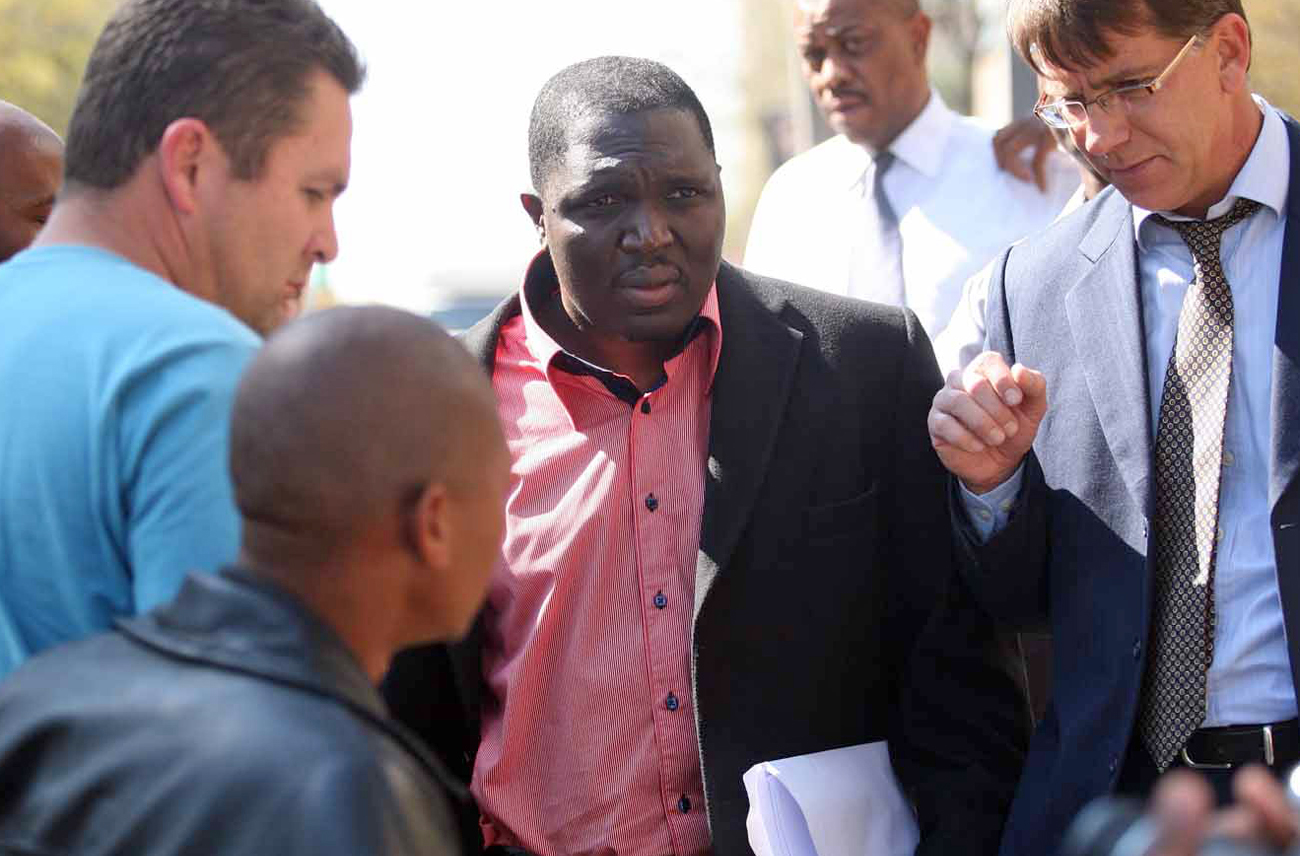
Analysis: Wa Afrika's arrest, a bigger picture

The big questions behind Wednesday's melodramatic arrest of Sunday Times journalist, Mzilikazi wa Afrika, cast an ominous shadow over South Africa’s fragile grip on democracy.

As we write this, the exact whereabouts of Mzilikazi wa Afrika are still unknown. Erik van den Berg, lawyer for the Sunday Times, says they know he was booked into the Watervalboven police station at 5:30pm on Wednesday. Then he was booked out. He has not been booked in anywhere else in Mpumalanga. Needless to say, this uncertainty really gives this story the fear factor. No lawyer has yet been to see Wa Afrika. Is that what the country ruled by the “greatest liberation movement” in the world has come to? This is behaviour reminiscent of one of the worst kinds of government - the one we thought we had relegated to history in 1994.

Strangely, the spin side of “Operation Arrest Wa Afrika” has been much quicker. The Hawks' Musa Zondi (you ask why the Hawks were involved here - so do we) was on the radio, talking about Wa Afrika's arrest, claiming it was a normal operation and that the arrest had nothing to do with Wa Afrika's work as a journalist. Which then turned out not to be the case. In fact, he was arrested for receiving a fax that was supposedly Mpumalanga Premier David Mabuza's resignation letter to SA President Jacob Zuma. After the Sunday Times checked with the Presidency and they claimed never to have received it, editor Ray Hartley decided not to run the story and it was spiked.

Perhaps someone realised that public perception matters when you arrest a journalist in the same way you would a serial killer armed with automatic weapons and on the run. But the awareness of public perceptions didn't go far enough to arrange for Wa Afrika's appearance in court or to let him see a lawyer immediately. If they needed to ask him a few questions, couldn't they just have followed due process? No spin doctor in the world can fix such crude conduct.

Of course, none of that happened, and it is no surprise that the media is so concerned here. It took nearly 24 hours for police to even tell us where and if he would appear in court. And, according to Hartley, Wa Afrika’s  interrogation began at 2:30 this morning - hardly a standard time to sit down for a chat with a journalist.

Of course, political reaction has been fascinating. Mabuza released a statement last night, at the witching hour, saying he welcomed the arrest which, he claimed, was further proof of a political conspiracy against him, and that Wa Afrika was a journalist who had ignored the gains being made in the province.

Mabuza's midnight statement told you all you needed to know about the province, and about how it’s governed.

It is clear that there is bad blood between Mabuza and Wa Afrika, and now it would appear that Mabuza has the journalist in his power. That may not be technically correct, as the police are run as a national “competence”, and officially premiers have no say and no power over them. But this leads us to the real issue.

The entire arrest, the outrage and anger that followed it and the giddy response from Mabuza all point to the same problem. The fact is that in this country the same people make decisions about who to arrest, which officers to use to do it, what to charge them with, and sometimes, it seems, who will do the judging. The checks and balances that are marks of a functioning democracy are simply not there.

In this country, Luthuli House decides how and who gets the power jobs in the civil service. The ANC decides who will head the police that will arrest a reporter and who will prosecute him. And we do know the nature of relationship between media on one side, and Bheki Cele and Menzi Simelane on the other.

The reaction also tells us another sad fact about our country. Your reaction to Wa Afrika's arrest will pretty much depend on your identity and whether you belong to the ANC or not. If you voted ANC, you’re probably pretty pleased that this rabble-rouser journalist who dissed your peeps is getting what he’s had coming to him. If you’re middle-class, educated and would consider voting for someone else, you’re bloody worried.

The reaction of the media is, naturally, more than just one of shared concern. For reporters and editors the sight of one of their own being bundled into a van by police officers with overwhelming force because of a story that is not even going to be run certainly looks like a sign of very bad times to come. The fact that it happened outside a building hosting a meeting of the SA National Editors’ Forum about defending media freedom can justifiably be seen as a crude attempt at intimidation.

To the older and greyer journalists' the developments of late, with the ANC hell-bent on railroading a raft of the laws through Parliament that will effectively muzzle the media and shield politicians behind even darker windows to keep them from public scrutiny, the Hollywood-style spectacular arrest of a journalist sounds way too familiar.

And we all thought it would never happen again.

Update: It is now understood that lawyers for the ST have finally been able to meet and speak to Wa Afrika. They have also been able to gave him a change of clothing. The lawyers are in discussion with the Nelspruit control prosecutor about a possible date and time of appearance and what charges he would face. Wa Afrika is now on his way to Kabokweni magistrates' court. By staff reporter. (Thursday, 12:20 SA time)

By Stephen Grootes

Photo: TimesLive

Thursday 5 August, 2010
 
Top Stories

You must be logged in to leave a comment. Please login or sign up.
What I don't get it is why Wa Afrika was rendered off to Mpumalanga. This seems highly unusual - not to mention all the other cloak and dagger tactics being employed in this case.

What legitimate circumstances would necessitate the police carrying out such a rendition?
Oh there is a lot happening that we all thought would never happen again. Racism, censorship, militarised police force, etc etc etc. Let's repeat what Freddie said (purportedly): If you stare into the Abyss long enough the Abyss stares back at you.
Yes, it's all scary. But why the paragraph on projecting who may or may not be disturbed by this:

"The reaction also tells us another sad fact about our country. Your reaction to Wa Afrika's arrest will pretty much depend on your identity and whether you belong to the ANC or not. If you voted ANC, you’re probably pretty pleased that this rabble-rouser journalist who dissed your peeps is getting what he’s had coming to him. If you’re middle-class, educated and would consider voting for someone else, you’re bloody worried."

Whose reaction are you talking about? The politicians? You have been talking about Mabuza and Luthuli House before that. So the opening sentence of that paragraph refers to a reaction that has already occurred.

Or does it? Because then the paragraph describes hypothetical reactions, linking the politicians' reactions by conjecture to possible citizens' responses and via a crude distinction between ANC supporters and educated middle-classes, as if the ANC doesn't have middle-class, educated supporters (shit no, not me). And by extension, as if anyone who doesn't support the ANC is necessarily educated and therefore enlightened.

I know my comment hardly addresses the gist of your story, but this paragraph, stylistically maverick as it may be, is crude, and itself says more about the journalist than it says about the story.
Could you explain, Rustum Kozain, how you as an educated citizen can find this 'all scary' yet continue to support the ANC? (If I've assumed your political affiliation incorrectly, I apologize and withdraw the question.)
Many South Africans are angry at the press, which has often not been negotiating the emotional landscape of the country skilfully. The unintended consequence is becoming apparent in the aggression that is now being reflected back at the press, gravely endangering the freedoms we value.

The SA media finds itself in a difficult position where the freedoms taken for granted in older democracies do not occupy the same inviolable position in the collective awareness of the body politic of SA. Public commentators will need to find a different tone if they wish for their pursuit of truth, sometimes uncomfortable, to find a more receptive audience.

The survival of a free press in SA probably depends in part on learning this.
Call him the Watervalboven one, and this story could be reprinted from any newspaper twenty years ago.

I hate to think that this is the start of a slippery slope, with white space soon appearing in our daily journals.

On the other hand, it could be seen as a wake-up call.
It's certainly kicked off a couple of discussions around here. Around stuff like encrypting internal e-mail, and guarding potentially sensitive documents from searches conducted on dubious, unrelated legal grounds.

We may call it the Protection of Information Project.
There is hope.

There is SA stuff on Wikileaks, open source software developed to avoid/evade oversight, individuals can use something like PGP software, (but don't try to use it in France), anonymous remailers are staging a comeback or you could just get off electronic media altogether. But you wouldn't agree with that, would you Philip ?
Hear hear, @Jens Eggers
"Transformation" is the war cry of the ANC. The problem has always been to define what that transformation means - what is to be understood by it??.

But now we are starting to see. The vague outlines of the shadow of what appears to be transformation is emerging.
This is where we go over the precipice. The way they are dealing with this brings visions of the Mugabe campaign against the media.

Latest see;
http://letterdash.com/g.annandale/hush-babies-dont-be-scared
The ANC is mutating into the old National Party - how else do you explain the fact that it is using exactly the same secret-police-style tactics to gag the press? The awful thing is, it's taken less than 20 years for this to happen, for the opressed to turn into the opressor. Yep, looks like SA's bring back detention without trial or explanation, banning orders, exit visas, persecution ...

ANC, why not concentrate on doing your job (the job you were elected for), which is to bring water, electricity, housing, education and jobs to the South Africans who suffered so much under the previous regime? Why not accept that freedom of the press is the mark of a civilised country? And no, that is not an elitist view ... unless perhaps you feel that South Africans don't merit this?
Agree

Interesting to note that more and more people will be voting with an informed opinion.