The Crossroads, Part II: The solution for Cosatu - and South Africa

On Monday, we discussed the painful nature of the dilemma that Cosatu finds itself in. Today, we bring your attention to the only political solution that would ensure real functioning democracy in South Africa has a fighting chance.

But before we start discussing the solution itself, there's a clear distinction we need to make between formal democracy and functioning democracy.

Formal democracy itself is not necessarily a difficult task to achieve: All the powers that be need to do is ensure a significant-enough number of citizens shows up to vote. From outside, just about any election that doesn't involve violence and intimidation is considered free and fair, and the country in question is left to its own devices. But way too many times election results are overwhelmingly skewed towards one side or the other. The reasons for that are varied:

  • The party already in power has control over media outlets, conducting Goebbels-like propaganda to frighten citizens from voting for the opposition, as happened in Serbia during the Milosevic years.
  • The control of food resources, as was the case in Zimbabwe where cutting off food supplies was used to threaten entire villages should they vote for the MDC.
  • Sometimes the imbalance in numbers between different nationalities in one country is used to drive a wedge between them, where the ruling party would regularly capture almost the entire vote of the majority nationality - as the recent Sri Lankan election amply confirmed, giving President Mahinda Rajapaksa total control over the country's future.
  • And sometimes, as in South Africa, the wounds of the recent past are so deep that almost the entire voting bloc of one race would never consider voting for the candidates of a different skin colour.

As a result, a government that's installed after such an election enjoys complete control over a country's affairs, pretty much free of any real oversight. The situation is aggravated if, as in SA's case, the initial victory was achieved by a party that was a genuine force for good, led by a saint-like personality and where the institutions of democracy didn't have enough time to develop their own spines. Even more worrying is if the party/alliance won four elections in the row and, no matter what happened, the voting patterns all but ensured their rule would not be challenged for a foreseeable time.

As a result, in South Africa, formal democracy is but a thin veneer over what really is a one-party state.

And then, there are functioning democracies, ones that do not rely on a party's past glory, but its current performance. The crucial difference between a functioning democracy and just a formal democracy is that at any given moment, the party in power can be replaced by the opposition, whose main job is to watch for missteps and report them to the electorate, mostly through a free media. That fear keeps the governing party in constant check. It also focuses it very nicely on the job of delivering. And, of course, no matter who's in power, the institutions of democracy retain their institutional memory and are able to continue running the country even during crises caused by the parties fighting for power.

Because, in the real world, the trust-but-verify approach is the best way for citizens to retain control over the ones they put in power. The democracies with giant majorities have to live only with the 'trust' part of the equation. In South Africa's case that would be, well, how can you not trust that the party of liberation will be committed to doing good and in a blemish-free fashion?

The practice of  deploying premiers of provinces, mayors of cities/towns/municipalities, rather than electing them directly, is just inconsistent with a functioning democracy.

While the US may not be the perfect example, there are still roughly 800,000 directly-elected officials there (at all levels, across the country), all of them one scandal away from getting the boot. And yet, even the president of South Africa is voted for by Parliament, and not directly by the people. Our premiers and mayors are first and foremost responsible to the party (most often the ANC) that deployed them, not to the people they're supposed to serve.

Which finally brings us to the point: If South Africa is to have a decent, liveable future, it needs to upgrade what is currently a formal democracy into a fully functioning democracy.

Strangely enough, in political terms, the one and only move that would ensure this crucial transformation is surprisingly simple, but probably the most difficult one: In short, South Africa needs to create another centre of political gravity that would equal that of the ANC.

And the ONLY player that could answer that call would be a Cosatu/DA alliance.

Okay, by now you have probably checked this reporter's forehead and called the ambulance. But the logic is there, and it’s strong.

First, the electoral math: Together, Cosatu and the DA would probably attract between 30% and 35% of the vote nationwide, while the ANC would probably have lost the absolute majority it now enjoys. Then efforts would focus on attracting the other, smaller players. The SACP would almost certainly go the Cosatu way; it is almost unthinkable for them to remain allied to a party that wouldn't deal properly with Julius Malema over his Zimbabwe and Mugabe statements. Cope, the Independent Democrats and Inkatha are not known to be the current ANC's friends either. Remember, the newly created bloc would enjoy a significant pull; it would be seen as a player that can actually win it this time around; and even if not many more parties themselves join, their voters would. And the ANC would then finally have to face the fact they have pissed off way too many people since 1994.

While the electoral map is a reasonably easy point to prove, the one that appears much more difficult is an ideological one: Cosatu and the DA appear to be just too far apart in their ideologies. And yet, that might not be entirely consistent with reality.

Should Cosatu finally decide that its mission is to represent the class of the overworked and underpaid, as we argued on Monday, then its first and foremost job is to help create an economy that would actually grow in the right way, an economy that takes care of its working class by increasing employment.

And as we’ve already noted, the ANC-controlled government has failed to deliver on any of that since it took power in 1994. What's worse, it has somehow managed to forget about the nationwide infrastructure. It is just a matter of time before the major failures will further affect SA's ability to produce value; Eskom's misdeeds alone will cost the working class several hundred thousand jobs.

Cosatu's and the DA's traditional constituencies, working and middle class respectively, are the prime generators of jobs and value in any country. The middle classes are the engines of the entrepreneurial class, which is consistently the world's best creator of sustainable jobs, and the working-class people are the ones who roll up their sleeves and make things happen.

Now, in a functioning democracy, both workers and business owners would be helped by an efficient government, whose job would be to make sure that the country and its people can rely on a first-class infrastructure, quality services and reasonable, well-enforced laws.

But we're not in a functioning democracy. The ANC-led government, through its arrogance, incompetence and wrong, if sometimes well-meaning, strategies, has become an astronomically expensive and bloated behemoth, that is more interested in feeding itself than delivering value to the taxpayers. In short, it is demanding some of the most expensive tax burdens in the world, collects them at a first-world rate and then delivers services in a manner more becoming of a third-world country.

Cosatu and the DA could continue as though nothing happened, content with the ANC government wedged between them, or they could decide that it is just way too expensive and inefficient. They could also decide that they can form a government of “national unity” and do a far superior job. Remember, both Cosatu and the DA are committed to stamping out corruption, enhancing economic growth and a more equitable society. Both Cosatu and the DA would also work hard on instilling much, much more accountability to voters on the part of leaders, creating a job-nurturing environment, creating an investment-friendly climate, an end to a bureaucratically entangling state and the creation of a knowledge society versus the tenderpreneur society we have today. In our books, that is what matters.

A Cosatu/DA alliance wouldn't be the world's first example of marrying ideas and electoral heft to deal with a crisis either.

As the Great Depression wrecked the US economy in late 1920s and early '30s, Roosevelt's Democrats brought together intellectuals, labour unions and ethnic voters (including African Americans in the north) in a coalition that saved the country. The key to their alliance was not pure ideological consistency, but an agreement on main issues and a coalition that was sufficient to win and to govern.

The latest example of a surprisingly good fit between the business and working classes, without a third party between them, is Brazil, whose economy is enjoying a stellar success under President Lula, himself a former union leader.

And it should really make sense from Cosatu and the DA's corners: Cosatu will truly have to throw away everything it believes in to remain in the alliance with the party that is now moving in a direction that will put them at odds on each and every substantive issue facing the country. Should it chose the DA as a partner, Cosatu would benefit from the skills the DA has acquired in successfully running the Western Cape, its well-organised infrastructure and a full line-up of experts willing to help. And that's just the beginning. The DA would, from its side, finally shed its image of being a “white” party, making the alliance itself the first political grouping that would transcend race in this country. Ever.

Strangely enough, a Cosatu/DA alliance would be very good for the ANC itself. If it's to retain power or not, the ANC will have to focus again on what its true mission is. By default its politics will have to migrate from the current behind-the-door showdowns between warring internal factions, which appear disinterested in the real problems facing the nation, to really delivering on electoral promises. Through that process, the ANC would have a chance of returning to the great party it once was. Nothing sharpens a party's focus like an election that could be lost.

But if Cosatu, and the SACP, continue fortifying the ANC's power, the ruling party will complete a process of transformation that will inevitably deliver populism as its main driving force, a prospect that could truly devastate South Africa.

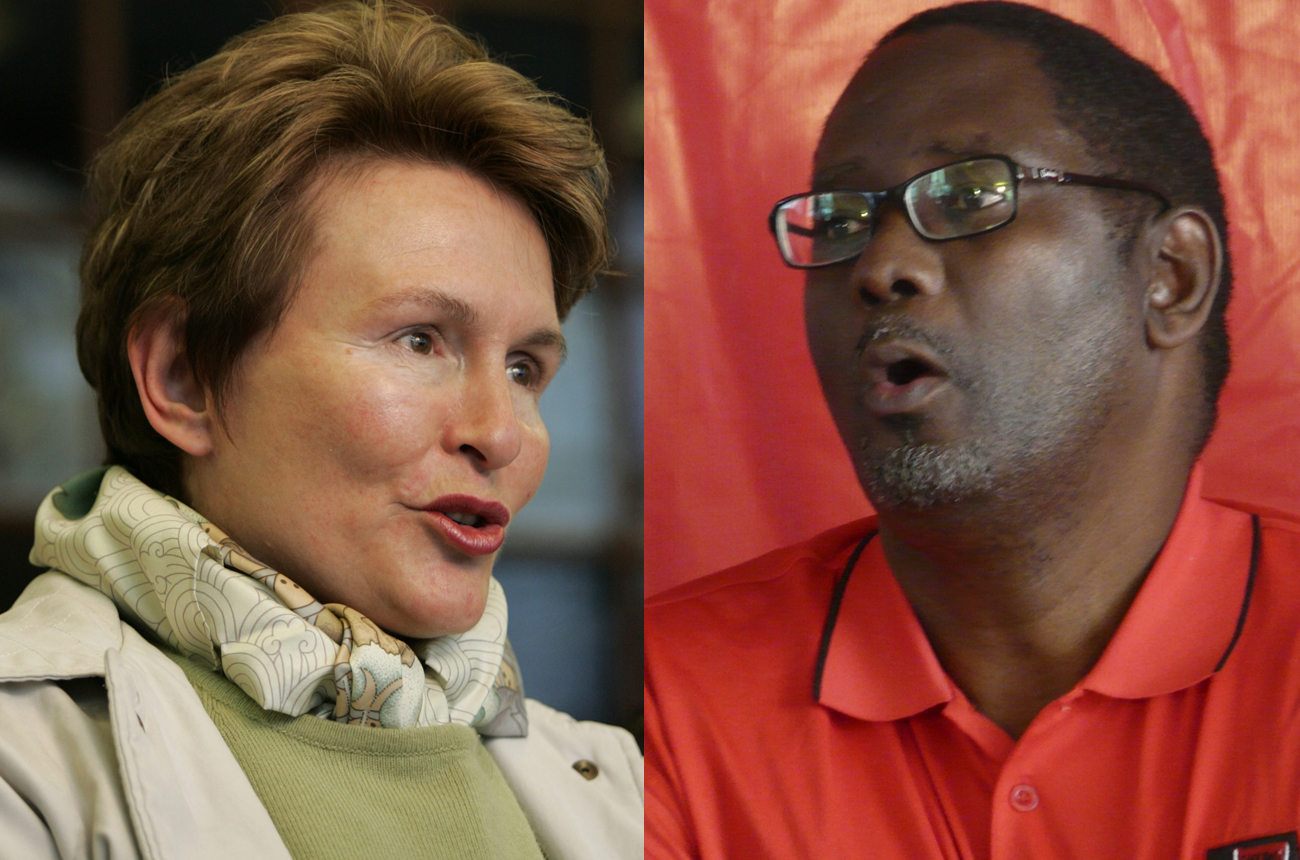
Dear reader, if you're still sceptical, we understand. The Cosatu/DA alliance is probably just a political fantasy scenario. But desperate times require desperate, though brave and bold solutions, like a President Vavi and a Prime Minister Zille.

By Branko Brkic

Read more: The Crossroads, Part I: Cosatu's dilemma.

Thursday 22 April, 2010
 
Top Stories

You must be logged in to leave a comment. Please login or sign up.
Sounds good! However it would only work if the participants remain independent and can stick to their core beliefs. Coalitions should come after elections not before. Cosatu would have to fight their corner as a party on their own merits. as do Cope, DA, ID, IFP etc. Currently Cosatu and the CP are hiding theit light under the ANC bushel.
A stroke of genius. Now if only it could happen...
Interesting fantasy, but I disagree with the coalition you propose. South Africa needs to move away from this paradigm that the DA are the alternative. Their politics is archaic and pestering to say the least (personal opinion obviously). Sure they are doing an OK job in the western cape, but they are so out of touch with what happens on the ground in the rest of the country that they will forever fall short of attracting the voters or appeal required for political party in Africa. Your scenario of having the alliance split is correct and desperately overdue. What South African politics needs is a more left and right wing (read: republican/democrat etc) orientation and grown ups to manage the parties they represent. Cosatu could build a formidable party and there are sufficient middle class intellectuals (that dont originate from Cape Town) that would join them to help develop the right structures to become a political party. Why would COSATU need the DA to dilute their ideologies and it will be all to easy come election time to label the coalition racist (only because of the DA contingent) as would inevitably happen? White people (DA voters) need to realise that voting for a person of a darker complexion is not going to make the world fall on their heads. The DA is definitely not the answer but the Cosatu/SACP (they should change their name by the way, because Karl Marx would have serious reservations about his ideologies being used as they are by these "communists") and ANC battling out their election manifestos would make for some enticing viewing. The working class above all deserve this and South Africa deserves this, that is a functional democracy.

Superb website by the way, keep it coming!

Good work Branko. I said, in reaction to another Daily Maverick piece, the other day that I would never vote for the DA in its current form. Having said that I would definitely vote for a President Vavi and Prime Minister Zille.
You read my mind (but I thought the idea was insane, so I didn't tell anybody :)).

Seriously, Cosatu's choice is simple - either it becomes an irrelevant appendage to the ANC (with the latter doing whatever it wants, and Cosatu following supine) or it needs to talk to Helen. A Cosatu breakaway to the left wouldn't solve the problem, since they'd either be a voice in the wilderness or find themselves in a coalition with the ANC again (which brings them right back to where they started).

They could also sell it to their members as a sinecure for the ANC: "We're working with the DA to give the ANC a wakeup-call, and we can always go back to working with the ANC once they rediscover their values".

There is, of course, always a third possibility: That ANC voters will look into the abyss and decide to choose country over party. In a sense, if SA voters aren't willing to do that, what hope is there for democracy in the long run anyway?
Yes yes yes.

Been saying it for years. It is not necessary to have the ANC kicked out however interesting a concept that might be. The trick is weaken them to such a stage that they have to not only hear the electorate but must actively listen to them an act upon their concerns. This to my mind was the great hope and ultimate failure of COPE.

COPE are little different in their psychology to the ANC only existing because of spats and infighting. They did however stand a chance of removing a block of votes from the ANC. If they had succeeded both parties would have undoubtedly benefited a substantial block of the electorate.

The appealing prospect of COSATU/DA is that if successful they would appeal to a far broader block of the electorate.

The challenge in my mind with a COSATU/DA party would be the infighting for positions and prominence. This is not an insurmountable problem but is probably the biggest one. Zille and Vavi are operators.

Although having only 5% of the voting strength of the DA Ms De Lille also has more to bring to the table. As recent discussions showed the ID and DA have more in common with each other than they have in opposition. The idea of these two bright strong willed and tenacious women combined with Vavi’s intellect is indeed appealing.

To Mr. Viljoen’s point I would ask are the DA really “so out of touch with what happens on the ground in the rest of the country” or have they maybe picked their battle field carefully building a stable base of delivery, reputation and support? I am not certain myself but certainly lean towards the latter.
I agree that they have picked their battle field and admirably won that battle. My point is that in doing so, have they not isolated themselves (Western Cape politics is very different from Limpopo or KZN politics for instance)? An alliance with COSATU (an idea that i would imagine messrs Vavi et al would be laughing uncontrollably at now) would still not expand the DA electorate substantially further than the hex river mountains and effectively discredit the trade unions among their own base do you not think?

Nevertheless, the current scenario in the country is playing out eerily like a George Orwell novel. Where did that old horse disappear to anyway!?!
..if the triumvurate of the lady.leaders Zille DA, De Lille ID and Dr Ramphele join forces to fortify the democracy (the whispers of possibility heard murmured in august company) it could deliver more oomph and gravitas to a courtship with Cosatu.

Genius indeed. But miraculous and improbable. Though who knows, we've lived through a miracle here once before.
Lovely stuff to read but for one small fact. Has anyone asked a DA or COSATU supporter whether they would vote for this water hole conceived wunder alliance?

What is needed is electoral system that allows people to cast a vote that cannot be tied back to a specific area. In this way no voter can ever again be threatened. The process would have to be electronic. All bank ATM's could act as voting stations. These ATM's can be programmed to allow one to vote via a voter’s credit card valid only for that specific voting day. An illegal vote, or second use of the card, can be programmatically negated by the card having its chip deactivated once used. Voter anonymity will also have to be handled by the program once eligibility to vote has taken place.

This level of anonymity will also do away for the need to get into bed with another party whose policies clashes with ones own. Functioning democracy, lekker phrase this, would then be easier to achieve as political entities can then vote for matters based on their principals. We might then in time see marriages that are made in political heaven.

Causes sadness in my heart to read that some voters dislike a party based on their personal dislike and not on whether the principles of the party matches that which they hold dear.

Yebo - when Lindiwe Mazibuko becomes DA leader & the bornfrees are the majority membership of COSATU. So 2019, more likely 2024. Please drink a toast for me too when it happens Branko! :-)
Hi Anna, In my humble opinion the born frees will be voting with the DA especially the ones that have benefited from their parent being on the gravy train.

My born free granddaughters will probably the ones voting with COSATU in the hope that they will ensure them employment because of the newly created WEE.

Let's not kid each other. A new racist elite is being created.
Brilliant Branko. How about it Helen?
I wonder who would find it harder to do - Helen or Zwelin?
Perhaps that could be the next instalment.
Why don't you ask them the question?
@Chris - Yes we do need to change the voting system, but your proposal misses the core issue. Before we enev look at the organisation of voting, the linkage between an MP and the party list needs to be replaced with a linkage between the MP and an individual voter. Yes, you've guessed, we need a constituency based system.

If I need to have an issue addressed in the Provincial or National Parliament by my MP I don't know who to go to.

When an MP has the prospect of being voted out by the electorate or his constituency party he will be a lot more attentive to his parliamentary duties and to his constituents, rather than to the party list compiler.

To address your other point - there is considerable evidence that between them Diebold and the Bush brothers stole two US presidential elections by manipulating votes submitted via electronic polling machines. We need a simple, verifiable and non-electronic system.
Hi Iain,
A constituency based system is to be strived for but we live in South Africa. The only way, or time, this will happen is when individual voters, or blocks of voters, can no longer be intimidated.

We manned eight voting station in Du Noon (mixed formal houses and shacks) and Doornbach (shacks only) during last year’s elections. About three hours before the polls closed we realised that the voter turn out was pathetic. The ANC supervising officials also realised it and sent out a call for some big guns to come and get the voters to the voting station. They arrived in numbers and the gentle persuasion commenced.

I am in agreement with you that we must return to the constituency electoral model. At this point we have to intertwine the two systems by pre allocating MP’s and MPL’s to constituencies. We have two assigned to us and they know they have to produce or we will scupper them during the Electoral College selection process. Let us find a way to make this an ideal to strive for by getting all concerned voters involved in the processes that place politician on proportional lists by pre assigning them to constituencies.

It is my opinion that the American process was flawed as it was left in the hands of politician’s supporters to control. Here in South Africa I propose that we remove that control from the government. Then by constantly publishing a running total of voting results every hour we might also ensure that apathetic voters come and vote. It is my opinion that we would be able to trust the banks not to manipulate an outcome.
Fantasy it is and it does you publication no credit to waste readers' time building up to such a far-fetched proposition.
Then here is a thought experiment you may find less of a time-waster: at what point did the merger between the (N)NP and the ANC stop being far-fetched? If someone had predicted it, say, four years before it happened, what would have been your reaction?
I was at the meeting where Marthinus told his supporters that the DA is the future and then less than 72 hours later he announced the deal with the ANC.

Fact is he hi-jacked the party and once the deal had been announced the DP members would never again have trusted him.

Those of us that chose to stay with DA did so because we could judge that a NNP/ANC marriage was amoral and would be short lived. Marthinus survives because the ANC dare not get rid of their tame NP politician. History though has already judged him. He dare not try and come back to the DA, or any other party I dare say, and today is a lonely little man.
Phillip is quite right. We must be able to look for possibilities to save our country.
Yes Chris, I will
and yes we must
Good stuff, Branko

I mooted this possibility of a COSATU / DA / ID / COPE / IFP coalition a week or so ago on DM - a case of great minds think alike, I hope.

Each party would need to stand on its own, retain its own brand identity and leadership, etc, but form a coalition government, as happens in a number of democracies around the world.

Even if the coalition failed to get a majority, if they put a big dent in the ANC's majority, it would surely not only be a wake-up call, but would force the ANC to make some much-neded changes.

The big break (breakthrough?) that is a pre-condition for such a coalition to happen would be for COSATU to contest an election under its own name.

Now WHAT would it take for COSATU to get to that point?

Whilst it can be argued that DA and COSATU have very different views on matters such as privatisation, and labour regulation, they share a disdain for corruption, cronyism, tenderpreneurship and nepotism.

BEE? Financial Mail reports that in W Cape, actual BEE and SMME tenders awarded as a proportion of all tenders has INCREASED substantially under the DA administration compared to the previous ANC led administration.
And this is AFTER the DA scrapped some of the previous BEE "rules" (that allowed for nepotism and cronyism to slip into the process).

For the coalition to happen, both organisations would need to put the country before the party - are they capable of this?

Another question - what can we as civil society do to make this happen?
Hi Peter,

You ask "what can we as civil society do to make this happen?". This is an easy one to answer. Contact your preferred political party and join a local branch in your area. Motivate neighbours, family and friends to join and then set about selling the idea.

You know the old adage about telling two friend who will each tell two etc etc etc. It works but our opportunity revolves around getting the apathetic voters away from TV's and PC games.
Brilliant - I'd vote for them in a flash
Yes Branko - I agree with your solution completely, if the functioning
democracy you're talking about is the Western liberal model, which is
premised in harnessing and managing self-interested energy. The best way
to "manage" the various interests of society in this kind of
adversarial democracy is by creating as much leverage and "equal"
oppositional force as possible.

But like a marriage, that is premised in a power struggle or at best
compromise (as in the case of coalitions), is this kind of democracy
actually functioning or is it dysfunctional?

I'd like to question the premise itself and our assumption that our
various interests are inherently conflicting. I'd like to find a space
where we can take this debate to the level of principle and ask
ourselves whether human nature is essentially premised on self-interest
or whether we do have the capacity for mutualism in us. If the latter is
a possibility, it becomes a question of how can we practically nurture
and manage our inclusive capabilities in societal institutions? How can
we transform our culture of contest and see ourselves as one organic
human family? I personally don't think that the contest of power model
serves our needs any longer.

The best it can do is create new winners and losers at any given time -
flipping the problem you've been analyzing so well. I don't actually
think that more leverage necessarily creates "diversity" of thought. It
actually creates serial homogeneity which creates the illusion of
diversity.

Would be interested to know if there is a space we can explore these
ideas? I've tried to begin the process: www.beyond.doubletake.tv
Cosatu seems to hold the keys to a diversified political future.

Unfortunately, it doesn't seem to have the political cojones / huevos to divorce itself from the Alliance, and Comrade Vavi is putting out personal fires, what with one scandal after another involving his wife and those kickbacks that the Mail + Guardian have reported on week after week.

The DA, for all its bulldog determination to hold governmental officials to account, is hampered by history and the perception, in the eyes of many voters, that it is a party for minority interests.

Sometimes political forces and voters don't walk the road less travelled. They tramp over well-trod ground, making the same mistakes as before. That's human nature. We don't know what we've missed until it is too late.