
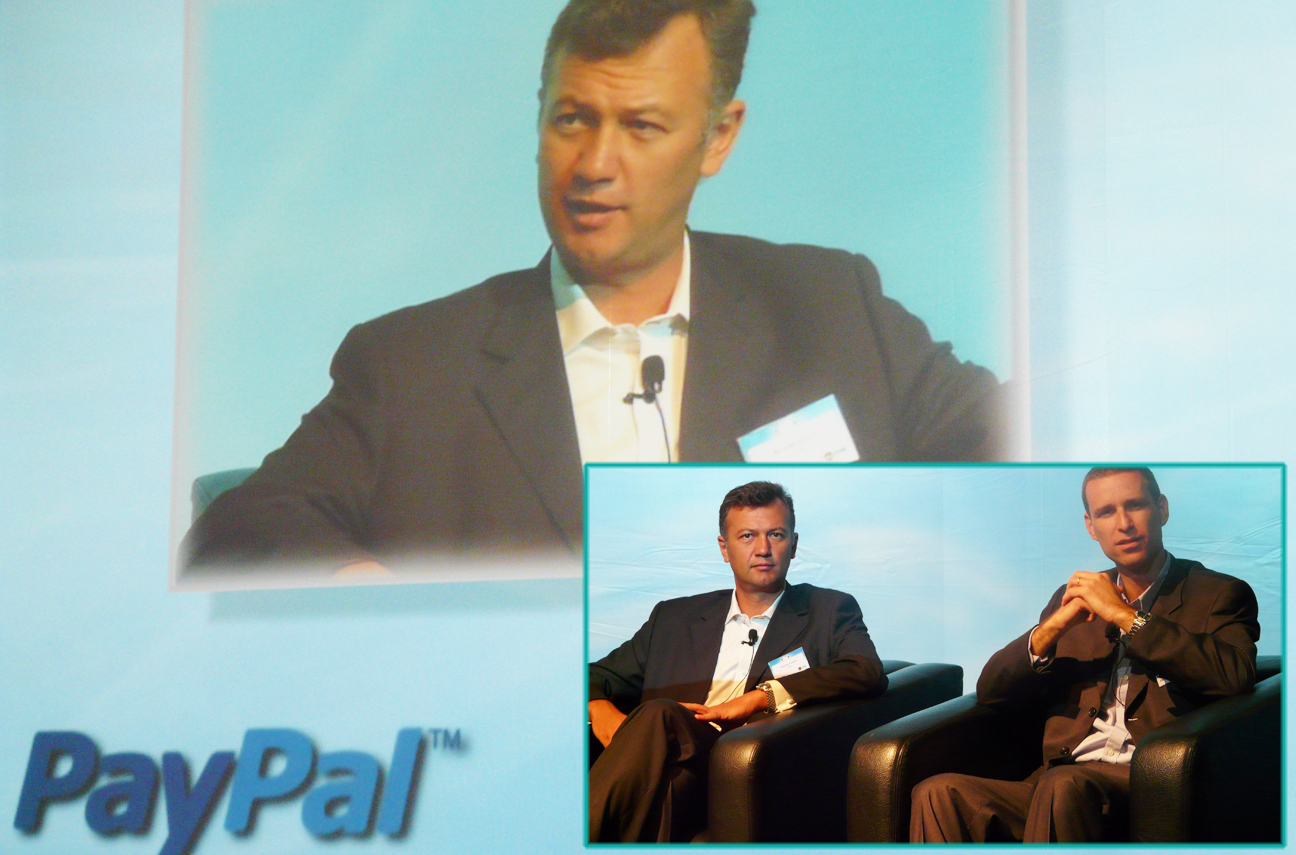
The Reserve Bank will tell you that it still has absolute control over the flow of money into and out of South Africa. And when it comes to amounts in excess of five digits that is largely true. But if easy global credit card transactions didn't destroy that control for everyday amounts, PayPal is about to do so.
It's a tremendous coup for First National Bank, which will, for a period of exclusivity it absolutely refuses to disclose (but sounds extendable), be the only South African conduit for money to and from PayPal accounts. It's great for local consumers and small businesses, who can now buy from and sell to people pretty much all over the world, cheaply, easily and with only miniscule amounts of paperwork. And it's pretty nice for PayPal, which gets to colour in one of the few parts of the world map that was dark until now.
But it's a bloody nightmare if you are one of the poor bureaucrats who have to keep track of money flowing into and out of the country. We like to think of these people as pasty, nervous types in bad ties locked up somewhere in a basement of the Reserve Bank building in Pretoria – and right now they must be crying into their pocket protectors.
Here's how it will work: You create a new account with PayPal, or admit to the company that the account you previously registered under the pretence that you live in the United States actually belongs to a Safrican. You open a new account with First National Bank and set it up for internet banking, or link up your existing account to PayPal.
Now you can transfer money to and from your PayPal account. It's not quite seamless; there may be a delay of up to four working days for the money to clear. PayPal doesn't yet recognise the rand as a currency, so every time you transfer money to or from PayPal the transaction will be handled in US dollars. But once the money is with PayPal you can transact with other people in any of the 21 currencies it supports. And if you are selling organic boerewors to expats, you can also accept payment in their currency of choice.
Every time you do a deposit or withdrawal via FNB, you'll pay 1.5% of the transaction value in fees. PayPal gets its pound of flesh when you receive money, charging either a variable rate of below 5% or a fixed fee typically below R1, depending on the country you're dealing with and the type of transaction.
In the middle of all this sit those unfortunate Reserve Bank gnomes. Because of exchange control regulations, you'll have to disclose a purpose for every deposit you make to PayPal, and give a source for any income that you withdraw from PayPal. The numbers for those count toward your personal annual foreign exchange allowance (currently at R750,000 for individuals), but also have to be to be tabulated to determine the how and why of all money flowing into and out of the country. Which was a great idea back in the day when there were a hundred people in the country doing foreign transactions via four banks, and the velocity of money was measured by the week. In a world where you can now pay R1.50 to a Ukrainian for a silly ringtone, however, it somehow seems a little less sensible.
FNB and PayPal flatly refuse to say whether their deal covers other African countries, or even the entire continent; FNB has operations in seven countries north of the Limpopo, and could offer this kind of service in any of those with little further development.
But that isn't the prize, says FNB CEO Michael Jordaan. The goal should be to allow the easy flow of money within, say, the Southern African Development Community. That will require a way for people without bank accounts to get their hands on cash, perhaps through a link-up with retailers, and definitely requires cellphone access to PayPal withdrawals and deposits.
"What we've learned is that to make it work with cellphones, you have to make it work for all cellphones, not just the smart-phones," Jordaan says. "I love my iPhone, but you have to start with the most basic phone out there and then roll out the cute applications on smart-phones."
Sounds like he's given it some thought, doesn't it?
FNB's immediate excitement about PayPal seems to be around it's pull as a customers' acquisition tool. It is hoping for a rush of new accounts to be opened, and Jordaan says it has priced PayPal transactions with that in mind.
In the longer run, however, the reach of PayPal and its near-frictionless infrastructure presents an opportunity to move money at rates that would be hard to beat in any other way. FNB has conducted its own study on the cost of moving money into and out of the country, a study it is slightly nervous to release. But the headline numbers clearly tell the story. To receive $100 via any of the big banks, including FNB, will cost a South African citizen around R100 in fees, or R70 at the bottom end. Via PayPal total fees will amount to less than R45. In sending money oversees the discrepancy is far bigger. A $100 transaction would cost between R170 and R200 via the banks, but using FNB/PayPal the cost should come in at under R12.
Does that mean a lot more money will be moving into and out of the country, albeit in tiny transaction amounts? Neither FNB nor PayPal will make any kind of projection or disclose their expectations on customer numbers of transaction volumes.
But both parties will only recover their costs, never mind show a profit, if those volumes are substantial.
Oh, and to our great disappointment – and contrary to our firm predictions – FNB will not allow the seamless transfer of eBucks, its alternative currency disguised as a loyalty scheme, to PayPal accounts. That, Jordaan says, is one of the many possible developments that will depend on customer demand.
By Phillip de Wet
Photo: FNB CEO Michael Jordaan (left) and PayPal's regional director for Israel (and now South Africa), Oded Zehavi, on stage at the official launch of their alliance in Johannesburg. Photo: The Daily Maverick
Watch the Zoopy news video of the launch


I phoned Notbank, Absa-luterubbish and that other bunch and they didn't even know about it - let alone have a response. I just about rolled around on the floor with laughter. Has Julius Malema joined the boards of the other three? (No one counts Capitec or the smarmy pirate banks, sorry "private" banks). Guess I'm gonna have to open an FNB account and close the others.
Then again, still feeling the hurt from what banks everywhere have done to the world economy and every one of us, there is no reason to trust anything vaguely resembling a bank - except, of course, a slot machine.
I am also disappointed that a lot of journalists who I would have thought would know better seem to have accepted the FNB/PayPal spin without appearing to analyse what is really being offered.
The SA incarnation of PayPal/FNB is completely irrelevant to most SA individuals and on-line businesses. For a merchant, FNB/PayPal is more about Exchange and Bank controls and taxing currently invisible purchases and earnings than about opening the sluice gates for International on-line trading. For individuals, because you cannot use PayPal to purchase from SA websites in Rand nothing changes.
Other examples of the Victorian bankers approach to on-line trading:
A merchant cannot link PayPal with his FNB business account, only a personal account. One in the eye for most SMME businesses.
Your local SA PayPal account will be denominated in US Dollars. There are probably two reasons for this.
1. If it were denominated in Rand, PayPal would need a local deposit taking licence. They don’t want the time and hassle of acquiring one. That is why they partnered with FNB. In reality, your “local” PayPal account is probably held on a US server. That also explains a Reserve Bank requirement to repatriate all funds to your FNB account within 30 days.
2. FNB don’t want you to be able to buy and sell online between local PayPal accounts without passing through your FNB account on the way. They don’t make anything on direct trades. So, the sales prevention team have agreed to denominate the account in dollars and only have dollar buy-now buttons on the PayPal interface. Incidentally, it is unlawful for an SA company to invoice in SA in anything other than Rand, so it’s probably unlawful to sell products denominated in USD.
Each transaction must be reported and uniquely identified. No bulking or offsetting of transactions is allowed. Every detail about the sender, receiver and the transaction will be reported to the Reserve Bank. Almost certainly SARS will have a look to see if VAT, duty and Income Tax need to be applied.
FNB will be adding 1.5% onto the transaction value. Added to Paypal’s 3.4% + R2.10 per transaction, the transaction fee per transaction equals about 5% + R2.10. A further deduction will be taken in commission for converting dollars to rands when you repatriate the money to your FNB Account, or converting rands to dollars when you top up your PayPal account. No low transaction fees for South Africans.
Unless you are an international trader of electronic products and services, happy to have the deductions taken from your cash movements, and later on receive a letter of demand from SARS for taxes due, the FNB/PayPal announcement is a mere distraction.
Those that trade under the radar to build up an overseas nest egg, to avoid SAs excessive taxation, whatever, will continue to do so. Their anonymous website will stay on a server in Manila, their electronic products will still be globally marketed in USD, and the proceeds will still end up in an HSBC account in the Caymans. Local PayPal is of no relevance.
The really disappointing thing about yesterdays announcements is that it is not the kick-start for on-line SMME business in SA that we had dared to hope for.
As some have said, it is perhaps a step in the right direction, but only a very small one.
* The business accounts most small businesses use can be linked to a PayPal account. Some have already reported their success in doing so. There's an issue with the type of online banking profile you use, but we understand that is easily overcome.
* FNB would make money on local transactions. You can't move money into or out of your PayPal account without paying the 1.5% FNB tax. At high enough volumes that will be close to pure profit for FNB; it has every incentive to encourage maximum transaction volumes rather than block SA-to-SA purchases.
* Actual costs will run closer to 6% plus usual FNB account charges – but if you can find a cheaper way for a Safrican to accept small, foreign transactions I'd sure like to hear about it.
Which leaves your complaint about exposure to tax. And I can't say I have a great deal of sympathy if your major objection is that it'll force you to comply with legislation and pay tax.
Second, if there were a Buy-Now button available in SA Rand, I could use it to pay my supplier directly from my SA paypal account, bypassing FNB completely. The only revenue they would make is the fee levied for topping up my PayPal account. If I pay out of sale proceeds directly from my PayPal account, the money need never pass through the FNB account and they would miss out on fees.
Third, you comment about tax is a b8t disingenious. There is a considerable offshore invisible trade operated by Saffers that never reaches this isle. I cannot see anyone who currently operates under the radar voluntarily switching to FNB/PayPal and losing at least 40% of their cash. SA is so far over the top of the Laffer curve that tax evasion is a national sport.
Finally, if internal trades were possible via PayPal, and they are using other portals, then because of the global reach of PayPal and the surety and security it offers, trade would markedly increase.
As it stands, FNB/PayPal offers nothing beyond that which is already available. At at a higher cost.
"Some clients may experience a problem when attempting to link their PayPal account to their FNB accounts. This may be because their online banking profile does not currently support this service or there is specific information i.e. a VAT or tax reference number missing in order to comply with exchange control reporting requirements.
What can you do if you are experiencing this problem?
You need to contact the FNB Commercial Client Resolution Centre on 0860 263 362. An agent will be able to assist you with:
Opening an appropriate online banking profile* and linking your accounts to the profile. Although you may already have an FNB Online Banking profile in your personal name, for reporting purposes you will need to open a Commercial Online Banking profile and link your business account to it. A new username and password will be issued for the Commercial Online Banking profile.
Updating the necessary information needed for exchange control reporting purposes.
Fortunately these are once off processes and once completed you will be able to link your PayPal account and make use of the FNB Top Up and Withdraw service with PayPal".
All clear now ?