Analysis: The successes and failures (but mainly the successes) of SpeakZA

On its own terms, Wednesday’s online campaign protesting the ANC Youth League’s disregard for media freedom has been an unqualified triumph. The day has also been an important one for South African social media. Wouldn’t it be great, though, if there could also be a real-world victory?  

Digital activism, if it’s to be worthy of the name, needs to be measured by its results in the offline world. On Wednesday March 24, the same day that Sipho Hlongwane made South African Web history by organising what appears to be the country’s largest ever online protest, digiactive.org announced the “crushing” of giant corporation Nestle by online green activists. The site was not engaging in hyperbole: aside from 122,000 views of a Greenpeace Youtube video, which shows an office worker finding an orangutan finger in a KitKat wrapper, 90,000 protesters took over Nestle’s Facebook page, thereby creating, according to digiactive.org, “one of the largest digital protests since last summer’s Iranian election protests.”

The concern of the anti-Nestle activists is that the giant corporation buys its palm oil from Indonesian producer Sinar Mas, which is allegedly involved in rampant deforestation where some of the world’s last wild orangutan populations live. Nestle’s response to the massive digital protest, while not a complete surrender, was certainly an acknowledgment of defeat.

The corporation denied on Wednesday that it buys palm oil “directly” from Sinar Mas, pointing instead to its supplier Cargill. The press statement read: “Cargill has informed us that Sinar Mas needs to answer Greenpeace’s allegations by the end of April. They have indicated that they will de-list Sinar Mas if they do not take corrective action by then.”

Passing the buck, sure, but also an implicit admission of wrongdoing and a (somewhat childish) promise not to do it again. Clearly, Nestle are worried that if the protests continue, people will stop eating their chocolates.

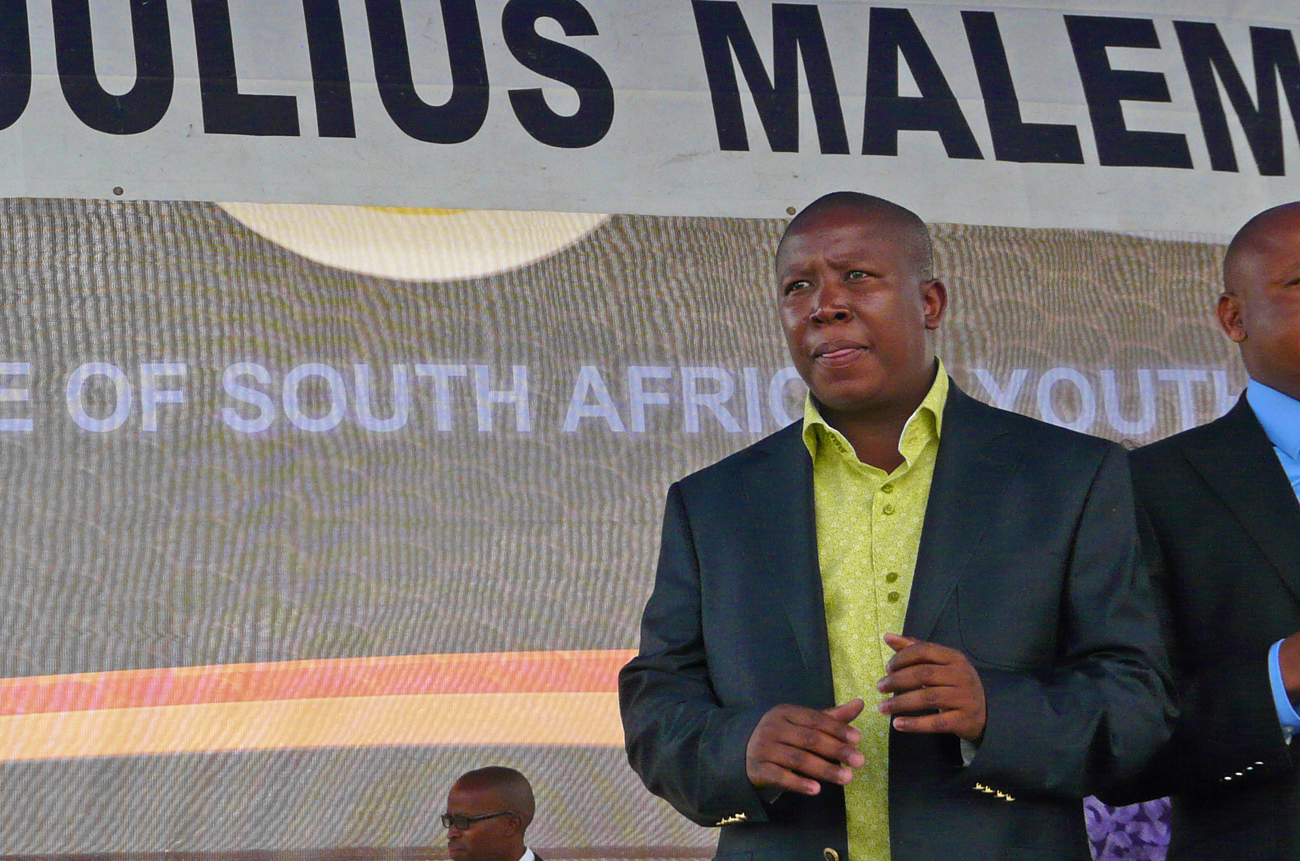
Are ANC Youth League president Julius Malema and spokesperson Floyd Shivambu worried about the digital protest Hlongwane has started? Is an online campaign that demands they reaffirm their commitment to media freedom something that concerns them? Do they think, for instance, it’ll result in less people voting ANC come the next general election?

Shivambu didn’t respond to a message left on his phone by The Daily Maverick, but he did respond to the Mail & Guardian. I’m guessing aloud here: could this be ascribed to the man’s contempt – given its predominantly white, affluent demographic – for online media? "We have 800,000 members behind us and millions of other ANC activists,” Shivambu told the M&G, “we will not be intimidated by desktop activists.”

Quite. And he also wouldn’t have been too intimidated – a) because he’s not on Twitter, and b) because it was entirely redundant – by the instant reaction of many #SpeakZA protesters to his comment. Desktop activists? Um, um…we’re actually proud of being desktop activists, at least we’re not Gucci activists, at least we’re not muzzled, so there!

A cry soon picked up, in different form, by the legions; and a point in the proceedings where the defenders of free speech and democracy began to look, themselves, like a mobocracy.

But still. Something profound happened today in the South African social media space. From around 10am on Wednesday morning and through much of the workday, tweets with the #SpeakZA tag (the handle of the campaign on Twitter and Facebook) were coming through at the rate of over one every twenty seconds. Which probably made it, right then, the largest social media campaign the local Web has yet seen. The number of blogs posted under the campaign banner should also have a claim to some sort of record.

“I was surprised how quickly it took off,” Hlongwane, a 21-year-old part-time law student, told The Daily Maverick. “I thought 50 blogs was ambitious; we shot past that immediately.”

The official blogroll, according to Hlongwane, counts 65 blogs – in other words, every blog that protests the ANC Youth League’s threats to free speech (see yesterday’s Daily Maverick article, link below, for a fuller description) points to 64 other blogs of a similar ilk. Hlongwane initially told The Daily Maverick that he intended to make the cut-off time for submission 9pm on Tuesday night, but he extended that to 11.30pm due to the overwhelming interest. On Wednesday morning, said Hlongwane, he was still receiving URLs by the hour. “There were well over 80 by 10.30am,” he added.

As for the number of #SpeakZA tweets, there’s literally been thousands – at 4.00pm on Wednesday, the rate of three-a-minute hadn’t slowed. Of course, not all tweets have been in support of the campaign. On Wednesday morning, someone named Dominic White aired his scepticism. “I can see it now: ANCYL conference swayed by opinions of middle class posted on the Internet, struggle songs replaced with Die Antwoord.” Minutes later, in response to the attack of a mini-mob, he wrote: “If someone set up a real-life protest about the ANCYL’s press manipulation, I’d be there.”

Again there were myriad comebacks, but Hlongwane’s was most on-message. “Your right to disagree with #SpeakZA is what we’re protesting for.”

And the student from KwaZulu-Natal has not budged from what he told The Daily Maverick on Tuesday – he’s not doing this to get in the Youth League’s face. “There’s a feeling that the ANC must be contacted directly,” Hlongwane said on Wednesday. “But I wanted this to be a solidarity thing amongst the voices in the blogosphere and on the Internet.”

In that sense, the campaign has been a resounding success. And for the principles it upholds, it deserves to be supported. It would be nice, though, if the mainstream media and offline civic society picked up on the protest. While online solidarity is a significant thing, a phenomenon South Africans can now fully appreciate, it’s still not enough (in this country, at least) to bring about change. 

By Kevin Bloom

Join: SpeakZA Facebook page

Read more: The Daily Maverick, Mail & Guardian, Digiactive.org

Watch: Greenpeace’s “Have a break” video

Main photo: The Daily Maverick

Wednesday 24 March, 2010
 
Top Stories

You must be logged in to leave a comment. Please login or sign up.
One day, and I hope soon, South Africa gets its head out the West's ass. I respect Kevin Bloom much, but this piece is ridiculous at worst and sadly hopeful at best. There aren't enough people on the ground who even know what social media means for this campaign to mean anything. I'm proudly South African, but am getting increasingly frustrated by the thought leadership space. We can't seem to get our smart people thinking about smart original African ideas, we are so absorbed by western models that we continue to waste time. Either we all pack up and move to somewhere in the West or come up with ideas that will shape and galvanize in a meaningful way!
Okay, we're listening. What's /your/ idea?
Michael, I didn't partake in today's "protest" because I'm not a "thought leader", nor does my audience know me as a political commentator. But your comment prompted me enough to make a comment in support of #SpeakZA here.

To think that this is a West vs African idea is a mistake - digital citizen journalism is a global phenomenon. There are enough cases where a normal person like you & me, with access to a computer & the internet, has been able to report on a incident to the public INCLUDING Africa. Just look at the success at Ushahidi in crowd-sourcing crisis information, and let's not forget how people in SA were reporting during the xenophobic gang attacks only a few months ago.

Digital media is not a toy: it is becoming a considerable force in spreading news, ideas, commentary & change. It's not going away; it's going to get even more influential. Yes, it is a double-edged sword as both fact & fiction can be spread quickly (& often a Lie will run around the world before the Truth has even put its boots on).

What are the alternatives to using digital media to protest? Do you want us to write letters to the newspaper (assuming that we even buy newspapers these days)? Or would you prefer that we hold a local meeting at a library where we write a manifesto, type it out & photocopy it to distribute under windshield wipers? Perhaps we should elect a leader & have that person make a statement on television?

Let me be facetious & suggest we hold a protest march outside of parliament - that's assuming we all arrange to take leave at the same time. Should we sign our names to a petition? As Phillip asks - what is your idea? (That's not rhetorical, please reply in the space below)

What the #SpeakZA campaign has done is galvanise a group of people who know the power of words & their far-reaching, unstoppable nature. Trust me, some of them have the ability to use words that would rip your self-image & dignity to shreds. But they CHOSE not to pick on someone because that person has a different colour, culture or creed. No, despite their own personal disagreements they chose to speak up & tell as many people that are willing to listen that they will not be silenced by those wanting to curtail of Right to Freedom of Speech!

Those that thought that they could control The Word should now be aware that even a tiny group can spread news quickly & that they cannot be stopped. Remember: the Internet is designed to bypass & re-route around damage & it considers censorship as possible damage.

The number of supporting blogs may seem like a small group - but, trust me, in the South African Social Media space this is a significant number, with an amazing number of respected bloggers taking part.

And they participated & stood up so that you, Michael, may have the right to read this article & write your comment - no matter whether you agree or not - without fear of government or political intervention.

It's definitely not a perfect protest. It would've been a miracle had we been able to invite enough "people on the ground" to sit behind a PC & write their views too. Do you know how many people in the SA Social Media space are working endlessly to make access to this very medium accessible to all South Africans?

None of those that took part have anything to gain personally, they did this because they know that they must, to protect your & my right to speak our minds. The right to express our views, our culture & our humanity without restriction - so that we may HOPE to recognise it in others.

That's the philosophy of "Umuntu ngumuntu ngabantu". An original African idea.
Aside from all the other good points, I am curious about why we need an African solution? Are Africans somehow immune to the basic laws of economics? Is there something special about African corruption that makes it less damaging than European corruption? Are we unable to repeat the same mistakes made by the rest of the world because of our very Africaness?

I'm all for creative - and appropriate - solutions. But time and again it seems our problem is being unable to do the simple stuff properly.

Kudos to Sipho for being willing to do something, and pulling it off. It might be a small start, but the journey of a thousand miles starts with a single step. Keep it up!
Many years ago I worked with a very creative man named Basil Gay - who wasn't, as it happens. We had a naysayer colleague who would always tell us why something wouldn't work. After a few repetitions of this behaviour, Basil one day looked at him and said: Ali, what's your *better* idea? So Michael, what is it?
Somewhere in Alaska, so the legend goes, where dirt roads get slushed up in summer and frozen in winter, there's a sign that reads: "Choose your rut carefully - you're going to be in it for the next 150miles".

Seems something eerily similar is happening in SA (as if we don't have catastrophes to cope with already). From the obsequious sycophancy of white (& other) laptop activists riddled with guilt because they don't believe they feel guilty enough about the sins of their fathers to the puerile pretentiousness of black pseudo-intellectual ubuntuism (which is about as originally African as Clovis technology)to the self-aggrandising (& -enriching) racist hate-monger pandering of the ANCYL to the Fundamentalist Church of Jacob Zuma of Latter-Day Saints (FLDS)[see Nat Geog Feb edition] that has no direction, no moral compass, no control and even fewer ideas. It's an absolute slushy mess.

The legendary Alaskan roadsign in the South African context reads: "Choose your arsehole carefully - you're going to have your head jammed up it for the next 10 years."
i am old enough to remember a time before social media, before email, before faxes - heck i worked in places where getting an international - even a cross town - phone call through was a chore, a mission and required lots of prayer.

over time, i have watched as the telex was replaced by the fax, email began to overwhelm snail mail, cellphones, then sms'es, overtook landlines then faxes and some uses of email. now social media are the next wave.

some years ago, using simple sms tech, hundreds of thousands of messages helped overthrow a president in the philippines with viral sms msgs that went across the nation with a 'meet@m.sq.wr blck'. and they did, in their thousands. and pres. estrada promptly hung up his presidential sash.

anyone who checks out the iranian revolution in 1979 will note that the ayatollah's msgs reached millions through the use of cassette taped sermons. some people may not remember cassettes but they were the high tech of their time...

and, of course, barak obama's 2008 presidential campaign made a major leap forward in campaign strategy with innovative uses of email and social networking.

the common thread here is the use of the technology, not the machinery and electronics themselves.

imagine for minute what the end of apartheid would have looked like - and when it would have happened - if cellphones and email had been widespread here in the 1980s, or 70s...or even earlier.

social media is going to have an impact here, the questions really are: how soon, and in what way? consider for a minute the evolving impact on china that comes from the fact that 300million+ people are already on the internet there. yes, a government can censor things if it throws enough money, time and energy at it...but there comes the time when the cost simply outweighs the benefit. once that happens, governments figure out other ways to monitor their citizens but they surrender on another front. google lost this most recent skirmish but they'll be back somehow, some way.

as far as i have been able to track it, the adoption of any or all of these technologies tends to follow logorithmic curves, not the growth pattern of adding 1, 2, 3, 4... new users pattern. it passes a certain point and - boom - the landscape is different.

five years from now we're going to be scratching our heads at the wonder of people all over the country using some sort of hybrid cellphone/sms/internet/email /social networking texture to do things we don't even have a widely accepted name for yet... i promise. i just can't tell what that will be, yet or where we're going to buy it.

if anyone doubts my broader point, just think about the impact of talk radio here in the 1980s...everyone could comment on anything. too many phones to tap and record, the government basically gave up on that. i remember listening to it near-obsessively to try to get a handle on the public temperature here. i knew it was a perfect stratified cluster sample survey with a 3% either way margin of error with a 95% coefficient of reliability - i just knew it mattered in some big way.

and, before i forget, remember too that operation vula by the anc was one of the earliest adopters of pretty rudimentary emailing arrangements, including a handmade modem that connected through public phones in hotel lobbies and on street corners...really.

this stuff is used by us and it guides us too.
Correction to my previous posting above, one word left out by bad typing:
----------
"if anyone doubts my broader point, just think about the impact of talk radio here in the 1980s...everyone could comment on anything. too many phones to tap and record, the government basically gave up on that. i remember listening to it near-obsessively to try to get a handle on the public temperature here. i knew it was NOT a perfect stratified cluster sample survey with a 3% either way margin of error with a 95% coefficient of reliability - i just knew it mattered in some big way."
---------
And just to underscore my comments above, today's newspapers carry a story about teenager 'wilding' as a spring ritual, but one that is organized (if that is the word here) by social networking and sms'es in the u.s. see the story at: http://www.nytimes.com/2010/03/25/us/25mobs.html?partner=EXCITE&ei=5043
Shame, I guess when people like Mathew, Clive etc... are grappling sincerely with a way to remain in SA and to wrap their heads around a solution, intense research deriving from the West seems the best hope. I wish you guys the best, but unfortunately, your posture is facing the wrong part of the world.
Here are a few suggestions:
1. Rally Chiefs and hold symposiums where you ask humbly for solutions (fyi- if you keep ignoring them, there is NO internet campaign in the world that will save your ass!)
2. Once you get traditional leaders on your side (including Pastors) you empower them with a holistic model of communication including the outlets the masses read, rather than wasting time with this online whisper.

This is a good start. Remember, I'm not Black against White or vice versus, but I'm sick and tired of these pathetic solutions that disregard African social infrastructure and having to sit back and watch smart people hope that its going to work. Black Africans without western education have been ignored SO LONG, its become the default to ignore them and educated blacks are just as guilty as whites.

Simply put... this internet conversation looks good on paper and in a coffee shop, but its far too removed from the pulse of the masses to make an impact on what your ultimate goal is- you may shut up Julius, you may even get to write what you want online, freely, but I'm sure you are smart enough to want a bigger solution and you know what I mean!