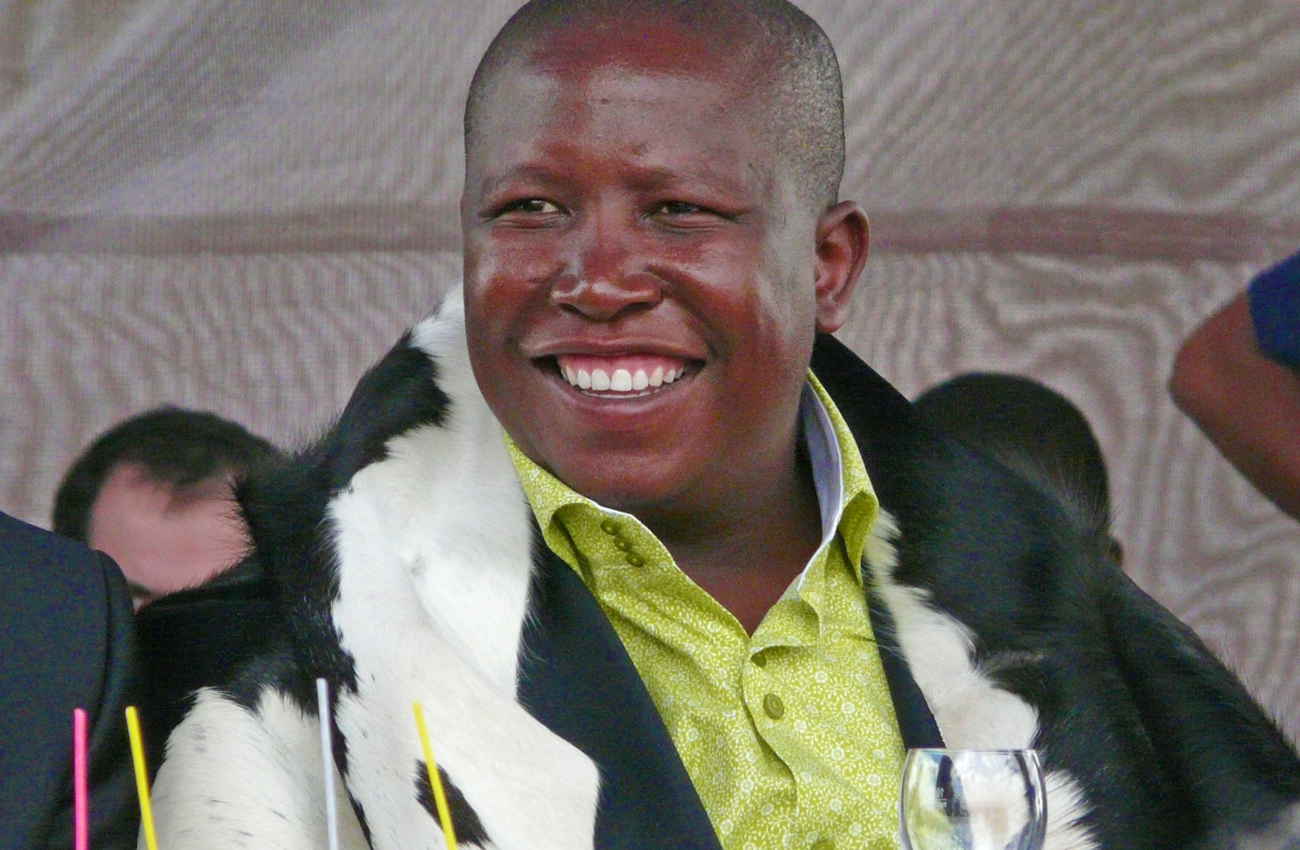
It is now official: Julius Malema is hate-speaker and harasser of women

The Johannesburg Equality Court on Monday ruled that Julius Malema is guilty of hate speech, has no protection in terms of freedom of speech provisions, denigrated women in general, added to the rape problem in South Africa, and must apologise.

It was a poignant end to a judgment that tossed out every defence Julius Malema had put up.

Be wary, in the words of Oliver Wendell Holmes, of turning into "a man who often speaks but seldom talks," the court advised ANC Youth League leader Julius Malema.

The Equality Court found that when Malema had told a group of students that the woman who accused Jacob Zuma of rape must have enjoyed herself because she stayed for breakfast and asked for taxi money, he engaged in hate speech. Because he had not expressed an opinion or comment, but professed to be stating facts (which he got wrong), that hate speech does not enjoy protection in terms of the constitutional provision for freedom of expression – which leaves him liable.

Which is why he now has two weeks to issue a public apology for what he said, and one month to donate R50,000 to People Opposed to Women Abuse (Powa). During hearings last year, Malema told the court he would comply with both those instructions if found guilty, so he is expected to do so shortly.

But the ruling has much more wide-reaching consequences, both for Malema and any person who would like to express an odious opinion on rape.

Malema, the court found, was speaking to the broader South African society – on which he has significant influence, especially when it comes to young people – rather than just to the students at the rally in Cape Town who were physically present. That means that, regardless of how those student interpreted his statements, they need to be judged on how any person on the street would react to them.

That means when Malema sings "kill the boer" he may be more easily held liable for those utterances than a person in the crowd singing along, or even some provincial ANC official who gets little media coverage.
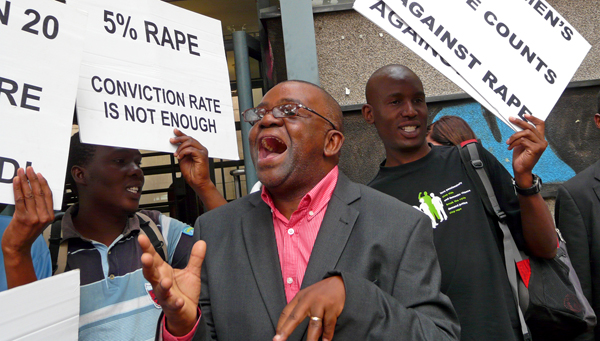
Photo: Mbuyiselo Botha, the media and government relations manager for the Sonke Gender Justice Network, celebrating the ruling in favour of his organisation outside the Johannesburg Magistrate's court on Monday.

The court also agreed wholeheartedly with Lisa Vetten, an expert researcher and councillor on violence against women, called by the Sonke Gender Justice Network. Vetten told the court that Malema had engaged in myth-making by trying to set out the parameters of what does (and does not) constitute rape. Doing so, she said, reinforces the idea that women lie about rape and creates the notion that men have no obligation to obtain explicit consent from women before sex. Instead consent can be inferred based on the behaviour of the woman after the fact – which raises a whole host of dangers.

And Malema's argument, that both he, and the ANC in general, work towards the empowerment of women, was rejected.

That effectively tosses intention straight out of the window. Whatever Malema meant to convey, and however the audience responded, he was judged on the potential impact of his words. That is a significant broadening of the reach of hate speech under the Equality Act. But not one that is likely to have a chilling effect on reasonable freedom of speech, unless you are in the habit of making speeches denigrating women (even women of opposition parties) based on their sex, or advocating hatred towards a cultural group.

By Phillip de Wet

Read Equality Court judgement in full.

Photos: The Daily Maverick

WATCH: The Sonke Gender Justice Network celebration

Monday 15 March, 2010
 
Top Stories

You must be logged in to leave a comment. Please login or sign up.
Viva Jozi Equality Court, viva!
Now let's see, who do we know who is in the habit of denigrating women who belong to different political parties?
A very welcome judgement.

This is also an indictment of the ANC at large. The Equality Court basically carried out the IFP's threat to silence Malema if the ANC wouldn't, albeit without subtly threatening him with bodily harm.
Nice article Philip - but the judgment isn't a broadening of the Equality Act; the Equality Act is in fact an unjustified broadening of the Constitution. See http://tinyurl.com/yljmmuw
I read your post after you linked it on Twitter. You have it almost entirely wrong. Your basic premise is flawed, your interpretation faulty, and your conclusion is plain wrong.

Sonke's argument (accepted by the court and hugely persuasive to me as a layman) is that there was significant harm to women. Specifically, Malema helped create or perpetuate the myth that whether rape took place or not can be judged retroactively, based on post-fact submission by the claimed victim. That can bring significant, direct, physical harm to a large number of women.

There are other important considerations as well; the misrepresentation of facts rather than expression of opinion, for one. I'd highly recommend you read the entire judgment (PDF at http://www.thedailymaverick.co.za/file/download/2010-03-15-malema-ecourt-judgement) rather than jump to faulty conclusions.

Make no mistake, I consider myself a foaming-at-the-mouth defender of freedom of speech – but there is no infringement in this case.
Phillip, I don't think you understand my point. I am not saying that the magsitrate got it wrong - her ruling is correct in terms of the Equality Act. But I am arguing that the hate speech provisions in the Equality Act are an unjustifiable infringement of the right to freedom of speech. In this I am not alone. I can point you to many highly respected legal commentators/scholars who share my view. Basically, the act creates an faultess crime - you can be found quilty of hate speech even if you had no intention of inciting harm. That goes much further than the constitution, which outlaws hate speech ONLY when there is intent to cause harm. Also, the Equality Act classifies speech that causes "hurt" as hate speech. So if I hurt someone's feelings, that could potentially constitute hate speech. Woe betide us if that is the case.
In Julius' case, his speech may have caused harm to women generally. He may even have intended to cause harm. But you should have to prove that in court, not simply assume it as the Equality Act does.
Julius is an easy punchbag - we're all feeling good that he got his come-uppance. But we're not thinking about the precedent set here. On the basis of your argument, for example, Deon Maas should be convicted of hate speech for ridiculing Christianity, and the editor of the Sunday Times should be fined for publishing a cartoon of the Prophet Mohamed because both hurt the feelings of/caused harm to religious groups.
Oh, and Phillip, unlike you I am not a foaming-at-the-mouth defender of freedom of speech. I am well aware of the harm that speech can cause, and therefore the necessity of regulating certain forms of speech. Which is why I support the hate speech provision inthe Constitution.
And I think you don't understand the usage of "harm" in this context – and you clearly still haven't read the judgment. Under current precedents, and this ruling in particular, neither of your examples hold.

Maas expressed an opinion, which is explicitly protected, so while it could be classed as hate speech he would not be held liable.

The Mohamed cartoon was a drawing. If you read the ruling you'll see that is treated differently from words, for starters. There also was no incitement and no indication of harm beyond affronted dignity, which is again insufficient to trigger sanctions.
Hi Philip - you should go and read the constitution and the Equality Act. Neither makes a distinction between opinion and fact. Neither makes a distinction between words and drawings. I do in fact understand the "usage" of the the term "harm" in this instance, and that lies at the heart of my argument, namely that the Equality Act goes far wider than the Constitution in its definition of hate speech. Again, I am not saying the magistrate erred - she applied the Equality Act correctly. I am saying that the Equality Act is an abberation.
Cheers
Conveniently enough I have a trained professional to interpret the Equality Act for me, alongside the Constitution and taking into consideration relevant precedents. In writing. Right there in this judgement. And in that interpretation there is a very clear line drawn between an opinion and a mis-statement of facts, and between words and images.

On the other hand, it is abundantly clear to me that without the Equality Act the harm done to at-risk women by Malema would have gone unpunished

So let's judge this law based on its implementation, which is all that matters. Has it done good? Yes, in this case. Has it ever chilled free speech? Not that I'm aware of (but I'm far from expert on the case law, and I'll be glad to hear of any examples). Does precedent give us any theoretical application that would limit freedom of speech? None that I've seen.
Another trained legal professional, Constitutional Law Prof Pierre de Vos in his blog (http://tinyurl.com/ybzk2o7), disagrees with you and the magistrate. I am now revising my opinion - it looks like she did get it wrong. But remember, my point wasn't about this particular ruling as such, but about the hate speech provisions of the Equality Act. I maintain that these are far wider than the Constitution intended.
As to the chilling effect, I can't cite case law because magistrate's court decisions are not normally reported. But it is obvious that it must have a chilling effect.
Lastly, what harm has Malema done to at-risk women, as you put it? The magistrate found that his words had the potential to cause harm by demeaning the dignity of wome. That is true. But there is no evidence of actual harm done to a particular victim. That is simply assumed.
Applying that standard to other cases, a complainant would simply have to assert that words may cause harm/hurt to him/her/a group of people for them to be punishable as hate speech. So if you say something that offends or hurts the feelings of, for example, Christians, you could find yourself convicted of hate speech even though your words caused no actual harm and you had no intention to harm anyone.
Lastly, I am not saying that people like Malema shouldn't pay a price for saying stupid and obnoxious things. But he should pay a political price, and that is up to his party and the voters, not the law.
"Lastly, what harm has Malema done to at-risk women, as you put it?"

That seems the core of the matter, doesn't it? On page 13 of the judgment you will find the following:

"In making such statements the Respondent created the notion that there existed no obligation on men to obtain explicit consent from women before sex; rather they need only wait until after sex to confirm where or not consent had been given."

We're not talking hurt feelings and huffy indignation here.
Instead of just returning to the judgment, as if it some kind of gospel, would you care to respond to Pierre de Vos' very specific cricism of it, and my criticism of the Equality Act as a whole?
But to answer your question: even if is is correct to state that Malema with his statement "created the notion" that there is no obligation to obtain explixit consent from women before sex (I would say he perpetuated or reflected this notion rather than created it, but anyway) - that still does not translate into incitement to cause harm to women.
The inaccuracy about asking for a taxi fare aside, Malema was really just repeating, in his uneducated way, what the judge in the Zuma rape trial concluded.
But Phillip, that is beside the point. I absolutely agree that what he said is offensive and reflects an attitude which is widely prevalent in this country and which does provide a context for violence against women. For that he should be censured. He should be disciplined b his party, and if he isn't, voters should discipline his party by not voting for it (dream on....). I disagree 100% with what he said. But that doesn't make it hate speech.
And if you'll stop ignoring the judgment, which is the context for the discussion, we can talk about hate speech as it is prosecuted rather than in pure alarmist theory.

Malema:
* made a generalised statement (not specific to the Zuma accuser),
* about a group defined by sex,
* which incites harm towards that group.
How that could be anything but hate speech is beyond me.

So let's go round the Equality Act roundabout one more time. We have here an excellent example of its positive impact, one of many. Do you have an equivalent example of negative impact, even a theoretical one you can map against precedent? No? Then clearly, in practise, it is a good piece of law.

This is what I mean by the flaw in your basic premise. You wish to judge law based on the worst case scenario for interpretation you can dream up. The only metric that counts, though, is the actual impact on society.
Phillip, we should continue this discussion next time I'm inJo,burg. You know what they say about fightin on the internet...
But just a last point: you say that Malema made a statement "which incites harm" towards a women. That really is the crux of the matter. You say that. So does the magistrate. But there is no evidence that harm ensued, and there is no evidence that he had the intention to incite harm. That is why it is not hate speech.
Cheers.
Julius Malema is very rich.
He drives expensive cars.
He lives in expensive houses.
He only drinks Johnny Walker.

His constituents live in shacks.
They travel by taxi.
Most don't have running water.

But they still like him!